

Queen Camilla Royal Garden Party: Tradition, Style and Service Meet at Buckingham Palace
Queen Camilla returned to one of the monarchy’s most enduring public traditions as she joined King Charles at Buckingham Palace for the third royal garden party of the 2026 season. Held on Tuesday, May 12, the event brought together formal pageantry, community recognition and carefully observed royal style on the palace lawns.
The gathering was more than a social occasion. Royal garden parties have long served as a visible expression of gratitude from the monarch to people who contribute to public life, community service, charity work and national institutions. This year’s May 12 event carried added attention because it came during a particularly full royal garden party calendar and featured Queen Camilla in a familiar but symbolically rich look.
A Palace Tradition With Modern Purpose
The royal garden party is one of the monarchy’s oldest public-facing rituals, dating back to the 1800s. Its purpose remains rooted in recognition: the monarch invites members of the public to Buckingham Palace as a way of thanking them for service to society. More than 30,000 people are invited to garden parties annually, making the events among the broadest ceremonial points of contact between the royal family and the public.
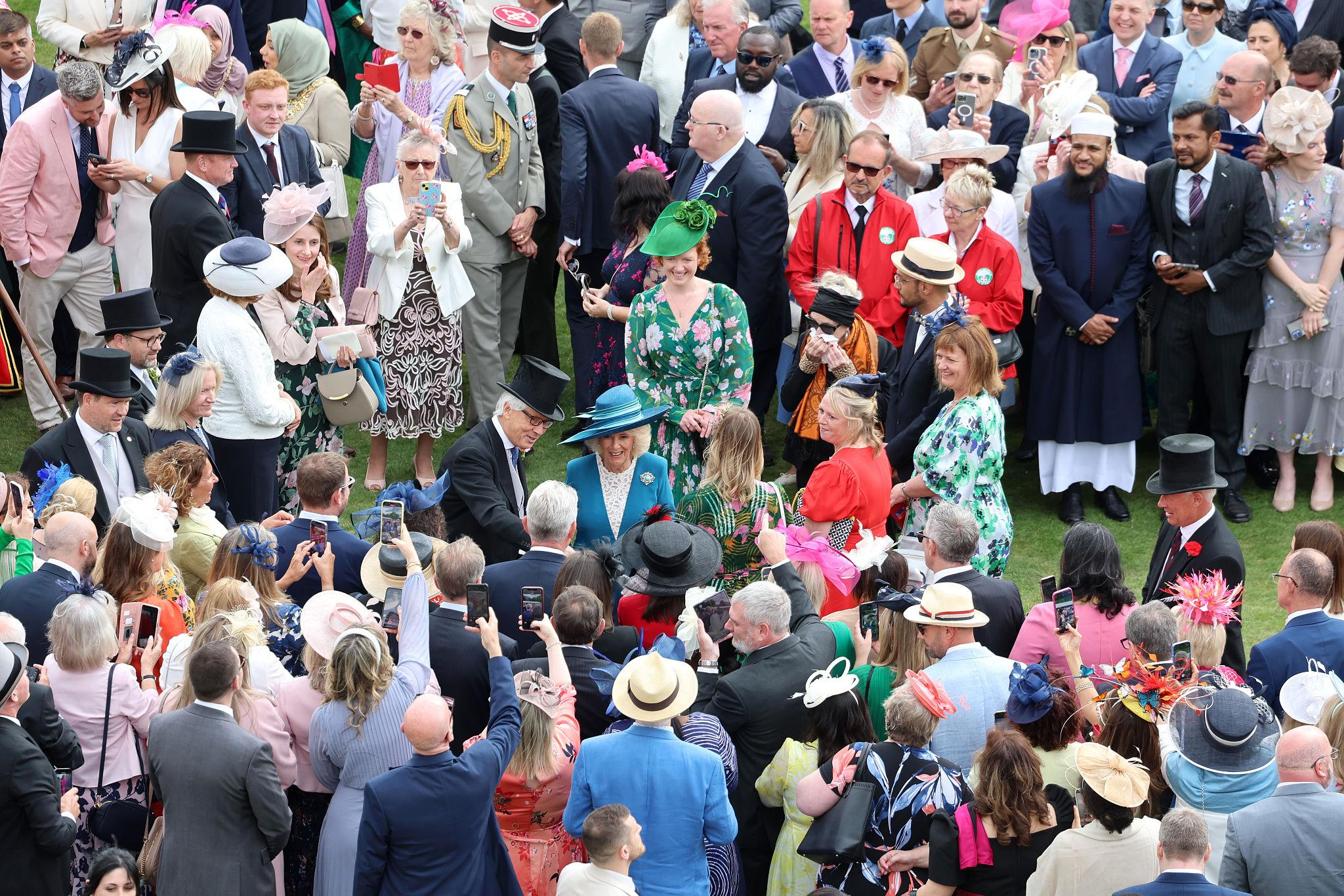
On May 12, King Charles and Queen Camilla hosted the third Buckingham Palace garden party of the season, joined by the Duke and Duchess of Gloucester. Guests entered the palace grounds at 3 p.m. local time, with members of the royal family arriving an hour later. The official start was marked by a military band playing the national anthem.
Once underway, the afternoon followed a well-established pattern: tea, cake, formal attire, carefully planned movement across the lawns and a chance for invited guests to speak with members of the royal family.
Queen Camilla’s Recycled Look Drew Attention
Queen Camilla chose a white Anna Valentine coat dress with black detailing, paired with gloves and a wide-brimmed hat. The outfit reflected the formal tone of the occasion while also continuing Camilla’s habit of rewearing significant pieces from her wardrobe.
The same black-and-white Anna Valentine dress had been worn when King Charles addressed a joint session of Congress during their U.S. state visit the previous month. She had also worn the matching Philip Treacy hat for the VE Day Thanksgiving Service in 2025.
Her accessories added further meaning. Queen Camilla wore the Queen Mother’s Cartier Palm Leaf Brooch, a diamond piece made in 1938. The brooch, also described as the paisley brooch, was once owned by Queen Elizabeth II after being inherited from the Queen Mother. Its palm leaf design features 203 diamonds set in platinum.
For royal observers, the choice of jewelry was not merely decorative. It connected Camilla’s current public role with the visual language of past queens, turning a garden party outfit into a quiet statement of continuity.
King Charles and the “Bridgerton” Atmosphere
King Charles appeared in a top hat and morning suit, creating an image that several observers compared to the period style popularized by “Bridgerton.” Queen Camilla’s gloves, hat and structured white outfit added to the sense of historical ceremony.
The royal family’s formal dress code reflects that tradition. The guidance states: “Gentlemen wear morning dress or lounge suits, while women wear day dress, usually with hats or fascinators. National dress and uniform are also often worn.”
The result was a scene that felt both theatrical and official: a palace lawn filled with hats, uniforms, summer dresses, morning coats and guests dressed for one of the most recognizable royal social events of the year.
Honoring Public Service Across the UK
Behind the pageantry, the garden party’s public-service function remained central. The May 12 event recognized frontline workers and people involved in community service, including volunteering, supporting charitable causes and working for emergency services.
The structure of the event is designed to give guests an equal opportunity to meet members of the royal family. According to the official explanation included in the source material, “Members of the royal family circulate among the guests through ‘lanes.’ Each takes a different route, and random presentations are made so that everyone has an equal chance of speaking to a member of the royal family.”
That detail matters. The event is formal, but it is also deliberately arranged around personal interaction. For many guests, a short conversation with a royal figure becomes the defining memory of the day.
Tea, Cake and the Scale of Royal Hospitality
Garden parties are also logistical operations. At each event, guests are estimated to consume approximately 27,000 cups of tea, 20,000 sandwiches and 20,000 slices of cake.
Those numbers underline the scale of the tradition. A Buckingham Palace garden party is not simply a reception. It is a large public ceremony built around hospitality, recognition and national symbolism.
The weather, however, remains an unavoidable concern. King Charles and Queen Camilla both carried umbrellas at the May 12 event. The late Queen Elizabeth once summed up the risk of staging a mass outdoor royal gathering when she told a guest in 2019: “Well, you do rather hope the sun shines when you invite 8,000 people to have tea on your lawn. It can be a bit of a worry.”
A Special Moment With Penny Pepper
Among the guests was Penny Pepper, a poet and activist, who presented Queen Camilla with a copy of her memoir, First in the World Somewhere: The True Adventures of a Scribbler, Siren, Saucepot and Pioneer.
The gesture had particular resonance because Queen Camilla is widely associated with reading and literary advocacy. The book chronicles Pepper’s life in the British punk scene from the 1980s to the 2000s, including her experiences with disability, identity and artistic freedom.
It was a small exchange within a large event, but it captured the human dimension of the afternoon: public recognition, personal stories and the symbolic visibility that comes with being received at Buckingham Palace.
A Busier-Than-Usual Garden Party Season
The May 12 garden party was part of a concentrated sequence of royal events. King Charles and Queen Camilla hosted the first Buckingham Palace garden party of the 2026 season on May 6, the third anniversary of the monarch’s coronation. Prince William and Kate Middleton then hosted the second garden party on May 8.
Ordinarily, the monarch hosts an average of three garden parties at Buckingham Palace and one at the Palace of Holyroodhouse in Scotland. In 2026, however, the calendar includes additional themed events.
The next Buckingham Palace garden party was scheduled for May 14 to celebrate the 50th anniversary of The King’s Trust. Another event was set for May 19 in support of The Not Forgotten Association, a UK charity dedicated to the physical and mental health of military veterans and service members. A garden party at the Palace of Holyroodhouse was also scheduled for June 30.
Why the Event Still Matters
The Queen Camilla royal garden party appearance shows how the monarchy uses tradition to maintain public connection. Every detail — the dress code, the national anthem, the tea, the palace lawns, the royal “lanes,” the invited guests — reinforces a ritual that is both historic and socially functional.
For Queen Camilla, the May 12 garden party also demonstrated how royal fashion can carry layered meaning. Her recycled Anna Valentine outfit, Philip Treacy hat and Cartier Palm Leaf Brooch connected sustainability, continuity and royal memory in one carefully assembled public image.
For the guests, the significance was more direct. The event recognized service, volunteering and contribution across the UK. That is why, despite its old-world appearance, the royal garden party remains relevant: it turns ceremonial hospitality into public acknowledgment.
Conclusion
Queen Camilla’s appearance at the May 12 Buckingham Palace garden party blended tradition, symbolism and service. Alongside King Charles, the Duke and Duchess of Gloucester, and thousands of invited guests, she helped sustain a royal custom that dates back to the 1800s while reflecting the modern monarchy’s focus on community recognition.
The hats, gowns and historic jewelry may attract attention, but the heart of the event lies in the people invited onto the palace lawns. In that balance between spectacle and service, the Queen Camilla royal garden party remains one of the monarchy’s most distinctive public traditions.


