
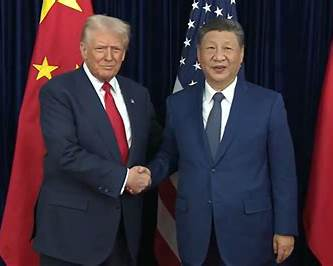
Trump in Beijing: Inside the High-Stakes Summit Between Donald Trump and Xi Jinping
Donald Trump’s return to Beijing for the first time in nearly a decade has become one of the most consequential diplomatic moments of 2026, placing the leaders of the world’s two largest economies face-to-face at a time of mounting geopolitical tension, economic uncertainty, and escalating global conflict.
The summit between President Donald Trump and Chinese President Xi Jinping is unfolding against the backdrop of the Iran war, fragile U.S.-China trade relations, disputes over Taiwan, and fierce competition in artificial intelligence and advanced technology. While the visit carries all the spectacle of state diplomacy — red carpets, military bands, and carefully choreographed ceremonies — the deeper reality is far more complicated.
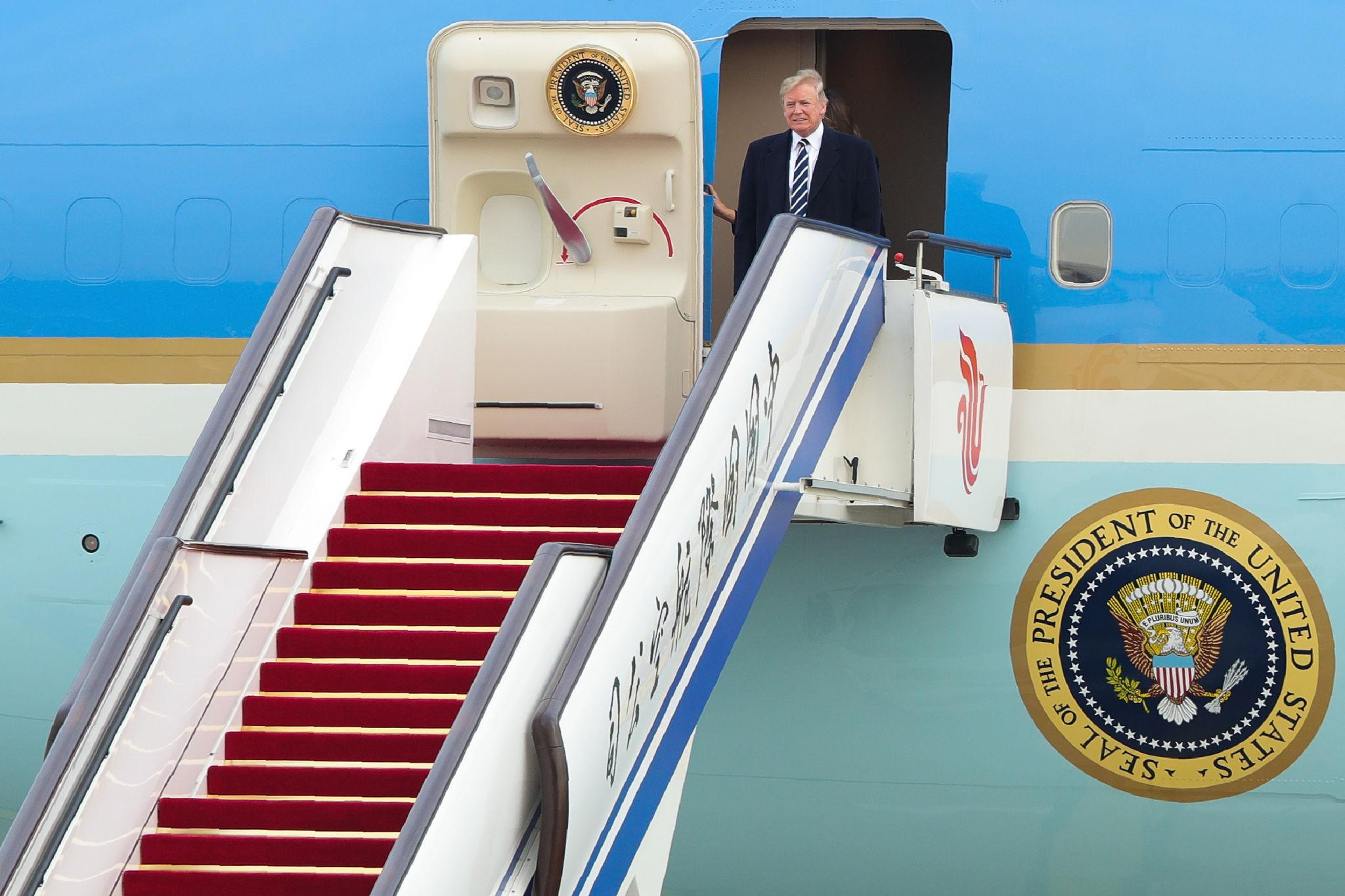
Trump arrived in Beijing to an elaborate welcome ceremony at Beijing Capital International Airport, greeted by Chinese Vice-President Han Zheng and accompanied by a delegation that included some of America’s most influential corporate leaders, among them Elon Musk, Nvidia CEO Jensen Huang, Apple CEO Tim Cook, Boeing CEO Kelly Ortberg, and executives from BlackRock, Goldman Sachs, Qualcomm, Visa, and Meta.
The symbolism was unmistakable: this was not only a political summit, but also an economic mission aimed at reshaping the next phase of U.S.-China relations.
A Summit Overshadowed by the Iran War
Although trade officially dominates the public agenda, the conflict in Iran looms over virtually every conversation between Washington and Beijing.
The ongoing war has transformed the global energy market and intensified pressure on both powers. Trump is seeking China’s assistance in persuading Tehran to reopen the Strait of Hormuz, one of the world’s most critical oil shipping routes. Iran’s blockade of the strait has disrupted energy markets and contributed to rising inflation pressures globally.
China occupies a unique position in the conflict. Beijing remains Iran’s largest oil customer and one of Tehran’s most important diplomatic partners. Analysts believe China now holds substantial leverage over the situation — leverage that Trump hopes Xi will use.
Defense Secretary Pete Hegseth recently stated that China possesses “a lot of leverage” over Iran, while Republican Senator Lindsey Graham accused Beijing of effectively propping up both Iran and Russia through economic ties.
Yet Chinese officials appear cautious about becoming deeply involved. Beijing has repeatedly called for de-escalation while avoiding direct intervention.
Laura Bicker, reporting from Beijing, noted that China’s economy — already under pressure from slower growth and unemployment concerns — has been hit further by surging oil prices connected to the conflict.
That creates a delicate balancing act for Xi Jinping: stabilize the Middle East enough to protect China’s economy while simultaneously maximizing Beijing’s geopolitical advantage over Washington.
Trump’s Push for Economic Wins
For Trump, the Beijing summit is also about domestic politics.
The U.S. president enters the meetings facing declining approval ratings and mounting economic concerns at home. Inflation linked to the Iran conflict, combined with fears surrounding global supply chains, has intensified pressure on the White House ahead of critical midterm elections.
Trump has framed the visit as an opportunity to secure tangible economic victories.
Before leaving Washington, he declared that his “very first request” to Xi Jinping would be for China to “open up” its economy to American companies and innovators.
The presence of major American CEOs aboard Air Force One underscored the administration’s priorities.
Nvidia’s Jensen Huang joined the delegation at the last minute, highlighting how semiconductor competition has become central to the U.S.-China rivalry. Nvidia remains deeply tied to the Chinese market despite Washington’s export controls targeting advanced chips. Elon Musk’s Tesla also depends heavily on Chinese manufacturing and consumers, while Boeing hopes to secure massive aircraft orders from Beijing.
American officials are expected to push for:
- Expanded Chinese purchases of Boeing aircraft
- Increased imports of U.S. soybeans and agricultural products
- More favorable conditions for American technology companies
- Stability in rare earth exports critical to U.S. defense and manufacturing
Trade between the two nations has sharply declined from its 2022 peak of $690.4 billion to approximately $414.7 billion last year.
Despite years of tariffs and retaliatory measures, both governments now appear eager to prevent another economic escalation.
Xi Jinping’s Stronger Position
While Trump arrives seeking deals, many analysts believe Xi Jinping enters the summit from a position of greater strategic strength.
China’s economy has proven more resilient than many expected during Trump’s aggressive tariff campaign. Beijing has diversified export markets, expanded technological self-sufficiency, and leveraged its dominance in rare earth minerals to counter U.S. pressure.
The result is a subtle but important shift in negotiating dynamics.
“The confidence that you see from Beijing in recent months that they are negotiating with the United States as equals, if not as the stronger player in the negotiation, is striking,” former State Department official Henrietta Levin said.
China is reportedly seeking several major concessions:
- Reduced U.S. restrictions on advanced semiconductor exports
- Removal of sanctions on Chinese companies
- Clearer U.S. opposition to Taiwanese independence
- Greater long-term stability in bilateral relations
Taiwan remains one of the summit’s most sensitive subjects.
Trump has signaled willingness to discuss U.S. arms sales to Taiwan, while Beijing continues to insist the island is Chinese territory. Analysts believe Xi could attempt to pressure Trump into softening Washington’s military support for Taipei.
Beijing’s Carefully Choreographed Welcome
China has transformed the visit into a major display of diplomatic theater.
As Air Force One landed in Beijing, hundreds of children waved Chinese and American flags while military honor guards lined the tarmac. A brass band played during Trump’s arrival, and city streets were decorated with welcome banners and illuminated skyscrapers.
The itinerary itself reflects Beijing’s emphasis on symbolism:
- Formal talks at the Great Hall of the People
- A state banquet hosted by Xi Jinping
- A “friendship photo” at Zhongnanhai, headquarters of China’s Communist leadership
- Cultural visits including the Temple of Heaven
Chinese social media also exploded with attention as the hashtag #WelcomeTrumpToChina became a top trending topic on Weibo.
Even Trump’s long-running Chinese nickname, “Chuan Jianguo” — loosely translating to “Trump the Country Builder” — resurfaced online, reflecting the widespread Chinese belief that Trump’s confrontational policies have unintentionally accelerated China’s global rise.
Technology, AI, and the Next Cold War
One of the most important — yet least publicly discussed — aspects of the summit is artificial intelligence.
Officials from both countries are expected to discuss a new U.S.-China dialogue on AI security and military applications.
This issue has become increasingly urgent as both powers race to dominate advanced AI systems while simultaneously fearing the dangers of autonomous weapons and uncontrolled escalation.
The semiconductor industry sits at the center of this battle.
China wants Washington to ease export restrictions on advanced chipmaking equipment and AI processors. Meanwhile, the U.S. remains determined to slow China’s technological advancement in areas considered strategically vital.
Nvidia’s participation in the delegation illustrates how intertwined business interests remain despite geopolitical rivalry.
From “Grand Bargain” to “Shrinking Summit”
Earlier this year, some observers envisioned the possibility of a sweeping “grand bargain” between Washington and Beijing — an agreement that could stabilize trade, reduce military tensions, and reset the relationship.
That vision has now faded.
Political analysts increasingly describe the Beijing meetings as a “shrinking summit,” where the primary goal is no longer transformation but stabilization.
Instead of dramatic breakthroughs, both governments appear focused on preventing crisis escalation.
“There was all the talk about the prospect for some kind of grand bargain between the U.S. and China,” former CIA China analyst Jonathan Czin said. “What I’ve heard over and over again is that maybe little bargains are possible.”
That may ultimately define the summit’s true significance.
The Trump-Xi meetings are less about solving the deep structural conflicts dividing the United States and China and more about managing competition between two superpowers increasingly locked into long-term rivalry.
The Broader Global Stakes
The outcome of the Beijing summit could influence:
- Global energy markets
- Semiconductor supply chains
- Artificial intelligence regulation
- Taiwan security
- U.S. manufacturing and agriculture
- Future tariff policies
- Stability in the Indo-Pacific
With both leaders under domestic and international pressure, neither side can afford a complete collapse in relations.
At the same time, neither Washington nor Beijing appears willing to fundamentally compromise on the core issues driving strategic competition.
That reality gives the summit enormous importance — even if it produces few immediate breakthroughs.
For now, the world is watching whether two leaders known for strong personalities and nationalist agendas can prevent an increasingly fragile relationship from sliding into deeper confrontation.
And in Beijing this week, amid ceremonial pageantry and carefully staged diplomacy, the future balance of global power may quietly be taking shape.


