

Nick Shirley Law: Why California’s AB 2624 Has Become a National Free-Speech Flashpoint
What many people are calling the “Nick Shirley law” is not the formal name of the legislation. The bill is AB 2624, introduced in California as “Privacy for immigration support services providers.” But in a matter of days, it has taken on a far more political nickname: the “Stop Nick Shirley Act.” That label has spread because critics believe the proposal moved into the spotlight after independent journalist Nick Shirley’s viral fraud investigations intensified scrutiny of publicly funded programs in California.
The fight over the bill is no longer just about one journalist. It has become a broader argument over where privacy protections end and where public-interest reporting begins. Supporters of AB 2624 present it as a safety measure for people and organizations serving immigrant communities. Critics frame it as an attempt to make exposure more costly, more legally dangerous, and therefore less likely. That is why the debate has moved beyond Sacramento and into national political commentary, media circles, and online platforms.
What AB 2624 actually says
At its core, AB 2624 would create a confidentiality framework for people connected to immigration support services in California. The bill text says it would establish an address confidentiality program for a “designated immigration support services provider, employee, or volunteer” who faces threats of violence or harassment because of that affiliation. It also defines “image” broadly to include “a photograph, video footage, sketch, or computer-generated image,” and “personal information” broadly enough to include names, addresses, telephone numbers, employment details, license plate numbers, and financial information.
The legislation builds on California’s existing privacy model for other high-risk categories by shielding certain addresses from disclosure and restricting the online posting or distribution of personal information or images when the conduct is tied to threats, intimidation, or incitement of violence. The bill text also creates civil remedies, including injunctions, attorney’s fees, and damages “up to a maximum of three times the actual damages, but in no case less than four thousand dollars.” The Legislative Counsel’s Digest further notes that some conduct under the broader statutory framework can trigger misdemeanor penalties, and existing related law includes fines of up to $10,000 and imprisonment in specified cases.
That distinction matters. The public controversy is not simply about whether the bill creates protections. It is about whether the definitions are broad enough, and the enforcement tools sharp enough, that public-interest documentation could be caught in the same net as genuine doxxing or intimidation.
Why Nick Shirley is at the center of the debate
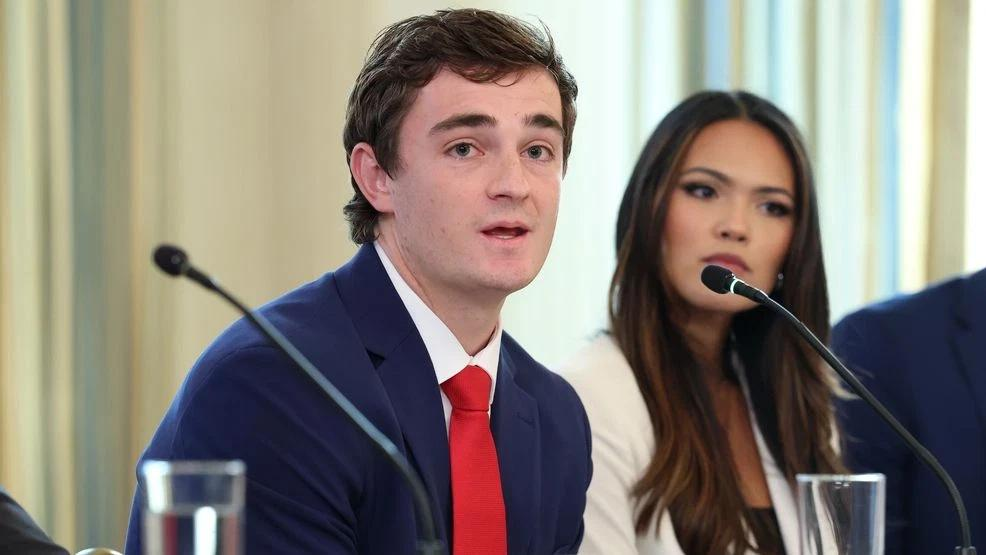
Nick Shirley’s name became attached to the bill because of the timing and visibility of his reporting. Shirley, a 24-year-old independent journalist, has drawn a large online audience by publishing video investigations into alleged fraud schemes. One of the California-focused videos described in reporting was a 40-minute investigation into hospice fraud, and that report says the video drew 42 million views on X. Shirley has also posted footage from outside facilities he claims were billing large amounts while appearing inactive. In one clip, he says, “Now we are here outside of Healthy Life Adult Daycare. This place, over the past few years, has billed $19.8 million alone. Now let’s go see if I can enroll my grandma, because she needs some daycare.”
Shirley has described AB 2624 in stark terms. In the language circulated widely online, he wrote, “California is trying to pass a bill that would criminalize investigative journalism with misdemeanors, $10,000 fines, imprisonment, and content takedown.” He added, “The proposed bill is titled AB 2624 and was made after I exposed mass fraud by immigrant groups in America.” He also claimed that, under the bill, “government-funded entities like the Somali ‘Learing’ Daycare centers would be protected from being exposed if they operated inside California.”
His rhetoric then escalated into a more openly political accusation. “UPDATE: The legislator who proposed this bill is Mia Bonta, the wife of Attorney General Rob Bonta,” he wrote. “The Attorney General of California’s wife is trying to silence me and other journalists who are exposing fraud. Are your donors mad they are being exposed?” Those statements helped transform a legislative privacy debate into a wider argument about political retaliation, media power, and state accountability.
The case supporters are making
Supporters of AB 2624 are arguing from a very different premise. The bill’s legislative findings say that people providing support services to immigrant communities “have been subject to harassment, threats, and intimidation for their work,” and that these workers have faced “doxxing, courthouse targeting, online harassment, anti-immigrant vigilante threats, and coordinated campaigns and death threats.”
Assembly Member Mia Bonta defended the proposal in committee by arguing that the threat environment is real, not speculative. As quoted in contemporaneous reporting, she said: “This program allows participants to keep their home and work addresses out of public records, giving them a critical layer of protection and privacy in an environment where their personal safety is increasingly at risk.” She also said, “This is not hypothetical. Advocates and workers are receiving death threats, being targeted at court houses and facing coordinated online doxxing campaigns.” From that perspective, the bill is not aimed at journalism as such. It is aimed at preventing the publication and circulation of identifying material in ways that supporters believe can place service providers and their families at risk.
That argument has political weight because it ties AB 2624 to an existing legal model rather than presenting it as a novel censorship regime. Supporters can say they are extending already recognized protections to another vulnerable class of workers and volunteers. The legislative architecture reflects exactly that logic.
The case critics are making
Critics, however, are focusing less on the bill’s stated purpose and more on its likely practical effect. Republican Assembly Member Carl DeMaio has emerged as its loudest legislative opponent and is the figure most associated with the phrase “Stop Nick Shirley Act.” In a committee exchange, he challenged the absence of a clear journalism exemption and warned that public-interest video reporting could become legally vulnerable. He told Bonta, “You do not provide an exemption for journalists.” He continued, “This is not about protecting people from violence. This is about threatening and intimidating people who are trying to shine a light on bad behavior. If you have nothing to hide, why fear the transparency?”
In a separate press statement, DeMaio sharpened the attack. “California Democrats are trying to intimidate citizen watchdog journalists and protect waste and fraud happening in far-Left-wing NGOs. AB 2624 can only be described as the ‘Stop Nick Shirley Act’ — a bill designed to silence citizen journalists exposing fraud and abuse of taxpayer dollars.” He added, “Instead of fixing the fraud problems being uncovered, Sacramento politicians are trying to shut down the people exposing them.”
His most pointed warning was constitutional and cultural at the same time: “If this bill becomes law, the message is clear to every journalist in California: expose corruption and you will be punished. AB 2624 is an unconstitutional direct attack on transparency and the First Amendment – and it needs to be defeated.” This is the argument that has turned a state bill into a national talking point. It frames AB 2624 not as a narrow anti-doxxing statute, but as a legal deterrent aimed at camera-based accountability.
Why Elon Musk’s intervention amplified the fight
The issue reached a larger audience when Elon Musk weighed in on X. Reacting to Shirley’s claims, Musk wrote, “California legislators are trying to make investigating fraud illegal.” That short statement mattered less as legal analysis than as amplification. It moved the controversy from activist and regional media spaces into a broader national political stream, where shorthand often travels faster than legislative nuance.
Once Musk entered the discussion, the argument hardened into two rival narratives. One side said the state was trying to criminalize exposure. The other said the state was trying to stop harassment masquerading as accountability. Those are not merely different legal interpretations. They are competing visions of how public oversight works in the age of viral video.
The fraud backdrop that makes the bill politically explosive
The political force behind this story comes from the fraud context. Shirley’s supporters argue that his videos were not random provocation but part of a broader public reckoning over abuse of government-funded systems. That claim gained traction because federal authorities have recently announced real fraud cases involving hospice providers in Southern California. On April 2, 2026, the U.S. Attorney’s Office for the Central District of California announced that eight defendants had been arrested in a health care fraud takedown involving alleged sham hospice operations and more than $50 million in intended health care fraud losses. The Justice Department said the defendants schemed to defraud the health care system, including by “running sham hospice care facilities that bilked Medicare by using people without terminal illnesses as beneficiaries.”
That does not prove every allegation made in online investigative videos. But it does explain why the bill’s critics believe this is the wrong political moment to make image-sharing and online publication riskier. When fraud enforcement is active, any proposal that broadens liability around filming, posting, or identifying operators in taxpayer-funded systems is likely to be viewed through a transparency lens first and a privacy lens second.
The legal gray area at the center of the controversy
The sharpest tension in the “Nick Shirley law” debate lies in the phrase intent. The bill text targets posting or distributing information and images with the intent to incite imminent great bodily harm or to threaten someone in a way that places them in objectively reasonable fear for their safety. On paper, that is narrower than a blanket ban on journalism. But opponents argue that intent-based standards can become contestable once a video goes viral and backlash follows. The question then becomes whether exposure of alleged misconduct will be treated as documentation of public concern or as conduct that foreseeably places subjects at risk.
That is why critics keep returning to the absence of a bright-line exemption. DeMaio’s concern is not only about what the bill says at its cleanest reading. It is about how complaints, injunction requests, and damage claims could be used in practice. Even if a journalist ultimately wins, legal pressure can still deter publication. In that sense, the most powerful effect of a law like this may not be conviction or judgment. It may be hesitation.
Where the bill stands now
As of the latest reporting and the current legislative text, AB 2624 has already cleared an initial step and remains active in the California legislative process. Reporting on April 14 said it had passed its first hurdle and was next headed to the Assembly Judiciary Committee for further consideration. The official bill page shows that it was introduced on February 20, 2026, amended on March 26, 2026, and amended again on April 9, 2026.
So the story is not finished. The controversy may intensify as the bill moves through committees, as its language is refined, and as lawmakers are pushed to clarify whether they intend to target doxxing alone or are willing to carve out stronger protections for public-interest reporting.
Why this matters beyond Nick Shirley
The larger significance of the “Nick Shirley law” is that it sits at the collision point between three forces shaping modern public life: viral citizen journalism, growing concern over harassment and doxxing, and rising distrust of government-administered systems. AB 2624 has become a test case because it touches all three at once.
If the bill is tightened, supporters may say California found a way to protect vulnerable workers without weakening scrutiny. If it advances without clearer safeguards for reporting, critics will keep using it as proof that modern institutions increasingly answer exposure not by disproving allegations, but by constraining the people who publish them. Either way, the phrase “Nick Shirley law” has already outgrown one journalist. It now stands for a broader national argument over whether the camera is a public watchdog, a tool of intimidation, or—depending on who is speaking—both at once.
Conclusion
AB 2624 is formally a privacy bill, but politically it has become something much bigger. To supporters, it is a necessary response to harassment, threats, and doxxing directed at people serving immigrant communities. To critics, it is a dangerously broad measure that could make investigative reporting more legally risky at the precise moment fraud allegations are drawing public attention. Nick Shirley’s videos, Carl DeMaio’s attacks, Mia Bonta’s defense of the proposal, Elon Musk’s intervention, and ongoing fraud prosecutions have all combined to turn a California bill into a national argument about transparency, safety, and the future of citizen journalism.


