

Ryan in The Boys: A Character at the Center of Power, Trauma, and the Final War
Introduction: Why Ryan Matters More Than Ever
In The Boys, few characters embody the series’ moral complexity as sharply as Ryan Butcher. Positioned between humanity and god-like power, Ryan is no longer just a supporting figure—he has become a central axis around which the show’s endgame is unfolding.
Season 5, particularly Episode 3, reframes Ryan’s role from a conflicted child into a decisive force in the escalating conflict between Homelander and Billy Butcher. What unfolds is not simply a battle of strength, but a deeply personal struggle shaped by identity, legacy, and manipulation.
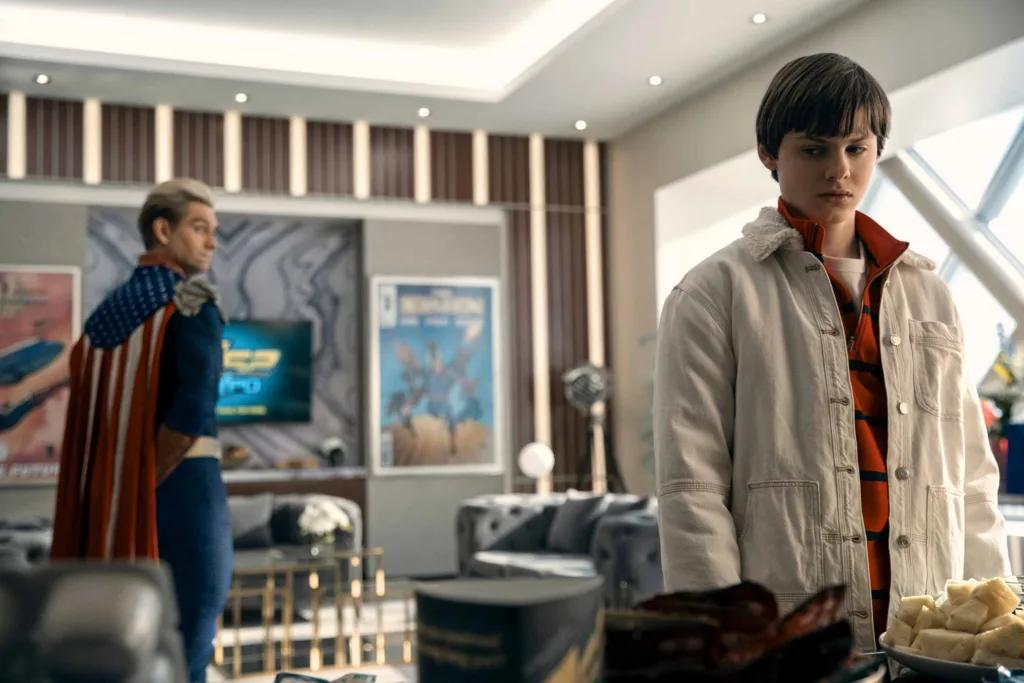
The Origins of Ryan: A Unique Supe Unlike Any Other
Ryan’s significance begins with his origin. Unlike most “Supes” in The Boys, who are artificially created using Compound V, Ryan is the first naturally born superhuman, inheriting his powers genetically from Homelander.
This distinction matters for two reasons:
- He represents a new evolutionary step in the show’s universe
- He carries the combined legacy of both victim and aggressor, being the son of Homelander and Becca Butcher
From early seasons, Ryan is portrayed as emotionally vulnerable, raised in isolation and shielded from the world. However, as the narrative progresses, that isolation gives way to exposure—first to Butcher’s influence, then to Homelander’s ideology.
Season 5 Turning Point: Ryan Returns to the Conflict
Season 5 initially sidelines Ryan, but his return in Episode 3 immediately signals narrative escalation. He re-enters a world already on the brink of collapse, with multiple factions pursuing control over the future of Supes.
Key developments include:
- Ryan reconnects with Butcher, who attempts to recruit him into a plan to kill Homelander
- The plan involves using a Supe-killing virus, which would also kill Ryan himself
- Ryan reluctantly considers the possibility, highlighting his internal conflict
This moment marks a critical shift: Ryan is no longer being protected—he is being weaponized.
The Moral Crossroads: Between Butcher and Homelander
Ryan’s psychological struggle defines his arc. He is caught between two opposing worldviews:
Butcher’s Perspective
- Supes are inherently dangerous
- The world would be safer without them
- Sacrifice—even Ryan’s—is justified for the greater good
Homelander’s Perspective
- Supes are superior beings
- Power defines destiny
- Ryan should embrace his god-like identity
This duality leaves Ryan in an unstable position. He is neither fully aligned with humanity nor willing to embrace the brutality of Supes.
The Confrontation: Ryan vs Homelander
The emotional and physical climax of Episode 3 comes when Ryan confronts Homelander directly.
What triggers the fight?
- Ryan questions his father about his past actions, including the truth about his mother
- Using his abilities, Ryan detects that Homelander is lying
- This leads to an immediate escalation into violence
Ryan initially fights back and even manages to draw blood from Homelander, a rare feat that underscores his potential power.
However, the imbalance becomes clear quickly.
The Brutal Outcome: A Beating That Redefines the Story
The confrontation ends in one of the most disturbing sequences in the series:
- Homelander overwhelms Ryan with sustained, brutal force
- He repeatedly punches him even after Ryan is defenseless
- The scene emphasizes not just physical dominance, but emotional detachment
Ryan is left severely injured and motionless.
At first glance, it appears fatal. The show deliberately lingers on the ambiguity.
Is Ryan Dead? The Critical Detail
Despite the apparent finality of the beating, Ryan survives.
- A subtle moment shows him struggling to breathe
- Butcher later finds him alive, though critically injured
This detail is pivotal. Ryan’s survival ensures that:
- The central conflict remains unresolved
- His role in the endgame is preserved
- The emotional stakes intensify moving forward
Power Analysis: How Strong Is Ryan?
Episode 3 provides important insight into Ryan’s abilities:
- He withstands direct attacks from Homelander
- He manages to injure him—something only a few characters have achieved
- His durability suggests he may eventually rival or surpass his father
This reinforces a long-standing theory within the series:
Ryan may be the only being capable of defeating Homelander.
Narrative Implications: What Ryan Represents
Ryan’s arc is no longer just personal—it is symbolic.
1. The Future of Supes
Ryan represents what Supes could become:
- Born, not engineered
- Potentially more powerful
- Less predictable
2. The Cost of Power
His story highlights:
- The loss of innocence
- The burden of inherited violence
- The consequences of being treated as a tool
3. The Moral Center of the Series
Unlike most characters, Ryan still wrestles with:
- Guilt
- Empathy
- Responsibility
That makes him one of the few remaining moral anchors in an otherwise cynical narrative.
What Comes Next: The Road to the Finale
Following Episode 3, several trajectories emerge:
- Ryan may align more closely with Butcher after being saved
- He could seek revenge against Homelander
- Alternatively, he may reject both sides and forge his own path
At the same time:
- Homelander’s increasing instability raises the stakes
- The search for V1 (a variant of Compound V tied to immortality) complicates the conflict
- The possibility of another father-son confrontation is almost certain
Conclusion: Ryan as the Decisive Variable
Ryan is no longer a passive character in The Boys. He is the decisive variable in a story driven by power, ideology, and survival.
His survival after Episode 3 ensures that the final chapters of the series will revolve around one central question:
Will Ryan become the hero who ends Homelander—or the next version of him?
That uncertainty is precisely what makes his character essential to the show’s conclusion.


