


Delta Goodrem’s Eurovision Moment: Australia’s Best Shot at Victory in Years
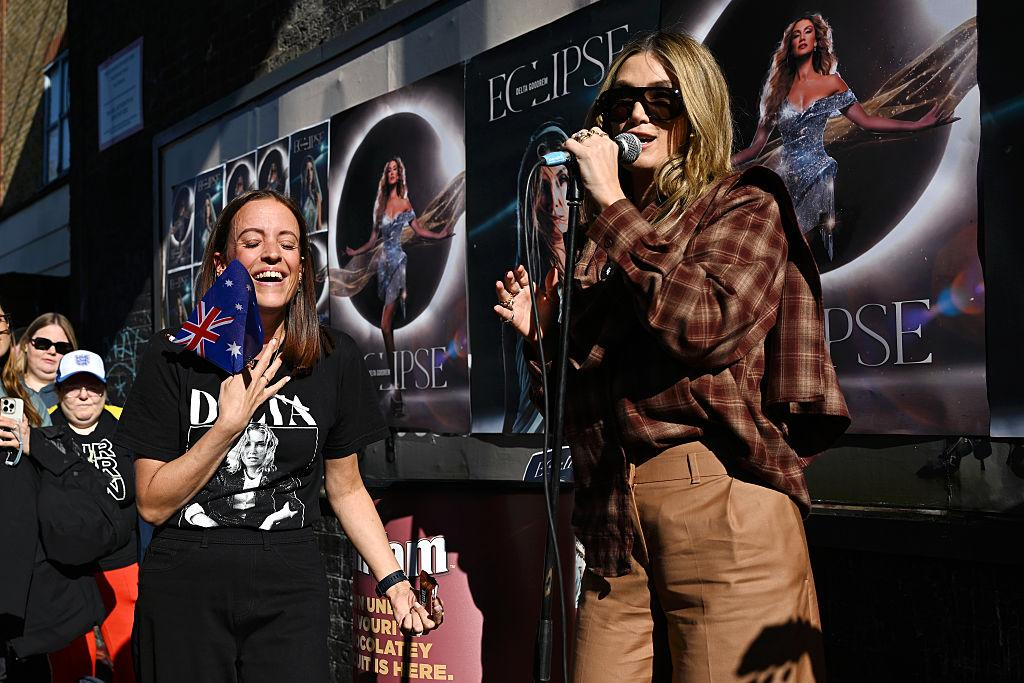
Delta Goodrem has turned Australia’s Eurovision 2026 campaign into one of the contest’s most closely watched stories, after a commanding semi-final performance pushed her into the grand final and sent Australia’s odds soaring.
Performing her Eurovision song “Eclipse” in Vienna, Goodrem delivered the kind of polished, theatrical and emotionally charged staging that Eurovision audiences often remember long after the voting is over. The Australian pop star rose above a golden piano at the song’s climax, wearing a dress adorned with more than 7,000 Swarovski crystals, while light, pyrotechnics and dramatic stage effects gave the performance the scale of a true grand-final contender.
Her qualification has not only revived Australia’s hopes after two years of missing the final, but also placed the country in serious contention for its first Eurovision win.
A Semi-Final Performance That Changed the Race
Goodrem advanced from the second semi-final of the Eurovision Song Contest in Vienna, joining the 2026 grand final after what was widely described as a technically strong and visually ambitious performance.
Her song, “Eclipse,” is a rousing ballad built for a classic Eurovision arc: emotional opening, controlled vocal build, dramatic staging and a climactic finish. During the final chorus, Goodrem climbed onto her grand piano before the staging lifted her into the air, creating one of the most memorable visual moments of Australia’s 2026 campaign.
After qualifying, Goodrem described the night as “pure magic.”
“To stand on that stage, share our hearts, and now know we’re heading to the grand final of Eurovision is something I’ll never forget,” she said.
“It’s an absolute honour to represent Australia on the Eurovision stage. Thank you for every vote, every message, and every bit of love.”
The result immediately shifted the tone around Australia’s entry. What had been seen as a strong but uncertain campaign became one of the major talking points of the contest.
Eurovision Odds: Why Delta Goodrem Is Suddenly a Serious Contender
Before her semi-final performance, Goodrem was reportedly sitting around ninth or tenth in some Eurovision odds markets. After the performance, Australia surged dramatically.
According to odds reported after the semi-final, Australia moved into second place among the favourites, with one market giving Goodrem a 16 per cent chance of winning, behind Finland on 34 per cent. Other figures placed Australia at 14 per cent, still second behind Finland, which remained the firm favourite at 38 per cent.
That leap matters because Eurovision odds often respond quickly to rehearsals, staging reveals and semi-final performances. In Goodrem’s case, the change appears to reflect a simple calculation: Australia has a seasoned vocalist, a polished song, a high-impact stage concept and a performer with the experience to deliver under pressure.
Still, Eurovision is rarely straightforward. The contest is split between jury and public voting, and Goodrem’s biggest strength may be with juries. Her pitch control, vocal discipline and professional staging are exactly the type of elements juries often reward. The public vote, however, can be less predictable, especially in years where novelty, humour, political feeling or viral moments reshape the final scoreboard.
Why “Eclipse” Works on the Eurovision Stage
Goodrem has said that “Eclipse,” which she co-wrote, is about “alignment — when things all come into the right place.”
That idea fits the moment. For Australia, Eurovision 2026 feels like a meeting point between artist, song, staging and timing. Goodrem is not an emerging performer being introduced to a global audience; she is one of Australia’s most recognisable pop names, with a long career built on ballads, dramatic vocals and emotional connection.
She also explained why the contest appealed to her:
“I’ve always loved the creativity, individuality, and joy Eurovision brings, connecting and uniting people across the globe through music — the universal language,” she said.
“It felt like the right moment to represent Australia.”
Released in March, “Eclipse” reached number one on the Australian AIR Independent Singles Chart, giving the entry a domestic platform before it reached the Eurovision stage. In Vienna, the song was transformed from a studio ballad into a full-scale television event.
Australia’s Eurovision History: Close Before, But Never First
Australia has competed in Eurovision for 11 years but has never won. Its best result remains Dami Im’s second-place finish in 2016 with “Sound of Silence,” also in a year when Australia looked capable of taking the trophy.
The country’s other strong results include Guy Sebastian, who placed fifth in 2015 as Australia’s first Eurovision entrant, and top-ten finishes from Isaiah Firebrace in 2017 and Kate Miller-Heidke in 2019.
Goodrem’s qualification is significant because it ends a difficult recent run. Australia had failed to qualify for the grand final for two consecutive years before 2026, making her success feel like a reset for the country’s Eurovision ambitions.
Why Australia Competes in Eurovision
Australia’s participation has long raised questions because Eurovision is historically a European contest. The answer lies in Australia’s deep Eurovision fanbase, multicultural ties and long-running broadcast relationship with the event through SBS.
Australia was invited to compete as a wildcard entry in 2015, originally as part of Eurovision’s anniversary celebrations. A continuing arrangement between SBS and the European Broadcasting Union later kept Australia in the contest.
Lachlan Woods, president of the Eurovision Song Contest Fans of Australia Network, captured the cultural argument behind Australia’s place in the competition:
“The way that I explain it to a lot of people is that a lot of Australians, a significant proportion of Australians have European heritage, not just British and Irish heritage,” he said.
“We can’t change geography, but what we can do is reflect the fact that we have a lot of European Australians who live in Australia and an incredible diversity of culture and inclusivity we want to show off to the world.”
For many Australian fans, Goodrem’s entry represents more than a song contest appearance. It is a chance to show that Australia can compete seriously, not as a novelty guest, but as a country capable of sending a world-class pop performance.
The Fan Reaction: Pride, Nostalgia and Belief
Goodrem’s Eurovision run has tapped into a deep reserve of Australian pop nostalgia. For many viewers, she is tied to the early 2000s breakthrough of “Innocent Eyes,” the album that made her a household name.
Woods said Goodrem’s selection had personal resonance:
“I did have to pinch myself when I saw that it was Delta representing Australia this year,” he said.
“I still remember being the little five-year-old kid dancing and borrowing my sister’s copies of Innocent Eyes.”
He added:
“It’s really exciting that we’ve got such a strong entry this year … seeing such a well-respected artist like Delta show why she is so well-loved on the global stage.”
“It’s just something that we can really be proud of as Australians.”
That pride is central to the momentum around Goodrem. Eurovision thrives on national identity, emotional connection and spectacle. Goodrem brings all three.
The SBS Factor: Where Australians Can Watch
For Australian audiences, SBS remains central to the Eurovision experience. The 2026 grand final is scheduled to air on SBS On Demand from 5am AEST on Sunday, giving local fans the familiar early-morning ritual that has become part of Eurovision culture in Australia.
The broadcaster’s long association with Eurovision has helped build the contest from a niche European broadcast into a major annual pop-culture event for Australian viewers.
What Happens If Australia Wins Eurovision?
A Goodrem victory would be historic, but it would also raise a practical question: would Australia host Eurovision?
The likely answer is no. Eurovision officials have previously indicated that if Australia wins, another European country would host the contest on Australia’s behalf because of the time difference and logistical challenges of staging the event outside Europe.
A similar discussion surrounded Australia’s strong 2016 campaign, when Dami Im finished second. At the time, Germany and the United Kingdom were reportedly considered possible hosts if Australia had won.
So while a Delta Goodrem victory would belong to Australia, the following year’s contest would almost certainly remain in Europe.
Who Else Is in the Eurovision 2026 Final?
Goodrem emerged from the second semi-final alongside nine other qualifiers: Albania, Bulgaria, Cyprus, Czechia, Denmark, Malta, Romania, Ukraine, and Norway.
They join the countries that qualified from the first semi-final: Greece, Finland, Moldova, Belgium, Croatia, Israel, Lithuania, Poland, Serbia, and Sweden.
The automatic finalists include the host country and the traditional automatic qualifiers: the United Kingdom, Italy, Germany, and France. Spain, Ireland, the Netherlands, Slovenia and Iceland are not taking part after boycotting the contest over the organising body’s decision to allow Israel to compete.
Delta Goodrem’s Personal Journey Adds Weight to the Moment
Goodrem’s Eurovision performance also carries emotional weight because of her personal and professional history. She became famous in the early 2000s with “Innocent Eyes,” starred in Neighbours, and later spent eight years as a coach on The Voice Australia.
Her career has also included serious health challenges. She underwent treatment for Hodgkin’s lymphoma at the height of her early fame. In 2018, surgery to remove her salivary gland left her unable to speak or sing.
“I couldn’t speak a word, let alone sing, and I had to learn how to talk from scratch,” she told the Guardian.
That history gives her Eurovision run added resonance. A performance built around vocal power becomes more meaningful when viewed against the reality that Goodrem once had to rebuild her voice.
Can Delta Goodrem Actually Win Eurovision 2026?
Goodrem can win, but the route is demanding.
Her most likely path depends on a strong jury score, followed by enough public support to withstand Finland’s lead and any late surge from other entries. The jury vote may reward her vocal precision, polish and staging. The public vote may depend on whether viewers connect emotionally with “Eclipse” as much as they respond to louder, quirkier or more viral performances.
Australia has been close before. It has had credible artists, strong vocals and memorable staging. What makes 2026 different is the convergence of timing, reputation and execution. Goodrem arrived with a song suited to her strengths, staged it with confidence, and delivered at the precise moment when Eurovision momentum can change overnight.
Australia’s Creative Director for Vienna, Paul Clarke, summed up the scale of the work behind the performance:
“Representing Australia is everything to her. Expect another level in the grand final.”
Conclusion: Delta Goodrem Has Given Australia a Eurovision Moment to Believe In
Delta Goodrem’s Eurovision 2026 campaign has become one of Australia’s most compelling entries since Dami Im’s near-victory in 2016. With “Eclipse,” she has brought together vocal strength, emotional storytelling, visual drama and national pride in a way that feels tailor-made for the Eurovision stage.
The odds suggest Australia is no longer just hoping for a respectable result. It is competing for the win.
Whether Goodrem can convert jury admiration and public emotion into Eurovision victory remains uncertain. But after her semi-final performance in Vienna, one thing is clear: Australia has a genuine contender, and Delta Goodrem has turned Eurovision 2026 into a defining moment in both her career and the country’s contest history.


