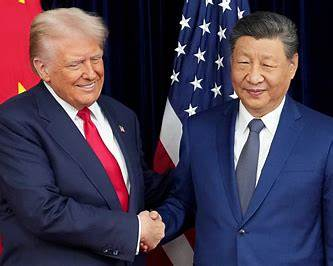
Trump and Xi Meet in Beijing as Trade, Iran and Technology Dominate Global Agenda
President Donald Trump arrived in Beijing on May 13, 2026, for one of the most consequential U.S.-China summits in recent years, stepping into a geopolitical landscape shaped by war in the Middle East, rising energy prices, technology rivalry, and renewed fears of a global trade confrontation.
The two-day summit with Chinese President Xi Jinping is expected to focus heavily on trade stability, the Iran conflict, Taiwan, artificial intelligence technology restrictions, and the future of economic cooperation between the world’s two largest economies. The meeting also arrives at a politically sensitive moment for both nations, particularly for Trump, whose domestic approval ratings have faced pressure amid inflation concerns tied to the ongoing Iran conflict.
A Carefully Choreographed Arrival in Beijing
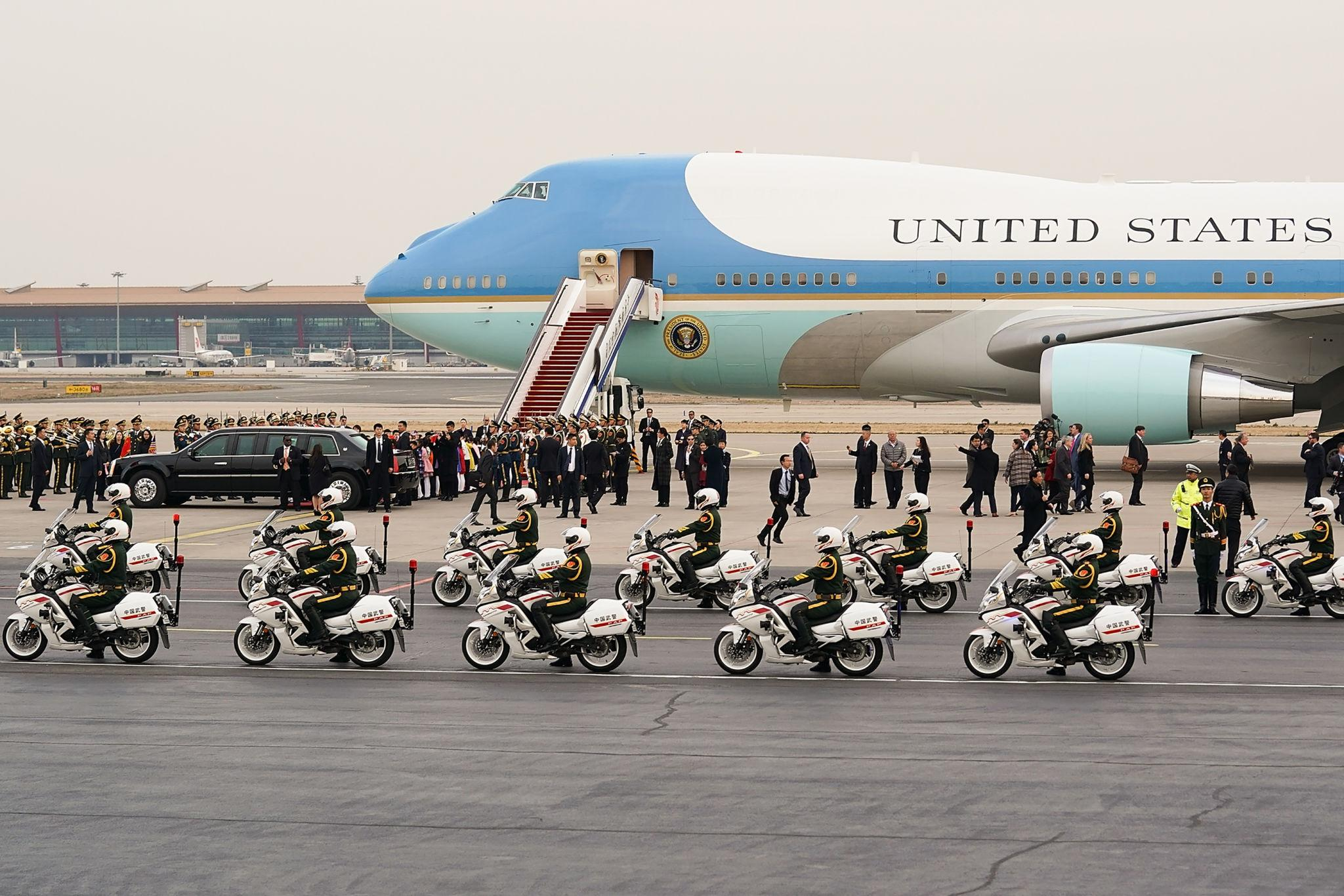
Trump’s arrival in China was marked by a high-profile state welcome that underscored the significance Beijing is placing on the summit. Air Force One landed at Beijing Capital International Airport where Trump was greeted by Chinese Vice President Han Zheng, senior Chinese officials, military honor guards, and hundreds of Chinese youths waving American and Chinese flags.


The ceremony reflected both symbolism and strategy. Beijing appears eager to project stability and diplomatic openness despite growing tensions between Washington and Beijing over trade policy, military activity in Asia, and technological competition.
Reuters described the scene as “lavish,” with tightly coordinated military pageantry and chants of “welcome, welcome, warm welcome” greeting the American president.


Trump himself framed the trip as a meeting between global superpowers.
“We’re the two superpowers,” Trump told reporters before departing Washington. “We’re the strongest nation on Earth in terms of military. China’s considered second.”
Why the Summit Matters
The summit is not simply another diplomatic visit. It is taking place during a period of extraordinary instability in global politics and economics.
Several major issues are converging at once:
- The U.S. and Israel’s ongoing war against Iran
- Disruptions around the Strait of Hormuz
- Surging global energy prices
- Fragile U.S.-China trade relations
- Escalating competition over artificial intelligence and semiconductors
- Growing disputes over Taiwan and military security in Asia
Each of these issues carries enormous implications for markets, manufacturing, and geopolitical stability.


The Strait of Hormuz crisis alone has become a critical factor. China imports roughly half of its crude oil and nearly one-third of its natural gas from Middle Eastern countries affected by the disruption, making stability in the region a core Chinese economic priority.
Trump has publicly minimized China’s role in resolving the Iran conflict, saying Xi does not need to “intervene,” yet the war remains impossible to separate from the broader diplomatic agenda.
Trade Truce Faces a New Test
At the center of the summit is an attempt to preserve the fragile trade truce between Washington and Beijing.
The United States and China stepped back from a damaging tariff war last year after both sides agreed to a temporary pause in escalating trade measures. Trump suspended triple-digit tariffs on Chinese goods, while China eased pressure on global rare earth mineral supplies.
Now, both governments are trying to prevent another economic rupture.
Trump has openly stated that trade will dominate the discussions “more than anything else.”
The U.S. delegation hopes to secure increased Chinese purchases of American products including:
- Soybeans
- Beef
- Energy exports
- Boeing aircraft
Meanwhile, Beijing wants Washington to reduce restrictions on advanced semiconductors and chipmaking equipment.
A proposed “Board of Trade” between the two countries is also reportedly under discussion as a mechanism for managing future economic disputes and avoiding another large-scale tariff conflict.
Technology Rivalry Takes Center Stage
One of the clearest signs that technology competition is central to the summit is the presence of major American corporate leaders in Trump’s delegation.
Executives accompanying the president include:
- Nvidia CEO Jensen Huang
- Tesla and SpaceX CEO Elon Musk
- Apple CEO Tim Cook
- BlackRock CEO Larry Fink
- Qualcomm CEO Cristiano Amon
- Boeing CEO Kelly Ortberg
- Meta executive Dina Powell McCormick
- Mastercard CEO Michael Miebach
- Goldman Sachs CEO David Solomon
Among the most closely watched figures is Nvidia’s Jensen Huang, who Reuters reported was added to the trip at the last minute. Nvidia has struggled to secure approval for sales of advanced H200 artificial intelligence chips in China.
Trump signaled that expanding U.S. corporate access to China would be a top objective.
“I will be asking President Xi, a Leader of extraordinary distinction, to ‘open up’ China so that these brilliant people can work their magic,” Trump wrote on Truth Social.
The summit is therefore becoming not only a geopolitical negotiation but also a battle over the future of AI leadership, semiconductor access, and industrial competitiveness.
Chinese Electric Vehicles Become a Major Concern
One unexpected issue drawing intense attention ahead of the summit is the rise of Chinese electric vehicle manufacturers.
American automakers and lawmakers fear that Chinese EV giants such as BYD could eventually gain access to Western markets, threatening U.S. and European manufacturers with dramatically cheaper vehicles.
BYD’s Seagull model reportedly sells for just $7,800 in China — far below the price of the cheapest electric vehicles currently available in the United States.
Rep. Don Beyer warned:
“The fact that it’s so inexpensive would destroy every other car company’s investment in electric vehicles.”
Although the U.S. currently maintains a 100 percent tariff and national security barriers against Chinese EV imports, Trump’s openness to Chinese investment has created anxiety within the American automotive sector.
The summit therefore carries implications far beyond diplomacy. It may shape the future structure of global automotive manufacturing and the pace of the electric vehicle transition.
Taiwan Remains a Dangerous Flashpoint
Another major source of tension is Taiwan.
China has strongly opposed U.S. weapons sales to Taiwan, including an $11 billion arms package authorized by Washington.
Ahead of Trump’s arrival, China’s People’s Daily described Taiwan as:
“the first red line that cannot be crossed in China-U.S. relations.”
The Taiwan issue has become even more strategically sensitive because the island plays a dominant role in global semiconductor production and advanced AI chip manufacturing.
Any escalation between Washington and Beijing over Taiwan would carry severe consequences for global technology supply chains.
Nuclear Arms and Global Security
Trump is also reportedly expected to raise the idea of a three-way nuclear arms agreement involving the United States, China, and Russia.
The proposal comes after the expiration of the New START treaty between Washington and Moscow, which removed limits on the world’s two largest nuclear arsenals.
China currently possesses more than 600 operational nuclear warheads, according to Pentagon estimates, with projections suggesting that number could exceed 1,000 by 2030.
Beijing has historically resisted joining nuclear limitation agreements, arguing that its arsenal remains significantly smaller than those of the United States and Russia.
Political Stakes for Trump and Xi
While the summit projects diplomatic grandeur, both leaders enter the talks with different levels of leverage.
Analysts suggest Xi may hold the stronger position.
China’s economy has slowed, but Beijing is not facing the same level of political pressure confronting Trump, whose administration is battling rising inflation, energy price spikes, and concerns about the economic impact of the Iran war.
Scott Kennedy of the Center for Strategic and International Studies argued that China could emerge stronger from the summit simply by avoiding major conflict.
“As long as there’s not a blow-up in the meeting and President Trump doesn’t go away and look to re-escalate, China basically comes out stronger,” Kennedy said.
Still, both governments appear eager to avoid another destabilizing rupture in relations.
What Happens Next?
The summit’s immediate outcomes may include:
- Expanded Chinese purchases of U.S. goods
- Commitments to continue trade negotiations
- Further dialogue on AI and semiconductor policy
- Limited agreements on energy and investment cooperation
- Efforts to prevent escalation over Taiwan
- Discussions on Iran and Middle East stability
However, the broader significance lies in whether Washington and Beijing can stabilize a relationship increasingly defined by strategic rivalry rather than partnership.
The Trump-Xi meeting is unfolding at a moment when the global economy, technology industry, and geopolitical order are becoming more interconnected and more fragile at the same time.
Markets, manufacturers, and governments around the world are watching closely because the consequences of these talks will likely extend far beyond Beijing.