


Rome Open: Why the Foro Italico Has Become the Defining Test Before Roland Garros
The Rome Open has reached one of the most revealing stages of the tennis calendar. Officially staged as the Internazionali BNL d’Italia at the Foro Italico, the 2026 tournament runs from 28 April to 17 May, placing it at the heart of the European clay-court swing and directly in the path toward Roland Garros.
Rome is rarely just another stop. Its heavy clay, slower conditions and historic setting often expose more than form. It tests stamina, physical recovery, emotional control and tactical maturity. This year, that pressure is already visible across the women’s draw, where Mirra Andreeva, Elena Rybakina and Coco Gauff arrive with Paris-sized ambitions, while Emma Raducanu’s withdrawal has turned the tournament into another chapter in her search for sustained fitness.
A Tournament That Feels Like a Grand Slam Rehearsal
The Rome Open sits in a critical position. By the time players reach the Foro Italico, the clay season is no longer new. Patterns have formed. Confidence has either grown or cracked. Injuries and fatigue have begun to show.
That is why Rome matters so much. It is not only about winning a prestigious title; it is about proving that a player’s game can survive long rallies, heavy balls, changing conditions and repeated physical stress before the French Open begins.
For top contenders, the event can serve as a launchpad. For others, it can expose problems that must be solved quickly. This year, both sides of that equation are already playing out.
Mirra Andreeva Turns Madrid Pain Into Rome Motivation
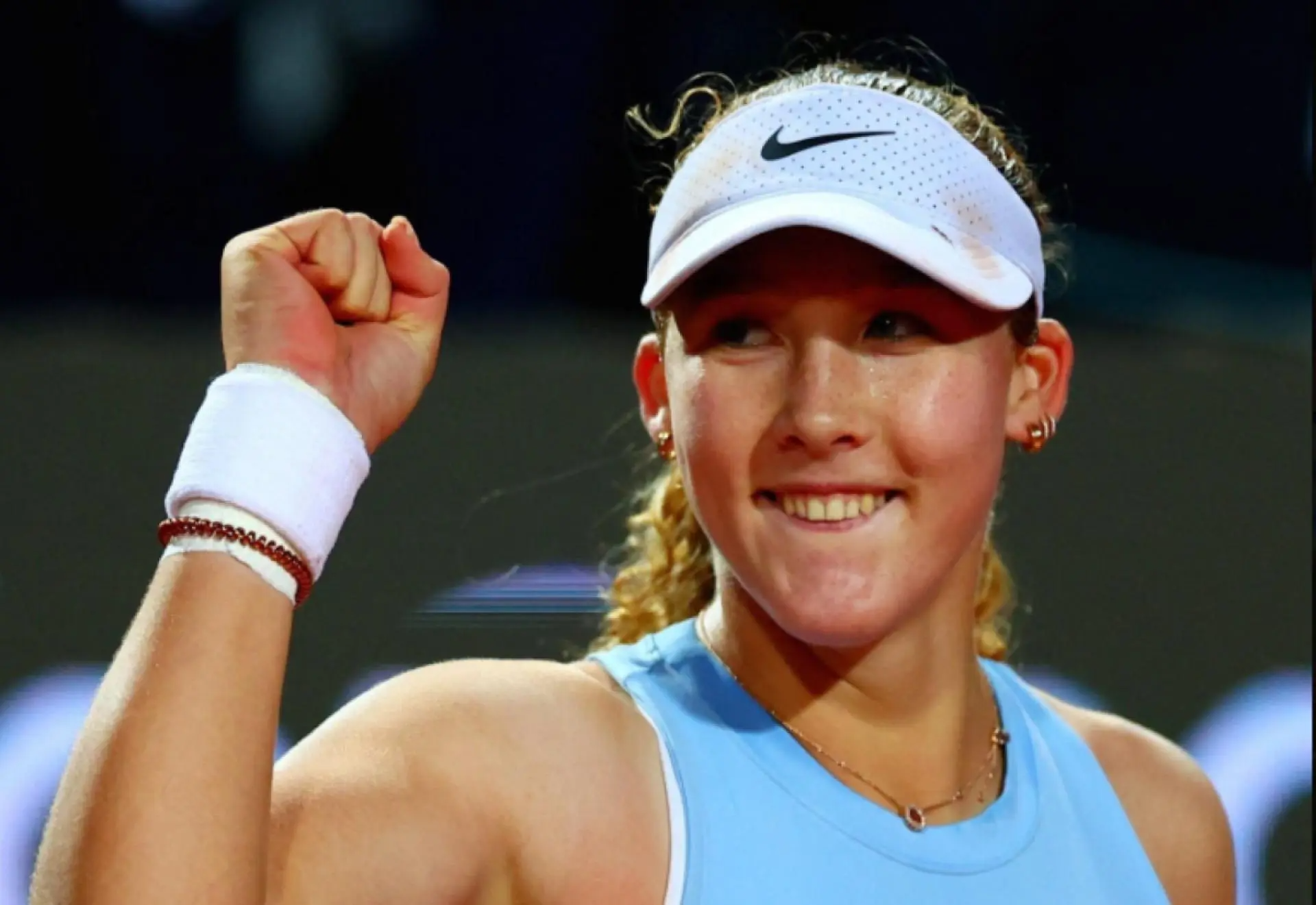
Few players arrive in Rome with more attention than Mirra Andreeva. After an excellent Madrid campaign in which she reached both the singles and doubles finals, the Russian enters the Foro Italico looking to convert near-misses into momentum.
Her Madrid run was emotionally demanding. She lost the singles final to Marta Kostyuk 6-3, 7-5, missing out on another WTA 1000 title, and also lost the doubles final alongside Diana Shnaider. The disappointment was visible, with Andreeva breaking down in tears during her on-court speech.
But Rome offers her an immediate reset. In her pre-tournament remarks, Andreeva made clear that she was not interested in carrying Madrid’s frustration into the next event.
“Of course, it was very good two weeks in Madrid, singles and doubles. I mean, two finals. vI think a lot of positives to take from those two weeks. Now Madrid is kind of in the past, so we have to forget about what happened there and try to put all of the focus that you have to try and perform well here in Rome,” she said.
That line echoed one of Rafael Nadal’s famous Rome reflections from 2019: “What happened in Monte Carlo happened. What happened in Barcelona happened. What happened in Madrid happened. And now we are here. We are in Rome.”
For Andreeva, the comparison is useful not because she is Nadal, but because it captures a clay-court truth: the calendar does not allow players to mourn for long. Rome demands immediate adjustment.
The Pressure of Being Young, Elite and Watched
Andreeva’s Madrid reaction also sparked a wider discussion about emotion in elite sport. Former WTA Coach of the Year Sascha Bajin defended her strongly after criticism of her tears.
“Everybody who’s shi–ing on Mirra, a 19 year old girl for crying after losing the finals clearly never dedicated his or her whole life towards one thing. Never played any competitive sports and clearly doesn’t understand the concept of giving it your all but still getting beaten.”
His comments cut to the heart of Andreeva’s situation. She is still very young, but already judged by the standards of established champions. Her results have accelerated expectations. Her emotional responses are now treated as part of the performance.
Rome will therefore test more than her forehand, footwork and point construction. It will test how quickly she can reset after disappointment and how well she can manage the psychological load of being viewed as a genuine Roland Garros contender.
Her immediate challenge is Antonia Ružic, an opponent she has not previously faced. Andreeva said she had seen a few points from Ružic’s play in Australia and would work with coach Conchita Martínez on a game plan, including notes, statistics and tactical discussion.
Elena Rybakina Faces a Different Kind of Rome Test
Elena Rybakina arrives in Rome from a different position: already established, already powerful, and already close to the very top. The information provided notes that she has been settled at No. 2 in the rankings for several weeks and could, between Rome and Paris, produce the kind of breakthrough that takes her to No. 1 for the first time.
Her game has the obvious weapons for clay: controlled power, reach, clean timing and the ability to finish points without needing excessive risk. But Rome’s conditions are not always simple for a player who likes the ball to travel through the court.
“The difference is big. The ball is not flying as much here. I feel like the court’s a little bit soft so the balls are becoming heavier. You really need to be always behind the ball and try to hit with all your body. The conditions are different, but I had time to practice. I still have couple more days. For now it’s been okay, I would say,” Rybakina said.
That is a precise description of why Rome is so important. The court takes away easy pace. It asks players to generate force with their legs, balance and timing. It punishes shortcuts.
Rybakina also arrives managing allergies, which affected her preparation. “Well, I could say that I wish I would feel better because last week I would say I was struggling a lot with the allergies. Now it’s getting better,” she said, adding that her team was adjusting practices and assessing her condition day by day.
For Rybakina, the question is whether her body will allow her game to impose itself across multiple rounds. If it does, Rome could become a decisive bridge to Paris.
Coco Gauff Returns With a Point to Prove
Coco Gauff’s Rome storyline is built around unfinished business. She was a finalist last year at the Foro Italico in a season that later brought her the Roland Garros title. In 2026, she arrives still chasing her first trophy of the year after a quarterfinal run in Australia and back-to-back semifinals in Indian Wells and Miami.
“Last year was a good tournament for me. It was tough losing the final, but it was a cool experience. I’m looking forward to being back here and hopefully putting up another good Tournament,” Gauff said.
Her relationship with clay has evolved. What once looked like a surface that demanded adaptation has become a platform where her athleticism, defense and competitive resilience can thrive.
“I think both clay and hard for me felt similar. Maybe clay just because it’s a shorter amount of tournaments. Usually if you’re playing well, you’re usually playing well the whole swing, whereas hard is a little bit broken up at times,” she said.
Gauff also addressed physical discomfort from Madrid, saying she felt fully recovered when she began practicing in Rome: “I mean, when I started my first practice, I felt 100%. I took three days off after my last match. Yeah, I feel fine, like nothing happened.”
That assurance matters. In Rome, confidence is not just about results. It is about whether a player trusts her body enough to extend rallies, slide aggressively and commit to clay-court movement under pressure.
Emma Raducanu’s Withdrawal Changes the Mood
While Andreeva, Rybakina and Gauff are trying to sharpen their Roland Garros credentials, Emma Raducanu’s Rome campaign ended before it began.
She arrived early at the Foro Italico to test her health and readiness through practice sessions on the heavy red clay. Her planned opening match was approaching, and it appeared she could make her first competitive appearance in two months. Instead, she withdrew, extending her absence beyond two months.
The timing added to the uncertainty. Her withdrawal came just 30 minutes after a press conference in which she gave little indication that she was about to pull out.
Raducanu explained that she had been dealing with a post-viral illness that affected her for two months. She said she had tried to push through a virus in February, but symptoms had still not eased by March.
“Post-viral, it’s quite hard, you feel drained, you feel tired, no energy, it’s difficult and it lingered for quite a while,” she said. “Right now I wouldn’t say I’m 100%. I’m still building my way back. It is difficult to then kind of maintain it, even if your tennis level is very high, it’s difficult to maintain for the full duration of the match.”
Her situation has implications beyond Rome. With the French Open approaching and only one WTA Tour tournament week remaining after Rome, she is hoping to receive a late wildcard for the WTA 500 event in Strasbourg.
Clay as Development, Not Just Results
Raducanu’s comments about clay also revealed a longer-term shift in thinking. Asked whether she had considered skipping the clay season and going straight to grass, as she did in 2024, she defended the developmental value of spending time on clay.
“I’m not necessarily thinking everything for the grass, because I know in the years to come, every time, every week that I get on the clay courts, it’s going to help me for the future and longer term. And it’s great for game development, for physical development, using your legs in a different way and loading. And I think it’s good for me as a player to be on the clay and spend time on it.”
That perspective is significant. Clay is often viewed narrowly through results, but for players still building physical durability and tactical variety, it can be a training ground. It forces better point construction, more disciplined movement and greater tolerance for discomfort.
The problem for Raducanu is that development requires continuity, and continuity has been the hardest thing for her to find. Her recent illness followed a foot injury that disrupted her off-season, and five months into the 2026 campaign she has contested only two matches in Indian Wells.
Why Rome Matters Beyond the Trophy
The Rome Open’s significance comes from its timing and its demands. It is late enough in the clay swing to reveal real form, but close enough to Roland Garros to shape the narrative going into Paris.
For Andreeva, Rome is about emotional recovery and proving that a painful final can become fuel. For Rybakina, it is about managing physical condition while chasing a possible rise to No. 1. For Gauff, it is about building on familiar ground and finding the title-winning rhythm that has so far escaped her this season. For Raducanu, it is about the more basic but crucial challenge of becoming healthy enough to compete consistently.
In that sense, Rome is not merely a tournament. It is a diagnostic event. It tells players what is working, what is fragile and what must change before the second Grand Slam of the year.
The Road From Rome to Paris
As the Foro Italico stages another edition of one of tennis’s most atmospheric clay-court events, the stakes are clear. Rome can create contenders, confirm doubts or force urgent recalibration.
The tournament’s beauty lies in that uncertainty. A player can arrive carrying disappointment, discomfort or expectation, but the clay offers no shortcuts. Every weakness is tested. Every rally asks a question.
And as Andreeva put it, “Madrid is kind of in the past.” In tennis, especially on clay, that is both a survival strategy and a warning. What happened before matters only if it helps players handle what comes next.
For the leading women in Rome, what comes next could define not only the tournament, but their path to Roland Garros.


