


Dimensity 9600 Leak Points to a Major Flagship Battle Over CPU Speed and Mobile Gaming Power
MediaTek’s next flagship mobile platform is beginning to take shape through a series of leaks, and the early picture is ambitious: a 2nm Dimensity 9600 series chip with major single-core gains, an all-big-core CPU layout, upgraded matrix-computing capabilities, and a GPU package designed to challenge — or potentially outpace — rival 2nm chipsets in advanced graphics features.
The leak, attributed to tipster Digital Chat Station, suggests MediaTek is preparing a direct answer to Qualcomm’s upcoming Snapdragon 8 Elite Gen 6 series and Apple’s next-generation A-series chips. While the company has not officially announced the Dimensity 9600 or confirmed final specifications, the leaked details indicate a chipset built around one clear objective: pushing Android flagship performance closer to the very top of the mobile silicon hierarchy.
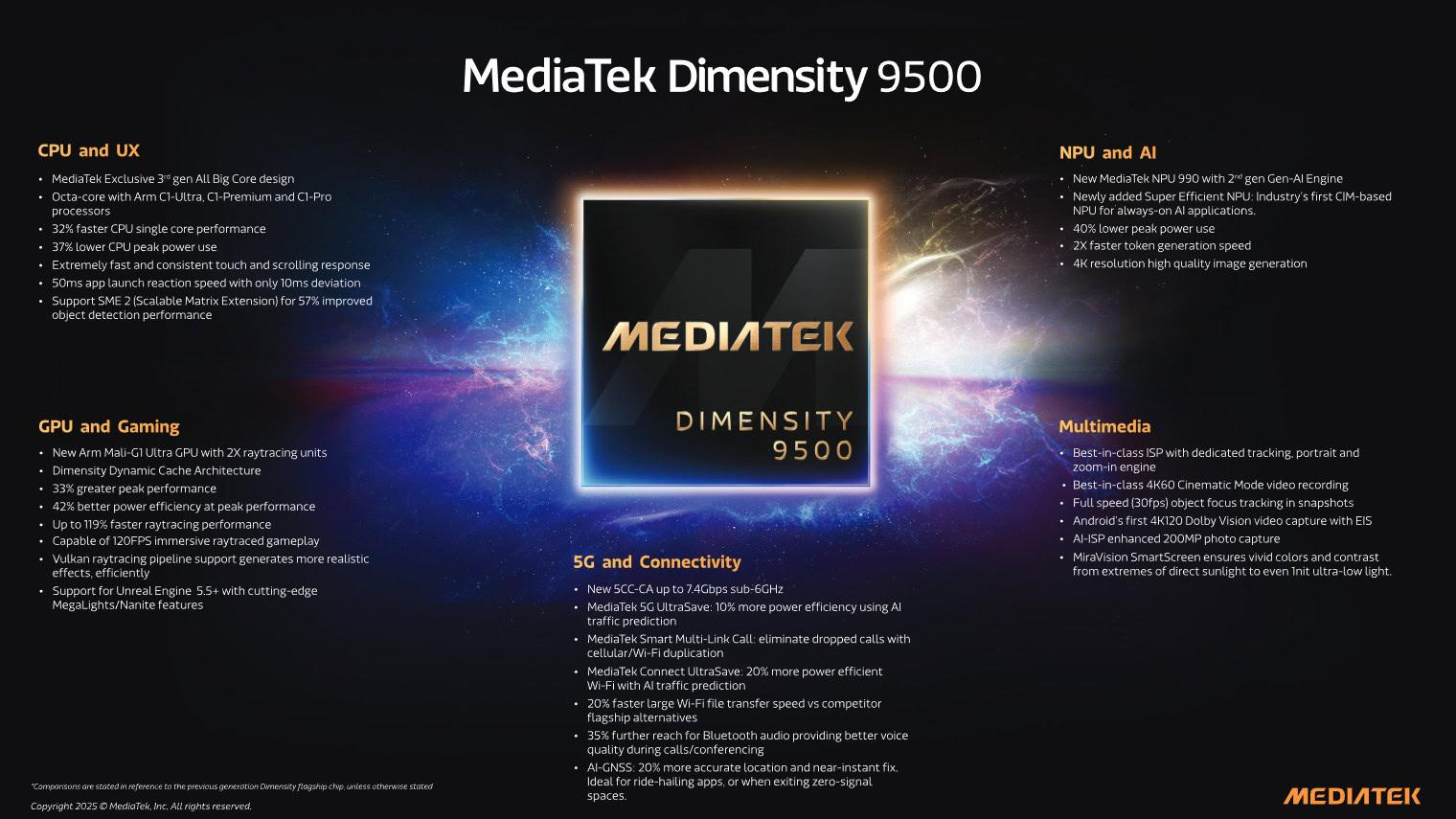
MediaTek’s 2nm Moment Could Define the Next Android Flagship Cycle
The most important detail in the leak is the process node. The Dimensity 9600 is said to be fabricated on a 2nm process, though there is still uncertainty over whether that means TSMC’s N2P or Samsung’s SF2.
That distinction matters because process technology directly affects performance, efficiency, thermals, and sustained workloads. A move to 2nm would give MediaTek more room to increase peak CPU speeds, expand graphics performance, and improve AI-related compute without necessarily causing the same power and heat penalties that would be harder to control on an older node.
One earlier leak specifically claimed the Dimensity 9600 Pro would use TSMC’s N2P process. However, another report stopped short of confirming whether MediaTek would use TSMC or Samsung. Until MediaTek confirms the platform, the foundry question remains one of the biggest unknowns around the chip.
The CPU Strategy: All-Big-Core Design With a 2+3+3 Layout
The Dimensity 9600 is tipped to use a 2+3+3 all-big-core CPU architecture. That means MediaTek is expected to continue leaning into a performance-first design rather than relying heavily on traditional small efficiency cores.
According to the leaks, the configuration may include two high-performance super cores, three “Gelas-b” cores, and three standard “Gelas” cores. Another report referred to the upper-tier cores as two “Canyon” cores, paired with three “Gelas-B cores” and three “Gelas” cores.
The key takeaway is that MediaTek appears to be prioritizing peak and sustained performance across more cores, rather than reserving serious compute power for only one prime core. This approach is especially relevant for demanding Android workloads such as gaming, video processing, AI features, multitasking, emulation, and high-refresh-rate user interfaces.
Single-Core Gains Are the Headline — But Multi-Core May Matter More
The leak suggests the Dimensity 9600 is being tuned for top-tier single-core performance, with claims that it could rival Apple’s flagship A-series chips. The comparison, however, remains unclear. The leak did not confirm whether the benchmark target is Apple’s current A19 Pro or the next-generation Apple A20.
That uncertainty is important. Apple’s A-series chips have historically been especially strong in single-core performance, which affects app responsiveness, browser speed, interface fluidity, and burst tasks. If MediaTek can close that gap, it would mark a notable shift for Android flagship phones.
Early benchmark estimates for the Dimensity 9600 Pro suggest Geekbench 6 single-core scores of around 4,200 to 4,300 and multi-core scores of around 12,000 to 12,500. Digital Chat Station reportedly noted that these are early estimates based on engineering samples, so they may not reflect final retail performance.
For context, the previous generation’s official figures were claimed to be around 4,000 for single-core and 11,000 for multi-core. On paper, that would make the Dimensity 9600 Pro a meaningful step forward, though not necessarily a dramatic generational leap in every metric.
The 5GHz Question
Another eye-catching detail is the reported clock speed. The Dimensity 9600 Pro has previously been tipped to reach 5GHz, with both super cores running close to that mark.
A 5GHz mobile CPU would be a major headline, but clock speed alone does not define real-world performance. Sustained speed, thermal behavior, app optimization, memory bandwidth, cache design, and power limits all matter. A phone chip can hit impressive peak frequencies in short bursts, but flagship users increasingly care about how long that performance can be maintained during gaming, recording, editing, navigation, and AI-assisted tasks.
The leaks also suggest there may not be major cache adjustments. That means MediaTek may be relying more heavily on architecture, process-node gains, instruction improvements, and clock speed rather than a large cache expansion to drive performance.
CME and SME Upgrades Point to AI and Compute Efficiency
Beyond raw CPU figures, the Dimensity 9600 is said to bring enhanced Compute Matrix Engine, or CME, and Scalable Matrix Extension, or SME, capabilities. One leak suggested CME/SME capabilities could potentially double compared with the previous generation.
This matters because modern phone chips are no longer judged only by CPU and GPU benchmarks. Matrix acceleration is increasingly important for AI, computational photography, image enhancement, voice processing, translation, generative features, and machine-learning workloads running directly on the device.
Another leak specifically mentioned support for SME2 instructions, promising faster AI performance and machine-learning efficiency. If accurate, the Dimensity 9600 series could be positioned not only as a gaming and benchmark chip, but also as a stronger foundation for on-device AI features in premium Android phones.
The GPU Leak May Be the Bigger Story
While the CPU figures will attract attention, the GPU claims may be even more strategically important. The Dimensity 9600 is tipped to feature a next-generation Arm GPU referred to in leaks as “Magni” or “Magin,” with the graphics block said to be larger than rival 2nm chipsets.
The leak claims MediaTek may have an advantage against competing 2nm chips through native frame interpolation, resolution upscaling, improved ray-tracing performance, and better overall rendering efficiency.
That combination points directly at premium mobile gaming. Frame interpolation can make games appear smoother by generating additional frames between rendered frames. Resolution upscaling can allow a game to render internally at a lower resolution and then reconstruct a sharper image, helping balance visual quality and performance. Ray tracing, meanwhile, can improve lighting, reflections, and shadows, though it remains demanding even for high-end mobile hardware.
If MediaTek executes well, the Dimensity 9600 could become one of the most important chips for Android gaming phones and performance-focused flagships.
Why Native Frame Interpolation and Upscaling Matter
The mention of native-level frame interpolation and super-resolution technologies is especially significant because mobile gaming is increasingly moving beyond simple frame-rate improvements. Chipmakers now want to deliver console-style visual features while keeping heat and battery drain under control.
For users, that could translate into smoother gameplay, sharper visuals, and better performance in demanding titles. For phone brands, it creates a marketing advantage: a flagship device can be sold not just as “fast,” but as capable of advanced rendering techniques that improve the gaming experience in visible ways.
The challenge is implementation. These features need strong developer support, reliable driver optimization, and careful thermal management. A powerful GPU on paper is only part of the story; the software ecosystem must also make use of it.
Qualcomm, Apple, Vivo, Oppo, and Xiaomi Are All Part of the Same Race
The Dimensity 9600 leak lands in a crowded and highly competitive flagship window.
The first Dimensity 9600-powered devices are expected to launch in September, the same timeframe when the first Snapdragon 8 Elite Gen 6 phones are also expected. Qualcomm is reportedly preparing both the Snapdragon 8 Elite Gen 6 and Snapdragon 8 Elite Gen 6 Pro, while Xiaomi’s 18 series is tipped to feature those chips around the same period.
On MediaTek’s side, the Vivo X500 series and Oppo Find X10 lineup have been mentioned as early candidates for the Dimensity 9600 series. One leak specifically suggested the Vivo X500 Pro series could debut in September, while the Oppo Find X10 Pro and Find X10 Pro Max are also said to feature the chipset. It remains unclear whether Oppo’s lineup would launch in September or follow an October timeline like the previous generation.
This sets up a familiar but high-stakes pattern: MediaTek, Qualcomm, and Apple all competing for the flagship performance narrative within the same launch season.
What Remains Unconfirmed
Despite the strong claims, several details remain unsettled.
MediaTek has not confirmed the Dimensity 9600, Dimensity 9600 Pro, final CPU core names, GPU branding, clock speeds, benchmark scores, cache configuration, manufacturing partner, or launch partners. The performance numbers are based on early leaks and engineering samples, which can change before commercial devices arrive.
There is also uncertainty over naming. Some reports refer to Dimensity 9600, while others mention Dimensity 9600 Pro. It is possible MediaTek could use multiple variants, but that remains unconfirmed.
The Apple comparison also needs caution. Saying the chip could rival Apple’s flagship A-series silicon is meaningful only when the target chip, test conditions, device cooling, benchmark version, and final retail hardware are known.
The Bigger Implication: MediaTek Is No Longer Just Chasing
The Dimensity 9600 leaks reinforce a broader shift in the Android silicon market. MediaTek is no longer being framed merely as an alternative to Qualcomm in high-end devices. It is increasingly being positioned as a direct flagship competitor with aggressive CPU architecture, advanced GPU features, and AI-focused compute improvements.
If the leaked claims hold, the Dimensity 9600 series could give Android manufacturers a powerful platform for premium phones and tablets in late 2026. That would benefit brands such as Vivo and Oppo, which could use the chip to differentiate their flagship devices against Snapdragon-based competitors.
For consumers, the practical result could be faster phones, stronger gaming performance, better AI features, and more competition among flagship Android devices. For the industry, it could intensify pressure on Qualcomm and Apple to keep raising performance and efficiency standards.
Conclusion: A Leak That Signals a Serious Flagship Fight
The Dimensity 9600 is still unofficial, but the latest leaks suggest MediaTek is preparing one of its most ambitious mobile chips yet. A 2nm process, 2+3+3 all-big-core CPU design, possible 5GHz-class clock speeds, improved CME/SME capabilities, and a next-generation GPU with native frame interpolation, upscaling, and improved ray tracing all point to a chipset designed for the very top of the Android market.
The biggest questions now are whether the final silicon can sustain those gains in real devices, how it compares against Snapdragon 8 Elite Gen 6 phones, and whether its GPU features translate into visible improvements for users.
If the September launch window proves accurate, the next flagship Android cycle could become one of the most competitive in years — and MediaTek may be entering it with more than enough performance to challenge the traditional leaders.


