


Sony a7R VI: The High-Resolution Camera That Challenges Sony’s Own Flagship
Sony’s new a7R VI arrives with a clear message: high-resolution cameras no longer have to be slow, specialized tools reserved only for landscape, studio, or commercial photographers. With a 66.8-megapixel fully stacked full-frame sensor, 30 fps shooting, 8K video, advanced AI autofocus, and a launch price around $4,499.99, the camera pushes Sony’s R-series into territory once dominated by the company’s flagship Alpha bodies.
This is not simply another resolution upgrade. The Sony a7R VI appears to redefine what an R-series camera is supposed to be: not just a detail machine, but a fast, hybrid, professional workhorse aimed at portrait, wedding, wildlife, sports, editorial, commercial, and video shooters alike.
A Resolution Camera Built for Speed
The heart of the Sony a7R VI is its newly developed 66.8MP back-illuminated fully stacked Exmor RS sensor. That matters because stacked sensors are designed to read data much faster than conventional sensors, reducing rolling shutter and making electronic shutter shooting far more practical.
The previous a7R V was already respected for image quality, but its slower sensor readout limited the usefulness of its electronic shutter in motion-heavy scenes or under lighting conditions where banding could become a problem. The a7R VI directly addresses that weakness with a sensor architecture said to deliver 5.6x faster readout than the previous model.
That change transforms the camera’s identity. Instead of being a high-resolution camera that can occasionally shoot action, the a7R VI becomes a high-resolution camera designed to compete in fast-paced environments.
The Flagship Question: Why the a7R VI Matters Against the a1 II
The a7R VI’s most disruptive feature may not be one individual specification, but its positioning. At about $4,499.99, it undercuts the Sony a1 II, which sits near $6,500, by roughly $2,000 while delivering higher resolution and several performance advantages that matter to many photographers.
The a7R VI can shoot 14-bit lossless RAW files at 30 frames per second, while the a1 II reaches 30 fps only with lossy RAW; for 14-bit lossless RAW, the a1 II is capped at 20 fps. That distinction is important for photographers who want both maximum burst speed and maximum image quality.
Sony also positions the new model as offering “the highest resolution and continuous shooting performance in the Alpha series,” a notable statement for a camera that is not officially the company’s top flagship.
Autofocus Gets Smarter, Wider, and Better in Low Light
The a7R VI’s autofocus system is built around Real-time Recognition AF+, supported by the BIONZ XR2 processor with an integrated AI processing unit. The camera offers 759 phase-detection points covering 94% of the frame, compared with 92% coverage on the a1 II.
Low-light autofocus is another major leap. The a7R VI can focus down to -6 EV in standard operation and down to -11 EV with Bright Monitoring enabled. That gives it a meaningful advantage over the a1 II’s quoted -4 EV performance and makes it especially relevant for events, concerts, receptions, night scenes, and astrophotography-style work.
The AI recognition system can identify humans, animals, birds, insects, cars, trains, and airplanes, while improving tracking stability in crowded scenes and maintaining focus when subjects are partially obscured. For photographers working in real-world situations where subjects move unpredictably, that matters more than headline megapixel counts alone.
Video: A Serious Hybrid Upgrade
Although the a7R VI is clearly built around still photography, Sony has given it a video feature set that makes it a serious hybrid camera.
The camera records:
8K at 30 fps,
4K at 60 fps,
4K at 120 fps,
and 10-bit 4:2:2 internal video.
In full-frame mode, the camera captures 8K from 8.2K oversampling, while 4K recording is supported from 5.0K oversampling. Sony also adds a new Dual Gain Shooting mode, designed to improve shadow detail and tonal gradation in video, although it comes with restrictions: it works only in 4K at 30p or lower, with ISO limits depending on the profile used.
For audio, the a7R VI can support 32-bit float 4-channel recording, but only when paired with Sony’s new XLR-A4 adapter. That makes the feature powerful, but accessory-dependent.
Stabilization, Battery Life, and Body Improvements
Sony has also revised the camera’s stabilization system. The a7R VI offers up to 8.5 stops of in-body image stabilization at the center of the frame and up to 7 stops at the periphery. The system also improves roll-direction compensation, which is particularly useful for handheld video.
The camera introduces Sony’s new NP-SA100 battery, rated at 2,670 mAh, replacing the older NP-FZ100 system used across many Alpha bodies. Battery life is listed at approximately 710 shots using the LCD and 600 shots using the EVF, up from the a7R V’s 530 and 440 figures.
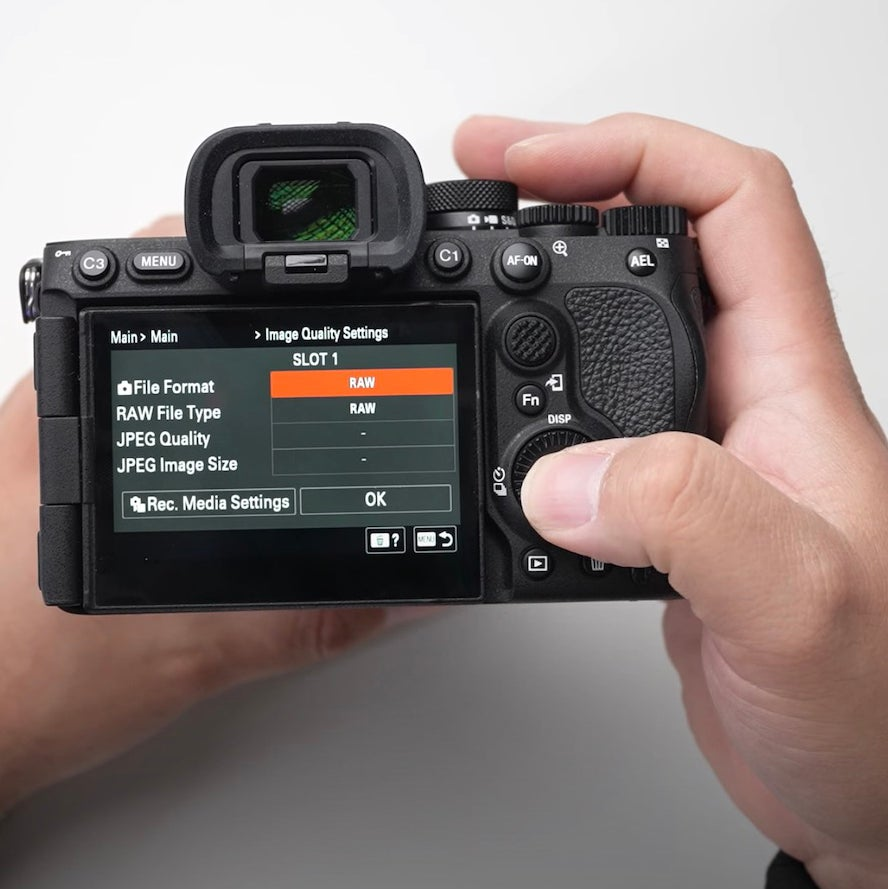
The body is made from magnesium alloy, includes a deeper grip, illuminated rear buttons, a front tally lamp, dual USB-C ports, full-size HDMI, headphone and microphone jacks, a PC sync socket, Wi-Fi 6E support, and two card slots compatible with CFexpress Type A and UHS-II SD cards.
Where the a1 II Still Has the Advantage
Despite the a7R VI’s impressive value proposition, the a1 II still holds several advantages.
The a1 II offers a faster electronic shutter speed of 1/32000, while the a7R VI tops out at 1/8000. The a1 II also has stronger flash flexibility, including electronic shutter flash sync, while the a7R VI does not support flash with the electronic shutter.
The a1 II also performs up to 120 autofocus and exposure calculations per second, compared with the a7R VI’s 60. For elite sports, wildlife, and high-speed professional work, that difference may still matter.
Its body layout also remains more control-heavy, with dedicated dials and buttons that some professionals prefer. In other words, the a7R VI may challenge the flagship on paper, but it does not replace every flagship workflow.
A Bigger Shift in Sony’s Camera Strategy
The larger implication is that Sony is collapsing the traditional gap between resolution cameras and speed cameras. The a7R line once represented detail-first shooting; the a1 line represented speed-first performance. The a7R VI blurs that separation.
For photographers, that could simplify buying decisions. A portrait shooter can now get speed. A wedding photographer can get resolution. A wildlife shooter can get crop flexibility and 30 fps bursts. A commercial creator can get high-end stills and 8K video in one body.
For Sony’s competitors, the pressure is clear. A fast, stacked, high-resolution full-frame camera at this price point challenges not only Canon and Nikon, but also medium-format systems aimed at photographers who prioritize detail above all else.
Conclusion: The a7R VI Is More Than a Megapixel Upgrade
The Sony a7R VI is significant because it changes expectations. It is not merely a successor to the a7R V, and it is not simply a cheaper alternative to the a1 II. It represents a new kind of high-resolution camera: fast enough for action, detailed enough for commercial work, capable enough for hybrid production, and priced aggressively enough to make Sony’s own flagship harder to justify for many users.
Its limitations are real: flash performance, maximum electronic shutter speed, and flagship-level control layout still leave room for the a1 II. But for the majority of photographers and hybrid creators, the a7R VI looks like one of Sony’s most consequential Alpha releases yet.


