

Flyers Close Season Strong as Michkov Shines Against Canadiens
A Statement Finish in Philadelphia
The final stretch of the NHL regular season often reveals as much about a team’s future as it does about its present. On April 14, 2026, the Philadelphia Flyers delivered a performance that underscored both—closing out their campaign with a 4–2 victory over the Montreal Canadiens in Philadelphia.
The result was more than just another win. It confirmed Montreal’s third-place finish in the Atlantic Division while showcasing Philadelphia’s emerging talent, led by a standout performance from Matvei Michkov.
The Stakes: Playoff Positioning and Momentum
For Montreal, the game carried tangible implications. Entering the matchup, the Canadiens needed a regulation win to overtake the Tampa Bay Lightning for second place in the division and secure home-ice advantage in the first round of the playoffs.
Instead, the loss locked them into third place, setting up a postseason meeting with Tampa Bay. Despite the defeat, the Canadiens’ late-season form—highlighted by a six-game road winning streak prior to this game—suggests they remain a competitive playoff force.
Philadelphia, meanwhile, had already secured third place in the Metropolitan Division. With playoff positioning settled, the focus shifted toward maintaining rhythm and evaluating depth players. The Flyers responded with a composed and energetic performance, extending their winning streak to three games.
Michkov’s Influence: A Star in Acceleration
At the center of the Flyers’ victory was Matvei Michkov, whose impact continues to expand with each game. The 21-year-old forward recorded a goal and two assists, driving the offensive tempo and dictating key moments.
His performance reflects a broader trend. Since the 2026 Winter Olympics, Michkov has accumulated 22 points in just 26 games, signaling a significant leap in consistency and effectiveness.
Philadelphia’s coaching staff has emphasized his development not only in skill execution but also in tactical understanding. As head coach Rick Tocchet noted, improved communication and adaptation have helped Michkov translate raw talent into reliable production.
By season’s end, Michkov reached the 20-goal milestone—marking back-to-back 20-goal seasons to begin his NHL career, a feat not seen in Philadelphia since Simon Gagné in the early 2000s.
Game Flow: Flyers Capitalize Early and Late
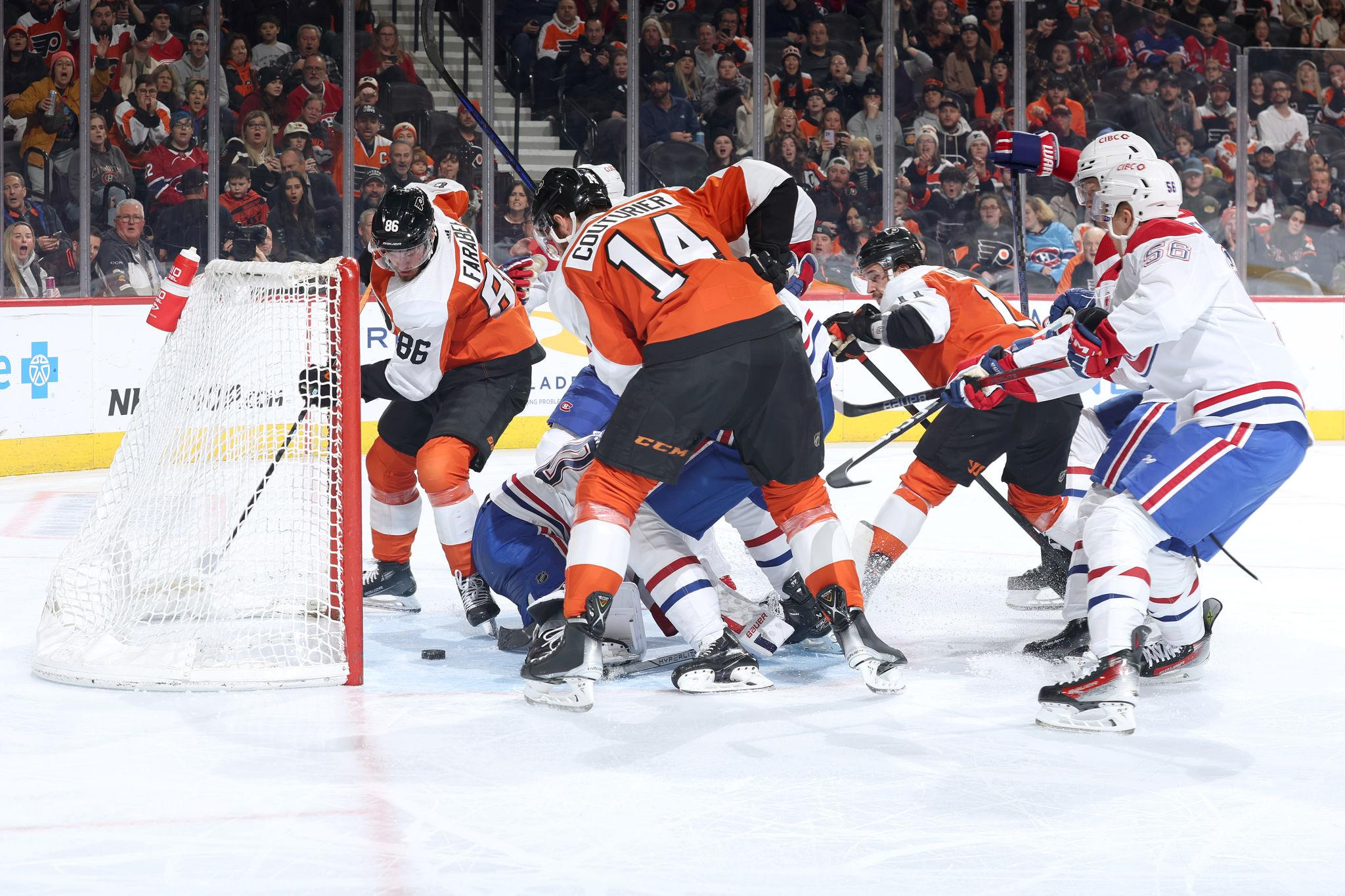
Philadelphia established control early in the first period. Porter Martone opened the scoring by deflecting a Michkov shot past the Canadiens’ goaltender. Minutes later, defenseman Oliver Bonk doubled the lead, scoring in his NHL debut—an immediate contribution that energized both team and crowd.
Montreal responded in the second period through Brendan Gallagher, who cut the deficit to 2–1. However, Michkov quickly restored the two-goal cushion with a well-timed finish in front of the net.
The Canadiens pushed back again late in the period, with Jake Evans narrowing the score to 3–2. But the Flyers sealed the outcome in the third period when Alex Bump capitalized on a defensive turnover to make it 4–2—a decisive insurance goal.
Emerging Talent Defines Philadelphia’s Identity
While Michkov drew the headlines, the game also highlighted the Flyers’ broader youth movement. Bonk’s debut goal and assist placed him among a select group of defensemen to record multi-point performances in their first NHL game.
Martone continued his impressive form as well, extending a six-game point streak that included nine total points.
These contributions are not incidental. Philadelphia deliberately rested several key players, including Trevor Zegras and Travis Konecny, yet still produced a cohesive and effective performance.
The implication is clear: depth is becoming a defining strength for the Flyers, particularly as they prepare for a first-round playoff series against the Pittsburgh Penguins.
Canadiens: Competitive but Marginally Short
Despite the loss, Montreal demonstrated offensive intent throughout the game. Captain Nick Suzuki reflected positively on the overall effort, noting that the team generated chances but fell short due to small defensive lapses.
Statistically, the Canadiens remained active in attack. Cole Caufield recorded 10 shots on goal—matching his career single-game high—while Jakub Dobes made 21 saves in net.
However, the inability to convert key opportunities and contain Philadelphia’s transitional play proved decisive.
What This Result Signals Ahead of the Playoffs
From a strategic perspective, the game offers two distinct narratives:
- Philadelphia Flyers: Enter the playoffs with momentum, depth, and a rapidly developing star in Michkov. Their ability to integrate young players without compromising performance suggests structural resilience.
- Montreal Canadiens: Maintain a solid foundation but must address execution inconsistencies. Their playoff matchup against Tampa Bay will likely hinge on defensive discipline and conversion efficiency.
The result—confirmed as a 4–2 Flyers win —may not alter standings dramatically, but it provides a clear snapshot of each team’s readiness for postseason hockey.
Conclusion: A Glimpse of the League’s Next Phase
The Canadiens vs Flyers matchup was not just a regular-season finale; it was an indicator of transition within the NHL. Established teams like Montreal continue to compete at a high level, but emerging talents—led by players such as Matvei Michkov—are beginning to redefine competitive dynamics.
Philadelphia’s victory reflects more than a single game outcome. It signals a shift toward youth-driven performance, where development pipelines and adaptability may determine playoff success as much as experience.


