Cape Town Floods Push Emergency Services to the Brink as South African Weather Service Warns of Ongoing Risks
The Western Cape is facing one of its most destructive flood emergencies in recent years as relentless storms, rising river systems, and severe rainfall continue to devastate communities across Cape Town and surrounding districts. With the South African Weather Service repeatedly warning of dangerous weather conditions, authorities are now grappling with mounting fatalities, large-scale displacement, and extensive infrastructure damage.
From flooded wine estates in the Cape Winelands to emergency rooftop rescues near Worcester and Rawsonville, the disaster has exposed the growing vulnerability of South Africa’s coastal and agricultural regions to extreme weather events.
The crisis has already claimed at least 10 lives, displaced more than 2,000 people, and left emergency response teams operating around the clock as swollen rivers threaten further destruction.


Severe Storm System Leaves Thousands Displaced
The latest wave of storms swept across the Western Cape after days of intense rainfall saturated river catchments and overwhelmed drainage systems. Communities in the Cape Winelands, West Coast, and low-lying agricultural zones were among the hardest hit.
Western Cape Minister for Local Government, Environmental Affairs and Development Planning Anton Bredell confirmed that emergency operations remain at a “critical level” despite temporary improvements in weather conditions.


“The Provincial Department of Health and Wellness has confirmed 10 fatalities across the province related to the recent severe weather conditions,” Bredell said.
Authorities say more than 2,000 residents have been displaced in the Cape Winelands district alone, while additional evacuations continue across multiple municipalities. Temporary shelters have been established as humanitarian organizations distribute blankets, food parcels, and hygiene supplies to affected families.
Emergency workers have also been racing to restore damaged infrastructure and reconnect electricity in flood-stricken areas, though ongoing water levels and inaccessible roads continue to hamper progress.
Breede River Floods Swallow Wine Farms
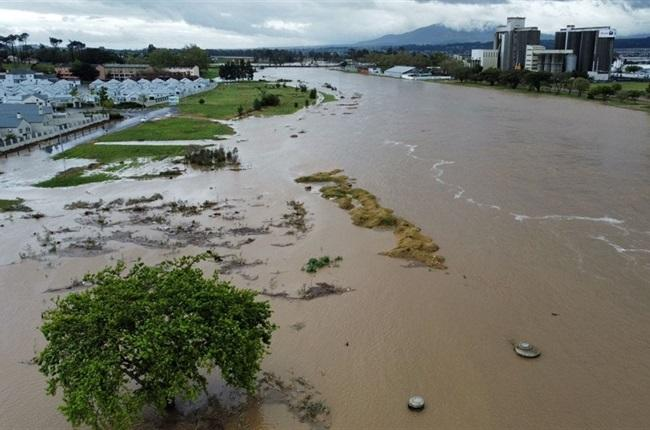
One of the most dramatic scenes unfolded along the Breede River, where historic flooding submerged some of South Africa’s most recognized wine estates.


Aerial footage from the disaster showed vineyards, farm roads, and buildings underwater as riverbanks burst under the force of fast-moving floodwaters.
Among the affected properties were Springfield Wine Estate, Van Loveren Wines, and De Wetshof Estate, all located in key wine-producing regions of the Western Cape.
The scale of the flooding has raised serious concerns for South Africa’s wine industry, which plays a major role in the country’s agricultural exports and tourism economy. Flood damage to vineyards, irrigation systems, roads, and storage infrastructure could have long-term financial consequences for producers already navigating economic pressures and climate uncertainty.
The floods also disrupted transport routes used for agricultural logistics, increasing fears about supply chain interruptions in affected farming communities.
South African Weather Service Warnings Become Reality
The South African Weather Service had issued severe weather alerts as the storm system intensified across the province, warning residents about heavy rainfall, flash flooding, and dangerous river conditions.
Those warnings proved accurate as river systems rapidly exceeded safe levels.
Officials confirmed that the Clanwilliam Dam rose above full capacity at 103%, forcing authorities to open all sluices while downstream communities were placed under close monitoring.
At the same time, the Breede River recorded flow volumes of 1,655 cubic metres per second near Swellendam, creating what authorities described as a “significant risk” for downstream flooding.
Emergency services repeatedly urged residents to avoid flooded roads, rivers, and low-water crossings, warning that even shallow floodwaters could become deadly.
The disaster has once again highlighted the crucial role played by the South African Weather Service in forecasting severe weather events and coordinating early warning systems for municipalities and disaster management agencies.
Rooftop Rescues Reveal Human Toll
As water levels rose rapidly, rescue crews were forced into dangerous operations to evacuate stranded residents.
The National Sea Rescue Institute (NSRI) confirmed dramatic evacuations involving children, elderly residents, and a paraplegic man. Rescue teams used inflatable boats, ladders, and emergency equipment to reach people trapped on rooftops and isolated properties.
In some farming areas between Worcester and Rawsonville, entire families were cut off by floodwaters overnight.
The scenes reflected the growing intensity of extreme weather emergencies facing South Africa’s emergency responders, who increasingly confront large-scale flooding events tied to climate variability and infrastructure vulnerability.
Cape Town and the Western Cape Face Growing Climate Pressure
Although winter storms are common in the Western Cape, recent years have seen increasingly erratic and destructive weather patterns.
Climate scientists have repeatedly warned that rising global temperatures may intensify rainfall extremes in some regions, even as drought conditions worsen elsewhere. The Western Cape itself has experienced both devastating droughts and severe floods within the past decade.
Urban expansion, aging stormwater systems, informal settlements located in flood-prone areas, and environmental degradation have further increased exposure to flood disasters.
The latest flooding crisis demonstrates how quickly weather emergencies can evolve into humanitarian and economic disasters when infrastructure systems become overwhelmed.
For many communities, recovery may take months.
Recovery Operations Begin Amid Continued Risk
Despite some improvement in weather conditions, authorities say the danger has not fully passed.
Disaster management teams remain deployed across the province while engineers assess damaged roads, bridges, electrical systems, and water infrastructure. Health facilities continue operating under contingency plans in areas where flooding disrupted access.
Provincial officials say all spheres of government remain fully mobilized as rescue and recovery efforts continue.
“The Western Cape Government extends its sincerest condolences to the families who have lost loved ones during the recent storms,” Bredell said.
For thousands of displaced residents, however, the immediate priority remains shelter, safety, and rebuilding after one of the province’s most destructive flood events in recent memory.
As river systems slowly stabilize and cleanup operations begin, attention is increasingly turning toward long-term resilience planning — including flood defenses, climate adaptation measures, and improved emergency preparedness.
The Cape Town floods have become more than a weather story. They are now a stark reminder of the growing pressure extreme climate events are placing on South Africa’s infrastructure, economy, and communities.