Fitbit Air: Google’s Screenless Tracker Enters the Wearable Wars With a Stephen Curry Twist
Google’s newest Fitbit device is not trying to be another smartwatch. The Fitbit Air arrives as something more focused: a lightweight, screenless health and fitness tracker designed for people who want continuous wellness data without another glowing display on their wrist.
- A Small Tracker With a Big Strategic Purpose
- What Fitbit Air Tracks
- Battery Life and Charging
- The Stephen Curry Edition: Performance Band or Marketing Premium?
- Bands Built Around Lifestyle, Not Just Exercise
- Google Health Becomes the Real Interface
- Automatic Workouts and the Challenge of Accuracy
- A Companion to Pixel Watch, Not a Replacement
- Google Health APIs Could Be the Bigger Story
- How Fitbit Air Compares With Whoop
- The Market Signal: Less Screen, More Health
- What Comes Next
- Why Fitbit Air Matters
Priced at $99.99, the Fitbit Air is positioned as a more affordable and less complicated alternative in the growing market for screenless wearables. It tracks sleep, heart rate, activity, workouts and health signals while pushing the deeper interpretation of that data into the redesigned Google Health app. It is compatible with both Android and iOS, available for preorder, and set to reach shelves in the U.S. on May 26.
But the version drawing the most attention is the Google Fitbit Air Special Edition, co-designed with NBA star Stephen Curry. At $129.99, it adds a more performance-focused band design with Curry branding, a water-resistant coating, raised interior print for increased airflow, and a distinctive orange-and-grey style aimed at users who want a tracker that can move from workout sessions to everyday wear.


A Small Tracker With a Big Strategic Purpose
The Fitbit Air marks a notable shift in Google’s wearable strategy. Rather than competing directly with full smartwatches such as the Pixel Watch, the device leans into a different use case: all-day and all-night tracking without screens, notifications, apps or constant wrist interaction.
Google describes Fitbit Air as its smallest tracker yet, built around a tiny internal “pebble” that sits inside interchangeable bands. The screenless design is central to the product’s identity. Instead of checking metrics on the device itself, users review insights through the Google Health app when they choose. That makes the Air less of a mini-computer and more of a passive health sensor designed to disappear into daily life.


That approach also reflects a wider market trend. Wearables are no longer defined only by smartwatches. Devices like Whoop, Oura, Polar Loop and other recovery-focused products have helped popularize screenless tracking for users who care about sleep, strain, readiness and recovery but do not necessarily want another display.
Fitbit Air enters that space with one major differentiator: it does not require a subscription for its core features. A Google Health Premium option exists, but the device itself is sold as a $99 tracker with essential health and fitness functions available without an ongoing monthly fee.
What Fitbit Air Tracks
Despite its minimal design, Fitbit Air carries a broad set of sensors and health features. The supplied details describe it as functionally similar to a Fitbit Charge 6 without the display, meaning many of Fitbit’s established tracking capabilities move into a smaller, screenless form factor.
Key tracking features include:


- 24/7 heart rate monitoring
- Heart rhythm monitoring with Afib alerts
- SpO2 monitoring
- Resting heart rate
- Heart rate variability
- Sleep stages and sleep duration
- Steps and daily activity
- Automatic workout and exercise detection
- Training load, also referred to as Cardio Load
- Daily Readiness
- Skin temperature sensing
- Smart wake alarms, regular alarms and low-battery alerts via vibration
The device uses an optical heart rate monitor, red and infrared sensors for SpO2, a skin temperature sensor, a 3-axis accelerometer and a gyroscope. It also includes a small LED for battery and pairing status.
There is no built-in GPS, which means outdoor route tracking depends on a paired phone through connected GPS. That will matter for runners and cyclists who want location data without carrying a phone. For general daily activity, gym sessions, sleep and recovery tracking, however, the absence of a display and onboard GPS helps keep the device small and lightweight.
Battery Life and Charging
Battery life is one of the Fitbit Air’s strongest practical claims. Google says the tracker can last up to a week on a charge. A quick charge of five minutes provides about one day of use, while a full recharge takes around 90 minutes.
Those numbers place the Air in a useful middle ground. It does not appear to match the longest-lasting screenless wearables on the market, but it offers far more endurance than many smartwatches and is likely to appeal to people who dislike charging a wearable every night.
The device is also rated water resistant to 50 meters, making it suitable for swimming and sweat-heavy workouts.
The Stephen Curry Edition: Performance Band or Marketing Premium?
The Stephen Curry edition is not a different tracker internally. The core “pebble” remains the same across Fitbit Air models. The difference is in the band.
Google’s official wording describes the special edition this way:
“We teamed up with 4-time NBA champion Stephen Curry to design our Google Fitbit Air Special Edition. It blends peak performance with elevated style to inspire unmatched confidence in every arena. With a water resistant design, raised interior print for increased airflow, and signature Stephen Curry design details, this band transitions smoothly from your toughest workout to your most stylish event.”
The band features a raised interior liner intended to improve airflow and dry more quickly, making it especially relevant for intense workouts. It also includes Stephen Curry design details, including a wordmark and “#LockIn” on the inside.
The visual appeal is also part of the pitch. The orange-and-grey colorway stands apart from the more restrained standard options and gives the special edition a sportier identity.
Still, the $30 price increase creates a clear buyer question: is the airflow-focused band worth it, or is it mainly a celebrity-branded upgrade? For users planning to wear Fitbit Air during high-intensity training, the material and interior design may offer practical value. For casual users, the standard version may be enough.
Bands Built Around Lifestyle, Not Just Exercise
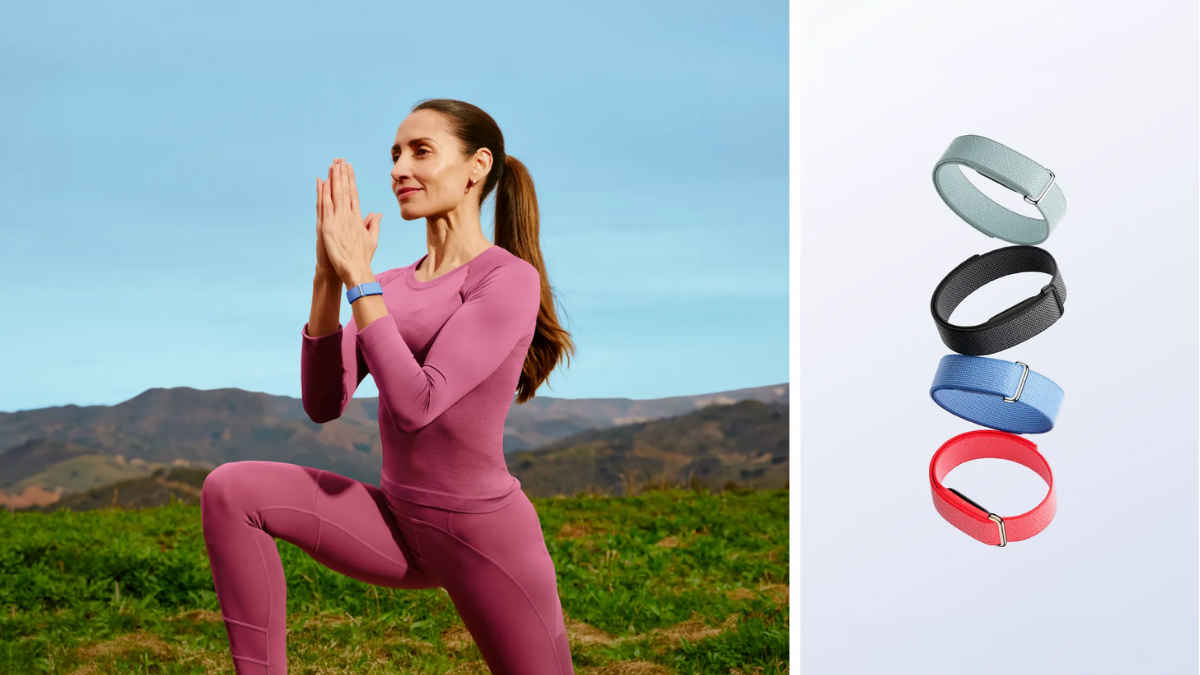
Fitbit Air’s modular design gives Google room to position the device as both fitness technology and fashion accessory. The pebble can be popped out and moved between different bands, allowing users to change the look depending on workout, workday or evening plans.
Google lists three main band categories:
Performance Loop Band
Made from recycled materials, this band is micro-adjustable and designed for a flexible, breathable fit. It comes standard with every Fitbit Air.
Active Band
A sweatproof and wetproof silicone band intended for high-intensity training and outdoor use.
Elevated Modern Band
A more discreet and stylish option meant to make the tracker look less like a fitness device and more like a bracelet.
Accessory bands start at $34.99, while launch colorways include options such as Obsidian, Fog, Lavender and Berry.
The only notable omission in the supplied material is the absence of a bicep band at launch. That could matter because screenless trackers often appeal to users who want flexibility beyond wrist wear, especially during workouts or when wearing traditional watches.
Google Health Becomes the Real Interface
Because Fitbit Air has no screen, the companion app becomes central to the product. Google is using the launch to push the renamed Google Health app, previously known as the Fitbit app. Fitbit Premium is also being repositioned as Google Health Premium, priced at $9.99 per month or $99 per year.
The app update is designed around health interpretation rather than simple metric display. It organizes data across major areas such as daily activity, fitness, sleep and health, while emphasizing personalization and AI-powered coaching.
Google says Fitbit Air was built to unlock the full power of the Google Health Coach, which provides personal health insights and recommendations. The device includes a three-month trial of Google Health Premium, giving buyers access to premium coaching features out of the box.
This is where Fitbit Air becomes more than hardware. The tracker collects the signals; Google Health interprets them. That matters because the future of consumer wearables is increasingly about analysis rather than raw data. Users already know their steps, heart rate and sleep time. The bigger challenge is explaining what those numbers mean and what to do next.
Automatic Workouts and the Challenge of Accuracy
Fitbit Air can detect and track common activities automatically, then send a recap after the workout. Google says the automatic detection gets better over time and becomes personalized to the user. Workouts can also be started from the app, logged manually, or followed through coach-recommended guided sessions.
This feature is important because screenless wearables succeed or fail on automation. Without a display, users are less likely to manually start every workout on the device itself. The more accurately the Air can detect walking, running, cycling, swimming and other common activities, the more invisible and useful it becomes.
However, automatic detection remains one of the hardest problems in wearable fitness tracking. A device must recognize when a workout begins, classify the activity correctly, track the right metrics and stop at the right time. If it misses sessions or mislabels them, users may lose trust in the system.
That makes Fitbit Air’s real-world performance especially important. On paper, the hardware and software look promising. In practice, the value will depend on how reliably the device captures activity without asking the user to intervene.
A Companion to Pixel Watch, Not a Replacement
One of the most practical ideas behind Fitbit Air is device pairing within Google’s ecosystem. Users can wear a Pixel Watch during the day and switch to the Fitbit Air for sleep, allowing them to avoid wearing a bulkier smartwatch overnight while still collecting recovery and sleep data.
The supplied information also notes that Fitbit Air can be used concurrently with a Pixel Watch at launch, with Google/Fitbit automatically pulling in the correct data and de-duplicating it. Support for other Fitbit devices is expected to expand later.
This is a smart positioning move. Fitbit Air does not need to replace the smartwatch. Instead, it can fill the gaps where smartwatches are less comfortable: sleep, long-duration passive tracking, or days when users want to wear a traditional watch.
For iPhone users, compatibility with iOS also gives Fitbit Air a route into households that may not use Pixel Watch at all. The bigger question is how seamlessly Google Health can integrate data from other devices and platforms over time.
Google Health APIs Could Be the Bigger Story
Beyond the hardware, one of the more significant developments is Google’s broader health data strategy. The supplied information notes that Google is expanding ways for data to flow into Google Health, including through Health Connect and revamped Google Health APIs.
The goal is to make Google Health useful with data from multiple sources, potentially including devices outside Fitbit’s own ecosystem. That could turn the app into a broader health and fitness hub rather than a Fitbit-only dashboard.
If Google can make third-party workouts, sleep data, heart rate variability and recovery metrics feel like “first-class” inputs inside Google Health, Fitbit Air becomes part of a much larger platform play. It would allow users to wear one device for sleep, another for workouts and still receive a unified view of their health.
That is a difficult promise to execute, especially across Android, iOS, Apple Watch, Garmin, Polar and other platforms. But it is strategically important. The winner in health wearables may not simply be the company with the best wrist sensor, but the one that best organizes data from everywhere.
How Fitbit Air Compares With Whoop
The Fitbit Air will inevitably be compared with Whoop because both are screenless wearables focused on continuous tracking. But the two products appear to target different users.
Whoop has traditionally been associated with serious athletes, recovery tracking and subscription-based coaching. Fitbit Air, by contrast, is priced for a broader audience and offers core functions without requiring a subscription.
Fitbit Air lacks some hardware features that high-end users may want, including onboard GPS. But at $99.99, it is positioned as a mass-market alternative for people who want sleep, activity, recovery and heart data without paying for a premium athletic platform.
That could make Fitbit Air especially attractive to casual fitness users, wellness-focused buyers, smartwatch owners who dislike sleep tracking with a bulky device, and people who want a low-profile tracker that does not constantly demand attention.
The Market Signal: Less Screen, More Health
Fitbit Air’s biggest cultural statement may be its screenless design. In a world saturated with notifications, many consumers are becoming more selective about which devices deserve their attention. A tracker that collects health data quietly, without buzzing constantly or showing apps, fits that shift.
It also reflects a maturing wearable market. Early fitness trackers were about steps. Smartwatches then expanded the category into notifications, apps and wrist-based computing. Now, screenless devices are bringing attention back to passive health monitoring, sleep quality and recovery.
Fitbit Air sits at the intersection of those trends. It is not nostalgic, but it does feel like a return to Fitbit’s original simplicity: wear it, move, sleep, check your progress later.
What Comes Next
The Fitbit Air’s long-term success will depend on three major factors.
First, the tracker must prove accurate. Heart rate, sleep, recovery and activity metrics need to be reliable enough for users to trust the recommendations.
Second, Google Health must avoid becoming too complicated. AI-driven coaching can be powerful, but users may tune out if the app becomes too wordy or difficult to customize.
Third, Google needs to grow the band ecosystem. More band styles, lower-cost third-party options and alternate wearing methods could make the Air more versatile.
If those pieces come together, Fitbit Air could become one of Google’s most approachable wearable products: affordable, lightweight, stylish and quietly useful.
Why Fitbit Air Matters
Fitbit Air is not just another fitness tracker. It is a statement about where Google wants wearable health technology to go: smaller hardware, deeper software, broader data integration and more personalized coaching.
The Stephen Curry edition adds celebrity style and workout-focused design, but the bigger story is the product category itself. Google is betting that many users do not need another screen. They need a comfortable sensor, a reliable app and clear guidance about their health.
At $99.99, Fitbit Air brings that idea to a wider audience. At $129.99, the Stephen Curry Special Edition adds a performance-minded option for users who want a more distinctive band. Together, they give Google a new way to compete in the screenless wearable market — not by replacing the smartwatch, but by giving people a quieter, lighter and potentially more practical way to track their lives.