


Spotify’s New Verification System Signals a Turning Point in the Fight Against AI Music
Artificial intelligence has already transformed the music industry, from AI-assisted mastering tools to fully synthetic artists capable of releasing songs, building fanbases, and even generating viral hits without a human musician ever stepping into a studio. Now, Spotify is taking one of its clearest positions yet in the debate over authenticity in digital music.
The streaming giant has officially launched a new “Verified by Spotify” system designed to distinguish human artists from AI-generated personas and automated music creators. The move comes as listeners, musicians, labels, and industry watchdogs increasingly question how streaming platforms should handle the explosion of AI-generated music flooding online catalogs.
Spotify says the new initiative is intended to improve “authenticity and trust for the artists behind the music,” while giving listeners more context about the people they are discovering on the platform.
The decision represents more than a simple verification badge. It signals a broader shift in how streaming platforms may define legitimacy, credibility, and artistic identity in the AI era.
A Green Checkmark With Major Implications
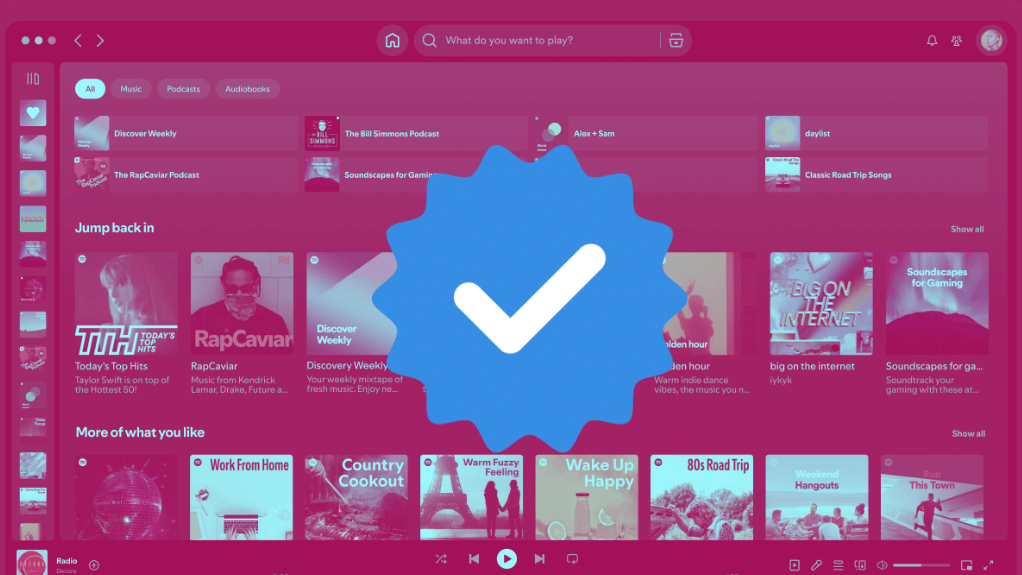
The centerpiece of Spotify’s rollout is a new light green checkmark labeled “Verified by Spotify.” The badge will begin appearing on artist profiles and next to artist names in search results over the coming weeks.
To qualify, artists must meet several requirements:
- Consistent listener activity and engagement over time
- Compliance with Spotify’s platform policies
- Evidence of a real-world artist presence, including concerts, merchandise, and linked social media accounts
Spotify emphasized that the system is designed to verify “real artists behaving in good faith,” combining automated checks with “human review and judgment.”
Most notably, AI-generated artists and AI-persona profiles are not currently eligible for verification.
Spotify acknowledged that “the concept of artist authenticity is complex and quickly evolving” and said its approach may continue to change over time.
That caveat matters because modern music creation increasingly exists in a gray area. Many artists already use AI tools for production, mixing, vocal enhancement, or songwriting assistance. Spotify’s new system is therefore not necessarily judging whether AI tools were used in the creative process, but whether there is a verifiable human artist behind the profile.
Why Spotify Is Making This Move Now
Spotify’s verification rollout arrives after years of mounting criticism surrounding AI-generated music on streaming platforms.
In recent years, users and artists have repeatedly called on Spotify to introduce clearer labeling systems for synthetic music. Community forum posts demanded “clear labels for AI-generated songs” and questioned why subscribers should continue paying full price if streaming catalogs became overwhelmed by automated content.
One particularly controversial case involved a group called The Velvet Sundown, which amassed hundreds of thousands of monthly listeners despite allegations that the band and its music were AI-generated. According to reports, the project had no interviews, no public live performances, and little evidence of real-world activity before later identifying itself as a “synthetic music project… with the support of artificial intelligence.”
At the same time, generative AI technology has advanced rapidly. AI systems can now create convincing vocals, instrumentals, and entire musical arrangements in seconds. That capability has created both excitement and fear within the entertainment industry.
Major labels and artists have raised concerns about copyright abuse, deepfake songs, and the erosion of opportunities for human musicians. Sony reportedly removed more than 135,000 AI-generated deepfakes of artists’ music from streaming services earlier this year.
Spotify’s latest initiative appears to be an attempt to reassure listeners that real human artistry still matters on the platform.
More Than Just Verification
Alongside the badge system, Spotify is also introducing a new beta feature that expands artist profile information.
The new profile section will showcase:
- Career milestones
- Release activity
- Touring history
- Other artist activity data
These details will appear in the About section of artist profiles on mobile devices and can also be accessed through the verification banner.
Spotify compares the feature to “nutrition facts” for music, offering listeners a quick snapshot of an artist’s activity and credibility.
Importantly, this additional information will appear across all artist profiles, regardless of whether an artist is verified.
The company says the goal is to help listeners “better understand and connect with the artist beyond the music.”
Spotify Says 99% of Popularly Searched Artists Will Be Verified
Spotify claims that more than 99% of the artists users actively search for will be verified at launch.
That figure includes “hundreds of thousands of artists,” many of them independent musicians spanning different genres, regions, and career stages.
However, Spotify also acknowledged that verification will be rolled out gradually because the platform hosts millions of artist profiles. The company noted that the absence of a badge does not necessarily mean an artist is fake or ineligible.
The platform says it will prioritize artists with:
- Active fan interest
- Cultural or historical significance
- Established engagement over time
At the same time, Spotify openly stated it will deprioritize “functional music creators and content farms whose content is primarily designed for passive or background listening.”
That distinction may prove controversial because it suggests Spotify is moving toward a more editorial role in deciding what constitutes meaningful artistry.
Critics Warn the System May Exclude Smaller Artists
While many listeners welcomed the new verification system, critics argue the policy could unintentionally disadvantage emerging independent musicians.
Ed Newton-Rex, a campaigner for creators’ rights and former AI executive, warned that Spotify’s approach could “punish real human artists who don’t have some of the markers the verification is based on,” such as touring schedules or merchandise sales.
Music scholars and industry analysts have also questioned whether streaming platforms should act as gatekeepers of artistic legitimacy.
Tiffany Naiman, director of Music Industry Programs at UCLA, described the change as a major cultural shift.
“This move reflects a repositioning toward something closer to an editorial and authenticating authority, a role historically held by labels, tastemakers and curators,” she said. “When a streaming platform starts deciding who qualifies as a legitimate artist … That’s not a technical question. It’s a cultural and economic one.”
Others point out that verification does not necessarily prove music was created without AI assistance. An artist could still use AI tools extensively while maintaining a legitimate human identity.
Professor Nick Collins of Durham University noted that AI involvement in music creation is rarely binary.
“AI usage is not a binary position between ‘entirely authentically handmade’ and ‘fully AI generated’ but can have lots of in-between cases,” he said.
That complexity highlights one of the biggest challenges facing streaming platforms: defining authenticity in an industry where AI is becoming deeply embedded in creative workflows.
Spotify’s Approach Differs From Rivals
Spotify’s verification-first strategy contrasts with approaches taken by some competitors.
Apple Music recently introduced “Transparency Tags” designed to help flag AI-generated music more directly. Other technology companies, including YouTube, TikTok, and Meta, have also moved toward labeling AI content in various forms.
Rather than focusing entirely on identifying synthetic music, Spotify appears to be emphasizing human identity verification instead.
Supporters argue this may ultimately be easier and more reliable than trying to detect AI-generated audio itself, especially as generative systems become increasingly sophisticated.
Spotify also framed the rollout as part of a broader transparency initiative that already includes features such as:
- SongDNA
- Expanded song credits
- About the Song
- AI credits
Together, these tools aim to give users more information about how music is created and who is behind it.
The Beginning of a Larger Industry Shift
Spotify admits the system is imperfect and says it will continue evolving over time.
But the launch may represent the beginning of a much larger transformation across digital entertainment.
As AI-generated media becomes harder to distinguish from human-created work, platforms may increasingly rely on identity verification systems rather than content analysis alone. Similar debates are already unfolding in journalism, visual art, film, publishing, and social media.
For the music industry, the stakes are especially high. Streaming services are no longer just distributors of music — they are becoming arbiters of trust, authenticity, and cultural legitimacy.
Spotify’s new badge system may not solve every issue surrounding AI music, but it clearly signals where the industry is heading: toward a future where proving there is a real human behind the art may become just as important as the art itself.


