


Luis Enrique and the Making of a Relentless PSG Machine
Paris Saint-Germain’s latest Champions League night in Munich was not only about survival. It was about identity, control under pressure, and the growing legend of Luis Enrique.
At the Allianz Arena, PSG drew 1-1 with Bayern Munich, advancing 6-5 on aggregate and booking a Champions League final against Arsenal. Ousmane Dembélé struck after just three minutes, Harry Kane equalized deep into stoppage time, but Bayern’s late surge came too late. For Luis Enrique, the result carried a deeper meaning: a second consecutive Champions League final with PSG and another major step toward turning the Parisian club from an ambitious powerhouse into a European reference point.
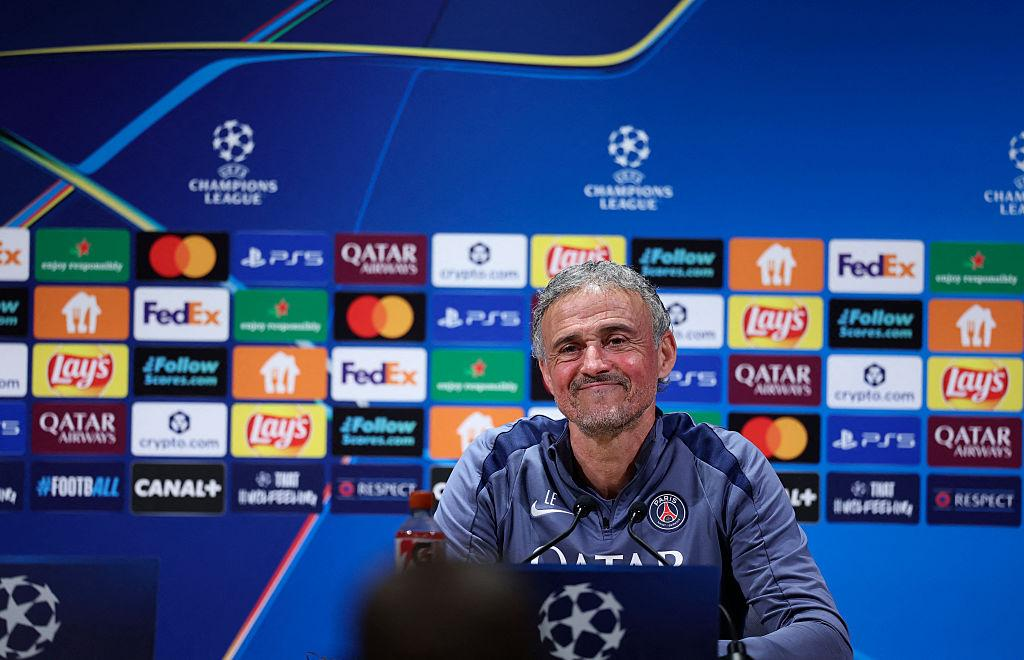
Munich, Again: The City Where PSG Found Its European Soul
Munich has become a symbolic place in Luis Enrique’s PSG story. Less than a year earlier, PSG lifted their first Champions League trophy there after a 5-0 victory over Inter Milan. Now, back at the Allianz Arena, the same club returned not as hopeful outsiders, but as defending champions protecting their status.
The match was shaped by the tension of a European heavyweight clash. Bayern, coached by Vincent Kompany, had the ball, the crowd, and the urgency. PSG had the advantage, the counterattack, and the emotional confidence of a team that already knew what it meant to win this competition.
The French side did not need long to strike. Khvicha Kvaratskhelia broke Bayern’s structure early, accelerated into space, and supplied Dembélé, who finished with the precision of a forward who understood the moment. It was 0-1 after three minutes, and PSG’s aggregate cushion grew immediately.
The Luis Enrique Method: Attack, Suffer, Adapt
Luis Enrique’s reputation has often been tied to possession, pressing, and proactive football. Yet this PSG performance showed another dimension: the capacity to suffer.
After the match, the coach captured the emotional and tactical contradiction of the night with one of his clearest lines: “We’re not used to defending, but we did it like angels.”
That sentence explains much of PSG’s evolution under him. This was not a team simply trying to dominate every phase through the ball. It was a team mature enough to defend its box, absorb Bayern’s pressure, and choose its attacking moments carefully.
Bayern finished the game pushing hard. Kane’s stoppage-time goal made the final minutes tense, but PSG had already done enough. The French side resisted through defensive discipline, goalkeeper interventions, and a collective commitment that Luis Enrique has repeatedly presented as central to the team’s identity.
Willian Pacho, later praised as a standout defensive figure, underlined that balance: “Our mentality of defending as a group is what defines us. The attackers help us defend and we help them attack; that is what makes the difference compared to other teams.”
Kvaratskhelia, Dembélé and the New PSG Star System
For years, PSG’s European story was dominated by individual celebrity. Under Luis Enrique, the star system looks different. Talent still decides matches, but the collective framework gives that talent purpose.
Kvaratskhelia was central to PSG’s attacking threat in Munich. He created the early goal, repeatedly unsettled Bayern’s back line, and became the outlet through which PSG could escape pressure. The supplied information notes that five of PSG’s eight attacking incursions at one stage passed through him, while he had won five of eight duels, completed three of four dribbles, made four recoveries, registered two shots, delivered nine passes in the final third, and assisted Dembélé’s goal.
Dembélé, meanwhile, delivered the decisive first-half blow. His movement at the penalty spot and instant finish reflected a player carrying both confidence and responsibility. His early goal did not merely put PSG ahead on the night; it forced Bayern into a match script that suited the visitors.
Even when Dembélé was later withdrawn for Bradley Barcola, PSG’s structure remained intact. That is one of Luis Enrique’s major achievements: the team no longer depends only on one player’s brilliance. It has automatisms, roles, and a competitive rhythm that can survive substitutions and momentum swings.
Bayern’s Frustration and the Tactical Battle
Bayern were far from passive. Kompany’s side had possession, pressure, and several moments of danger. Harry Kane, Michael Olise, Jamal Musiala and Luis Díaz all carried attacking responsibility, while Joshua Kimmich increasingly tried to command the late push.
But PSG’s defensive plan disrupted Bayern’s rhythm. One key detail from the match was that Bayern were kept without a shot on target in the first half of a home game for the first time in any competition since April 2022 against Augsburg in the Bundesliga.
That statistic is a strong reflection of Luis Enrique’s tactical success. Bayern had possession, but PSG controlled danger. Bayern had territory, but PSG often controlled the type of chances allowed.
Manuel Neuer’s post-match assessment was blunt: “I think today we lacked that killer instinct in attack, but in the end we did have chances to win the match.” He added that PSG had been “simply lethal” in the first leg, when they scored five goals.
Al-Khelaïfi’s Public Backing: “The Best Coach in the World”
If the match confirmed Luis Enrique’s influence on the pitch, Nasser Al-Khelaïfi’s comments confirmed his authority inside PSG.
The PSG president described the coach in glowing terms: “Luis Enrique is a revolution in football, not only at PSG, but in the history of football with what he has done and is doing: his ideas and what he believes in, he truly is the best coach in the world. Signing him as coach is one of the best, if not the best, decisions I have made in the last 15 years at the club.”
He went further, calling him “a fantastic coach, the best in the world” and praising how he manages “the day-to-day operations of the club, the players, the media, everything.”
Those remarks matter because PSG has often been viewed as a club where coaches had to manage pressure from above, dressing-room hierarchy, and public expectations. Under Luis Enrique, the balance appears different. The club’s president is not simply celebrating results; he is endorsing a project.
A Coach on the Edge of European Immortality
Luis Enrique’s Champions League record is becoming one of the defining parts of his managerial legacy. The supplied information notes that he reached 50 Champions League victories faster than any coach in history, requiring only 77 matches and surpassing Pep Guardiola’s previous mark of 80. It also places him ahead of names such as Zinedine Zidane, Diego Simeone and José Mourinho in that race to 50 wins.
The Munich result also sends him to his third Champions League final after 2015 with Barcelona, 2025 with PSG, and now 2026 with PSG. If he wins the final in Budapest on May 30, he would claim a personal Champions League hat-trick and join the select group of coaches with three or more European Cups: Carlo Ancelotti, Bob Paisley, Zinedine Zidane and Pep Guardiola.
That is the scale of what is now at stake. Luis Enrique is no longer only the coach who once led Barcelona to continental glory. He is building a second great European chapter in Paris.
PSG vs Arsenal: A Final With Spanish Minds on the Touchline
The final against Arsenal brings another layer of intrigue. PSG will face Mikel Arteta’s side in what the provided information describes as a first-time Champions League final pairing between the two clubs. It is also presented as the first final in the competition’s history featuring two Spanish coaches from clubs who had not previously met at this stage.
Luis Enrique spoke warmly about Arteta: “I have a lot of affection for Arteta. We were teammates when he was young. Now he’s built a great team, but we know exactly what we want to achieve.”
That line captures the emotional and competitive nature of the final. There is respect, but no ambiguity. PSG know their target: defend the Champions League crown and confirm that last season’s triumph was not a one-off peak.
The Wider Meaning of Luis Enrique’s PSG
The significance of Luis Enrique’s work is not only tactical. It is cultural.
PSG have long chased European legitimacy. Money, stars and domestic dominance brought attention, but the Champions League demanded something else: resilience, identity and repeatability. Under Luis Enrique, PSG have begun to look like a club with a stable competitive language.
Their run of nine Champions League matches without defeat, described as their best sequence since a 13-match stretch between October 2012 and November 2013, points to a team moving closer to historic consistency.
The club also appealed to supporters after qualification, urging celebration with restraint: “This immense joy must be celebrated with pride and respect. True to the club’s values. Tonight, Paris is proud. Paris is united.”
That message reflected the scale of the moment. PSG are no longer celebrating only qualification; they are managing the responsibilities that come with being a European champion.
Conclusion: Luis Enrique’s Paris Project Enters Its Defining Night
Luis Enrique’s PSG are one match from turning a breakthrough into a dynasty. The 1-1 draw in Munich was not beautiful in the traditional sense, but it was revealing. PSG pressed, scored early, absorbed pressure, defended collectively, and survived the emotional storm of a Bayern comeback attempt.
For Luis Enrique, it was another proof of concept. His team can dazzle, but it can also endure. It can attack through Kvaratskhelia and Dembélé, but it can also defend through Pacho, Marquinhos, Nuno Mendes and a midfield willing to sacrifice.
Now Arsenal await in Budapest. The final will test PSG’s ability to repeat greatness, and it will test Luis Enrique’s claim to a place among the finest Champions League managers of the modern era.
What began as a reconstruction in Paris has become something larger: a team with conviction, a coach with full institutional backing, and a club standing at the edge of another historic European night.


