

Dalton Rushing: The Dodgers Prospect Forcing a Bigger Conversation
A Breakout Moment That Demanded Attention
For much of the early 2026 MLB season, Dalton Rushing existed on the periphery of the Los Angeles Dodgers’ stacked roster—a highly regarded prospect waiting for meaningful opportunities. That changed abruptly on April 16, 2026.
With Shohei Ohtani removed from the batting lineup due to a shoulder injury, the Dodgers needed a temporary solution at designated hitter. What followed was not just a solid fill-in performance—it was a statement.
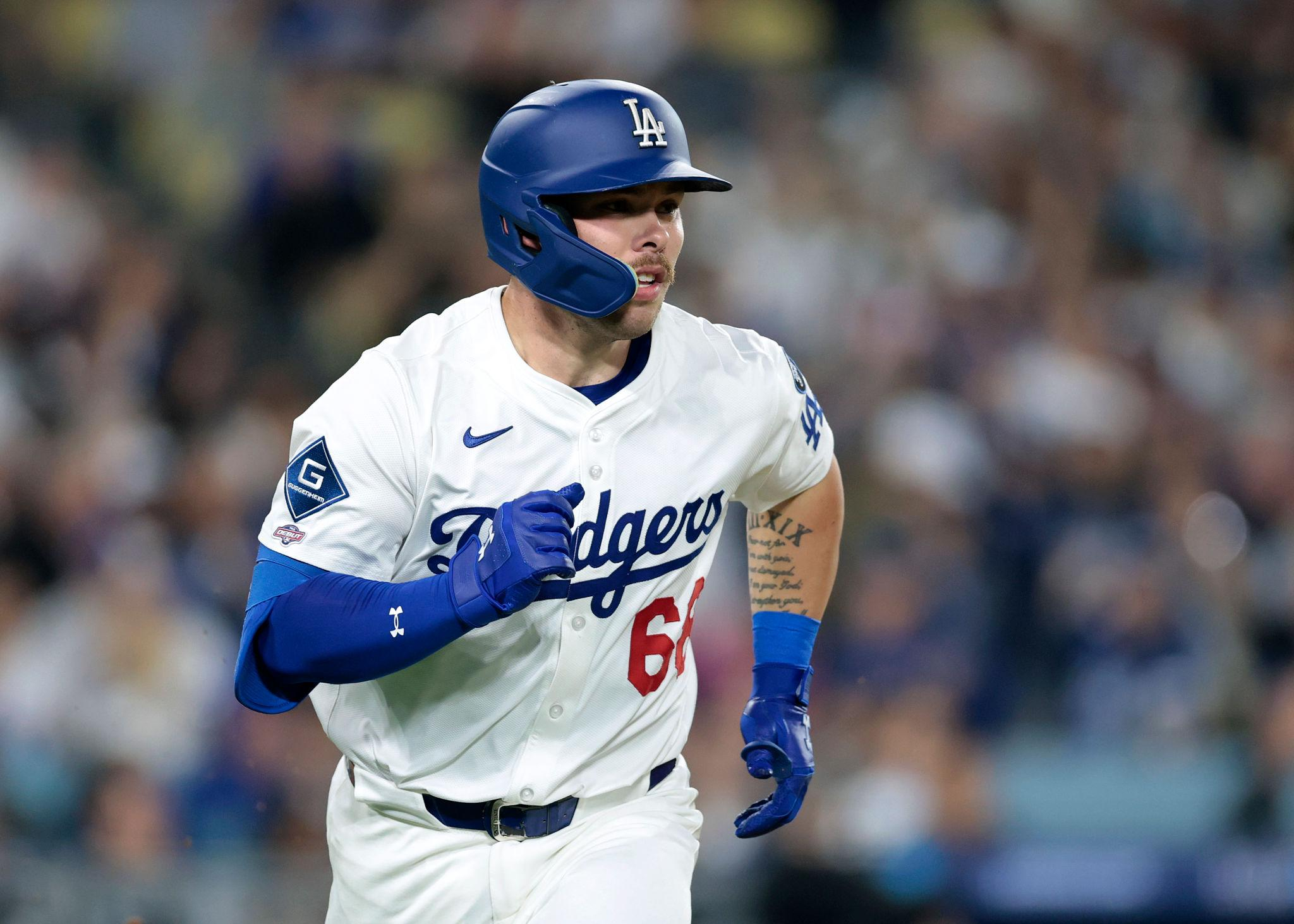
Rushing delivered a decisive grand slam in the eighth inning during an 8–2 win over the New York Mets, turning what had been a competitive game into a rout. The performance was not an isolated flash. It was the culmination of a quietly dominant stretch that is now forcing the Dodgers—and the wider baseball community—to reconsider his role.
When Opportunity Meets Preparation
Rushing’s emergence is best understood through context. The Dodgers are a team defined by depth and star power, making consistent playing time difficult for emerging players.
Behind established catcher Will Smith, who signed a 10-year, $140 million contract in 2024, Rushing’s pathway to regular starts has been constrained. Attempts to diversify his defensive profile—such as time in left field or potential use at first base—have not significantly altered that reality.
Yet when an opening appeared, Rushing capitalized with precision.
In the April 16 matchup:
- He went 2-for-4, including a grand slam and a double
- He drove in four runs, accounting for half of the Dodgers’ total output
- He continued a remarkable early-season run, now hitting 9-for-17 (.529) with four home runs, eight RBIs, and seven runs scored across limited appearances
This level of production is not typical for a reserve player. It is the profile of a hitter demanding more consistent involvement.
The Ohtani Factor: Filling an Unfillable Role
Replacing Shohei Ohtani, even temporarily, is a task few players can realistically handle. Ohtani’s dual-threat dominance as both pitcher and hitter makes him a singular presence in modern baseball.
On this occasion, however, Rushing did more than simply hold the line.
After the game, Ohtani’s reaction was understated but telling:
“We had a really good DH today.”
That comment, brief as it was, carried weight. It signaled internal recognition that Rushing’s contribution was not merely adequate—it was impactful.
Ohtani himself had delivered a strong pitching performance, striking out 10 batters over six innings, but the offensive narrative belonged to Rushing.
A Prospect With No Clear Lane
The paradox surrounding Dalton Rushing is straightforward: his performance suggests readiness, but the roster limits his opportunities.
The Dodgers’ structure presents multiple barriers:
- Catcher: Blocked by Will Smith
- First base: Occupied by Freddie Freeman, who rarely misses games
- Designated hitter: Typically reserved for Ohtani when not pitching
As a result, Rushing’s appearances have been sporadic—just five games at this stage of the season. Yet his output within that limited window has been disproportionately high.
This mismatch between performance and opportunity is now central to the Dodgers’ internal decision-making.
The Strategic Crossroads: Development vs. Deployment
Recent roster moves have intensified speculation about Rushing’s future within the organization.
The Dodgers’ decision to adjust their roster—designating Anthony Banda for assignment and claiming catcher Ben Rortvedt—may appear routine on the surface. However, the ripple effects have been significant.
The discussion has shifted toward two primary scenarios:
- Developmental Path
- Return Rushing to Triple-A for regular playing time
- Prioritize long-term growth and positional refinement
- Transactional Path
- Use Rushing as a high-value trade asset
- Address immediate roster needs through external acquisition
Interest from teams such as the Boston Red Sox has reportedly amplified the second possibility, transforming Rushing from a developmental prospect into a strategic asset.
This is not merely a player decision—it is a philosophical one. It reflects how the Dodgers balance present competitiveness with future sustainability.
Performance Trends That Are Hard to Ignore
Rushing’s early 2026 statistics provide a compelling case for increased involvement:
- Batting Average: .529
- Home Runs: 4
- RBIs: 8
- Runs Scored: 7
All of this production has come within a minimal sample size, but the underlying trend is clear: efficiency and power.
Notably, he has already matched his home run total from the previous season, suggesting a tangible leap in offensive capability.
For a team that prioritizes run production and lineup depth, these numbers are difficult to dismiss.
The Broader Implications for the Dodgers
Rushing’s emergence arrives at a critical juncture in the Dodgers’ season.
With Ohtani managing a shoulder injury and the team navigating a demanding schedule—including upcoming series against the Colorado Rockies, San Francisco Giants, and Chicago Cubs—the need for reliable offensive contributors is immediate.
His performance provides the Dodgers with:
- Lineup flexibility when Ohtani is pitching
- Depth insurance in case of injuries
- A potential power bat off the bench
More importantly, it introduces a new variable into the team’s strategic planning.
If Rushing continues at this pace, the question is no longer whether he deserves playing time—it becomes where that playing time can be found.
What Comes Next?
The Dodgers face a series of decisions that will shape not only Rushing’s trajectory but also the team’s roster construction.
Possible outcomes include:
- Increased rotation into the DH role when Ohtani pitches
- Spot starts at catcher to relieve Will Smith
- Continued evaluation in a hybrid utility role
- Inclusion in trade discussions as a high-value prospect
Each path carries trade-offs. Increased playing time may accelerate development but disrupt established roles. A trade could yield immediate benefits but sacrifice long-term upside.
Conclusion: From Prospect to Pressure Point
Dalton Rushing’s rise is no longer a minor subplot within the Dodgers’ season. It is a central narrative.
His grand slam against the Mets was more than a highlight—it was a catalyst. It forced a reevaluation of his place within a roster already filled with elite talent.
The Dodgers now face a familiar but complex dilemma: how to integrate emerging talent without destabilizing a championship-caliber structure.
Rushing has done his part. He has performed when given the chance, produced at an elite level, and demonstrated adaptability across roles.
The next move belongs to the organization.


