

Business Under Pressure: How Regulation Is Reshaping the Modern Enterprise
Introduction: A New Era of Complexity
Business today is no longer defined solely by markets, customers, and competition. Increasingly, it is shaped by a powerful and often unpredictable force: regulation. Across industries and geographies, companies are navigating an expanding web of laws, compliance requirements, and administrative procedures that directly influence how they operate, grow, and innovate.
In South Africa, this trend has become particularly pronounced. Businesses are confronting a rapidly evolving regulatory environment that is transforming compliance from a back-office function into a central strategic concern. At the same time, global data shows that this is not an isolated phenomenon—companies worldwide are grappling with similar pressures.
This article examines how regulatory complexity is reshaping business operations, the challenges it creates, and the emerging strategies organisations are adopting to remain competitive.
The Expanding Regulatory Landscape
Over the past two decades, the regulatory environment affecting businesses has grown significantly. Companies must now comply with a broad range of requirements, including:
- Labour legislation
- Environmental compliance
- Procurement rules
- Financial reporting obligations
- Sector-specific regulations
Each of these areas carries its own set of rules, documentation requirements, and enforcement mechanisms. The cumulative effect is a substantial increase in compliance obligations that businesses must manage on a daily basis.
What makes this environment even more challenging is its constant evolution. New policies are introduced, existing legislation is amended, and municipal by-laws change regularly to address local governance needs. For businesses operating across multiple regions, this creates a fragmented system where requirements differ depending on location.
Compliance: From Legal Obligation to Strategic Challenge
Historically, compliance was primarily the responsibility of legal departments. Today, that model is no longer sufficient.
Compliance has evolved into a business-wide responsibility that affects multiple functions within an organisation—from executive leadership to operational teams.
As one industry perspective notes, compliance is no longer just a legal function; it is a management challenge that requires coordination across departments.
This shift reflects a deeper transformation in how businesses operate:
- Executives must align governance structures with regulatory demands
- Managers must translate laws into operational procedures
- Frontline teams must apply compliance rules in real time
Without clear access to accurate and up-to-date legal information, this process becomes inefficient and risky.
The Cost of Complexity
The impact of regulatory complexity extends far beyond administrative inconvenience. It has measurable consequences for business performance.
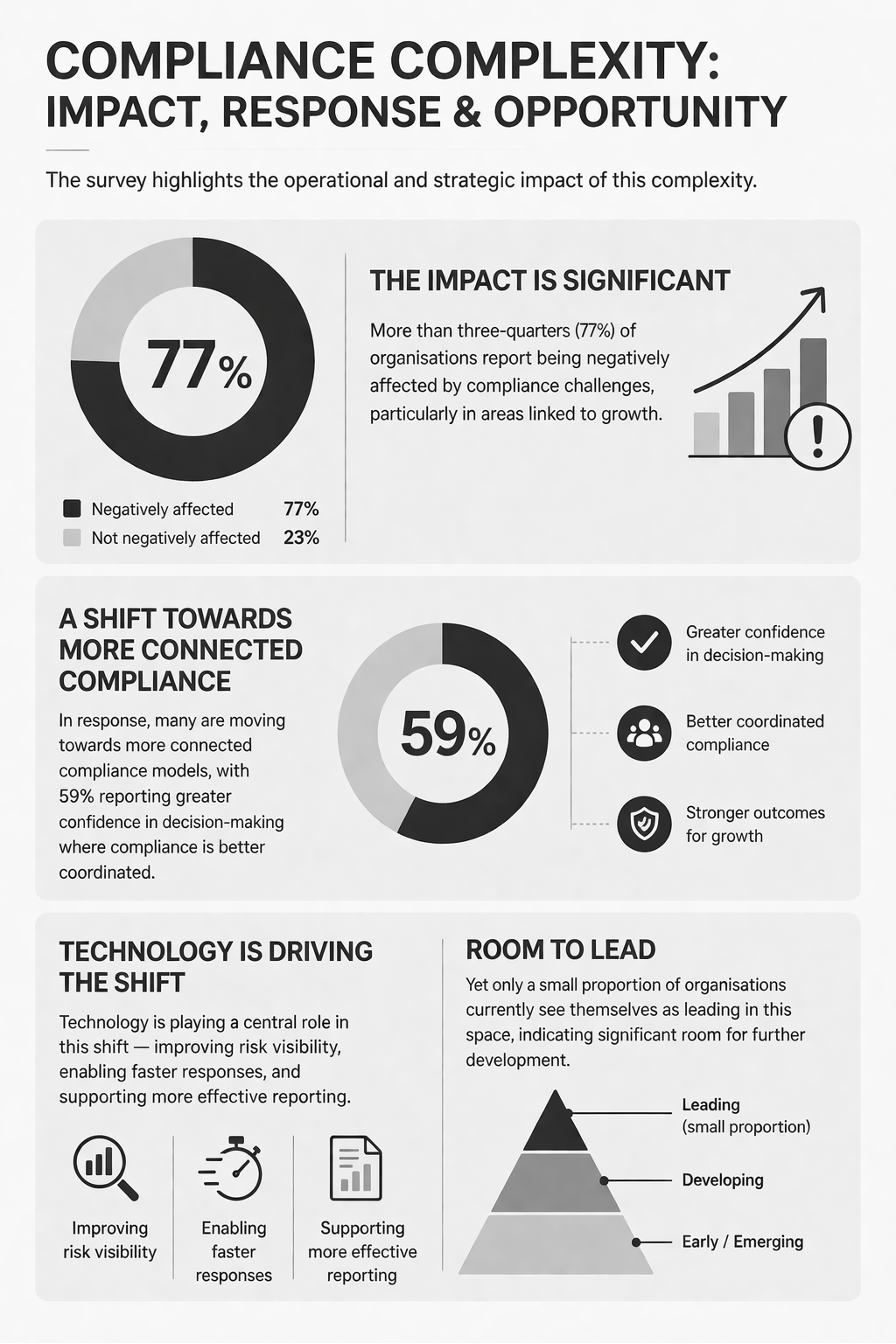
According to the 2025 PwC Global Compliance Survey:
- 85% of organisations reported increased compliance complexity over the past three years
- 77% said compliance challenges negatively affected key growth areas
These challenges manifest in several ways:
- Reduced capacity to launch new products and services
- Slower market expansion
- Increased operational costs
- Lower profitability
In many cases, compliance failures are not deliberate but result from difficulty accessing the right legal information or keeping pace with regulatory changes.
Small Businesses: Bearing the Heaviest Burden
While large corporations often have dedicated compliance teams, small and medium enterprises (SMEs) face a disproportionate burden.
As highlighted in national policy discussions, small businesses must contend with “a multitude of regulations, by-laws, licensing requirements and bureaucratic hurdles.”
These challenges include:
- Multiple licensing processes
- Inconsistent requirements across municipalities
- Lengthy approval timelines
- High administrative costs
Such barriers can discourage entrepreneurship and limit the growth potential of smaller firms, which are often key drivers of employment and innovation.
The Business Licensing Bill: Reform or Risk?
In response to these challenges, policymakers have proposed reforms aimed at simplifying the regulatory environment. One notable initiative is the Business Licensing Bill, which seeks to replace the Businesses Act of 1991.
Key Objectives of the Bill
The proposed legislation aims to:
- Introduce a unified national framework for business licensing
- Standardise application processes and requirements
- Establish a centralised digital licensing platform
- Improve transparency and consistency in decision-making
- Streamline enforcement mechanisms
If implemented effectively, these measures could reduce administrative burdens and improve predictability for businesses.
Criticism and Concerns
However, the proposal has also faced criticism. Some stakeholders argue that it may inadvertently increase bureaucracy rather than reduce it.
Concerns include:
- Duplication of existing regulatory processes
- Additional licensing requirements
- Greater administrative pressure on municipalities
Critics warn that adding more layers of regulation could harm the very businesses the reforms are intended to support, particularly SMEs.
Technology as a Strategic Response
As regulatory complexity increases, businesses are turning to technology as a critical tool for managing compliance.
The Rise of Digital Compliance Systems
Modern organisations are adopting digital platforms that:
- Integrate legal and regulatory information
- Provide real-time updates on legislative changes
- Enable efficient tracking and reporting
- Improve audit trails and data accuracy
These systems transform compliance from a reactive process into a proactive, data-driven discipline.
At industry events such as SAP HR Connect, business leaders emphasized that compliance is now “an always-on discipline” requiring continuous monitoring and adaptation.
The Role of Artificial Intelligence
Artificial intelligence is playing an increasingly important role in this transformation. Companies are leveraging AI to:
- Automate administrative processes
- Identify compliance risks more quickly
- Enhance decision-making through data insights
According to industry data, 82% of companies plan to increase investment in compliance technology, highlighting its growing importance.
Human Capital and Organisational Transformation
Regulatory complexity is not only a technological challenge—it is also a human one.
HR departments, for example, are facing increased administrative burdens due to:
- Changes in parental leave policies
- Proposed increases in severance pay
- New rules governing working conditions
These developments require organisations to rethink how they manage their workforce and allocate resources.
Digital transformation in HR is emerging as a key strategy, enabling companies to:
- Improve efficiency
- Reduce compliance risks
- Focus on talent development and organisational culture
As one executive noted, embedding compliance into systems allows HR teams to concentrate on long-term performance rather than administrative tasks.
From Burden to Opportunity
Despite its challenges, regulatory complexity also presents an opportunity for businesses to evolve.
Organisations that invest in:
- Structured legal information systems
- Integrated compliance frameworks
- Digital transformation initiatives
are better positioned to:
- Manage risk effectively
- Make informed strategic decisions
- Respond quickly to regulatory changes
In this context, compliance becomes not just a requirement but a competitive advantage.
Conclusion: The Future of Business in a Regulated World
The modern business environment is defined by complexity, and regulation is at the heart of that complexity. For companies in South Africa and beyond, navigating this landscape requires more than adherence to rules—it demands strategic thinking, technological innovation, and organisational agility.
While reforms such as the Business Licensing Bill aim to simplify the system, their success will depend on careful implementation and stakeholder alignment.
Ultimately, the businesses that thrive will be those that view compliance not as a constraint, but as an integral part of their strategy—leveraging it to build resilience, enhance efficiency, and drive sustainable growth in an increasingly regulated world.


