
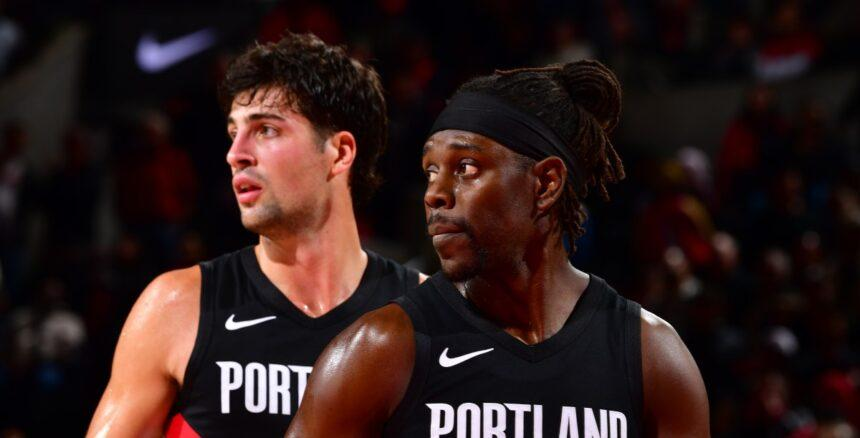
Deni Avdija’s Breakout Night Redefines the Trail Blazers’ Future
In a game defined by volatility, pressure, and shifting momentum, one performance cut through the chaos and rewrote expectations. Deni Avdija delivered a defining postseason debut, powering the Portland Trail Blazers past the Phoenix Suns in a 114–110 play-in victory that secured the Western Conference’s No. 7 seed.
What unfolded in Phoenix was not simply a win—it was a transition point. For a franchise rebuilding its identity and a player evolving into a focal point, this night marked a shift from potential to proof

A Game That Shifted on Control, Not Luck
The contest followed a familiar arc of playoff tension: early control, mid-game instability, and a decisive closing stretch. Portland initially built a comfortable advantage, only to see it erased as Phoenix surged with a sustained run that flipped the scoreboard late in the fourth quarter.
At one stage, the Suns led by double digits, appearing to have absorbed Portland’s early momentum and imposed their experience. But the closing minutes told a different story.
Avdija’s influence became absolute. He attacked the paint, forced defensive collapses, and dictated possession outcomes with precision. His stat line—41 points, 12 assists, and seven rebounds—was not merely productive; it was structurally dominant. He accounted for scoring, playmaking, and tempo control when Portland’s offense stalled.
A critical sequence defined the outcome: a late drive through the lane, culminating in a three-point play with 16.1 seconds remaining, reversed the lead permanently.
The Anatomy of a Fourth-Quarter Comeback
Portland’s recovery was built on execution rather than desperation. The team closed the game on a decisive run, converting defensive stops into efficient offensive possessions.
Key contributions extended beyond Avdija:
- Jrue Holiday added 21 points and late perimeter shooting stability
- Jerami Grant contributed 16 points, including crucial fourth-quarter three-pointers
- Defensive sequences and late steals created high-value transition opportunities
Phoenix, by contrast, struggled in key situational moments. Despite strong scoring from Jalen Green (35 points) and Devin Booker (22 points), execution faltered in the closing possessions. Missed free throws, a failed three-point attempt in the final seconds, and inability to secure rebounds proved decisive.
The game ultimately turned on composure. As Avdija summarized:
“We showed character today. We showed growth… we didn’t give up the whole game.”
From All-Star to Offensive Anchor
This performance extended beyond statistical output—it reframed Avdija’s role within the team hierarchy.
Already a first-time All-Star, he entered the postseason with recognition but not yet full validation as a primary option. This game altered that perception.
His offensive approach was deliberate:
- Continuous downhill pressure on the defense
- Shot creation under physical coverage
- Distribution under collapsing defensive schemes
“I basically wanted to go downhill… create whether it’s for me or somebody else,” he explained.
That approach exposed a critical weakness in Phoenix’s defensive structure—the inability to contain penetration without overcommitting. Portland capitalized by generating both direct scoring and open perimeter looks.
The Supporting Structure Around Avdija
While Avdija dominated the narrative, the broader team framework played a stabilizing role. Under coach Tiago Splitter, the Blazers have constructed a system emphasizing discipline and late-game execution.
The roster blends veteran stability with emerging talent:
- Scoot Henderson continuing his development as a lead guard
- Shaedon Sharpe providing perimeter scoring bursts
- Donovan Clingan contributing interior presence
Avdija acknowledged the collective progress:
“I feel like as a team we had growth this season, and I think that’s the most important.”
This structural balance allowed Portland to withstand momentum swings without losing tactical coherence.
A Turning Point for the Franchise
The significance of the result extends beyond a single game. Portland’s victory ended a multi-year absence from the postseason and signaled a re-entry into competitive relevance.
The trajectory has not been linear. The franchise navigated roster instability, injuries, and organizational restructuring. Yet this game suggested the emergence of a new identity—one anchored in resilience and adaptability.
The final stretch illustrated that identity:
- Down by double digits late
- Maintained defensive discipline
- Executed high-efficiency possessions under pressure
- Closed the game with a decisive scoring run
The result was not accidental; it reflected accumulated adjustments over the season.
What Went Wrong for Phoenix
For the Suns, the loss exposed recurring issues in high-leverage situations.
Despite strong offensive production, several factors undermined their position:
- Defensive breakdowns in the paint
- Inconsistent rebounding at critical moments
- Missed opportunities at the free-throw line
- Failure to convert the final possession
As coach Jordan Ott noted, the inability to secure stops and rebounds proved decisive.
The Suns now face a secondary play-in opportunity, but the psychological impact of this collapse remains a variable.
The Road Ahead: Playoffs and Proof
Portland advances to face the No. 2 seed, the San Antonio Spurs, led by Victor Wembanyama. The matchup presents a significant escalation in competition level.
Avdija acknowledged the challenge directly:
“It’s gonna be tough. It’s gonna be a fight. We’re gonna bring everything we’ve got.”
The critical question is sustainability. Can Avdija maintain this level of offensive control against elite defensive schemes? Can Portland’s supporting cast replicate its late-game execution?
Conclusion: A Defining Moment, Not an Endpoint
This play-in victory will be remembered less for its scoreline and more for what it revealed. It established Deni Avdija as a player capable of dictating postseason outcomes and positioned the Trail Blazers as a team no longer defined by rebuilding narratives.
The performance did not guarantee future success. However, it provided a clear indicator: Portland now possesses a primary option capable of scaling under pressure.
For a franchise seeking direction, that clarity carries substantial value.


