Google’s Gemini Intelligence Is Turning Android Into an AI Operating System
Google is preparing one of the most ambitious transformations in Android’s history. With the announcement of Gemini Intelligence, the company is moving beyond traditional voice assistants and pushing Android toward what executives describe as an “intelligence system” — a platform where AI actively understands context, automates tasks, and works across apps and devices with minimal user input.
- Android’s Biggest AI Shift Yet
- Gemini Intelligence Expands Beyond Smartphones
- Chrome on Android Is Becoming AI-Powered
- Rambler Wants to Fix Voice Typing
- Smarter Autofill Raises Both Convenience and Privacy Questions
- AI-Created Widgets and Personalized Interfaces
- Google’s AI Race Against Apple and OpenAI
- AI Fatigue and User Skepticism Still Exist
- The Beginning of an AI-First Android Era
The new Gemini-powered capabilities were unveiled ahead of Google I/O 2026 and are expected to begin rolling out this summer on the Samsung Galaxy S26 series and Google Pixel 10 lineup before expanding to other Android devices later in the year.
Rather than functioning like a simple chatbot, Gemini Intelligence aims to become deeply integrated into the Android ecosystem, spanning phones, watches, cars, laptops, browsers, and potentially smart glasses. The announcement signals Google’s latest effort to compete aggressively in the rapidly evolving AI market against rivals such as OpenAI, Anthropic, Amazon, and Apple.


Android’s Biggest AI Shift Yet
For years, digital assistants focused mainly on answering questions or setting reminders. Gemini Intelligence represents a major leap beyond that model.
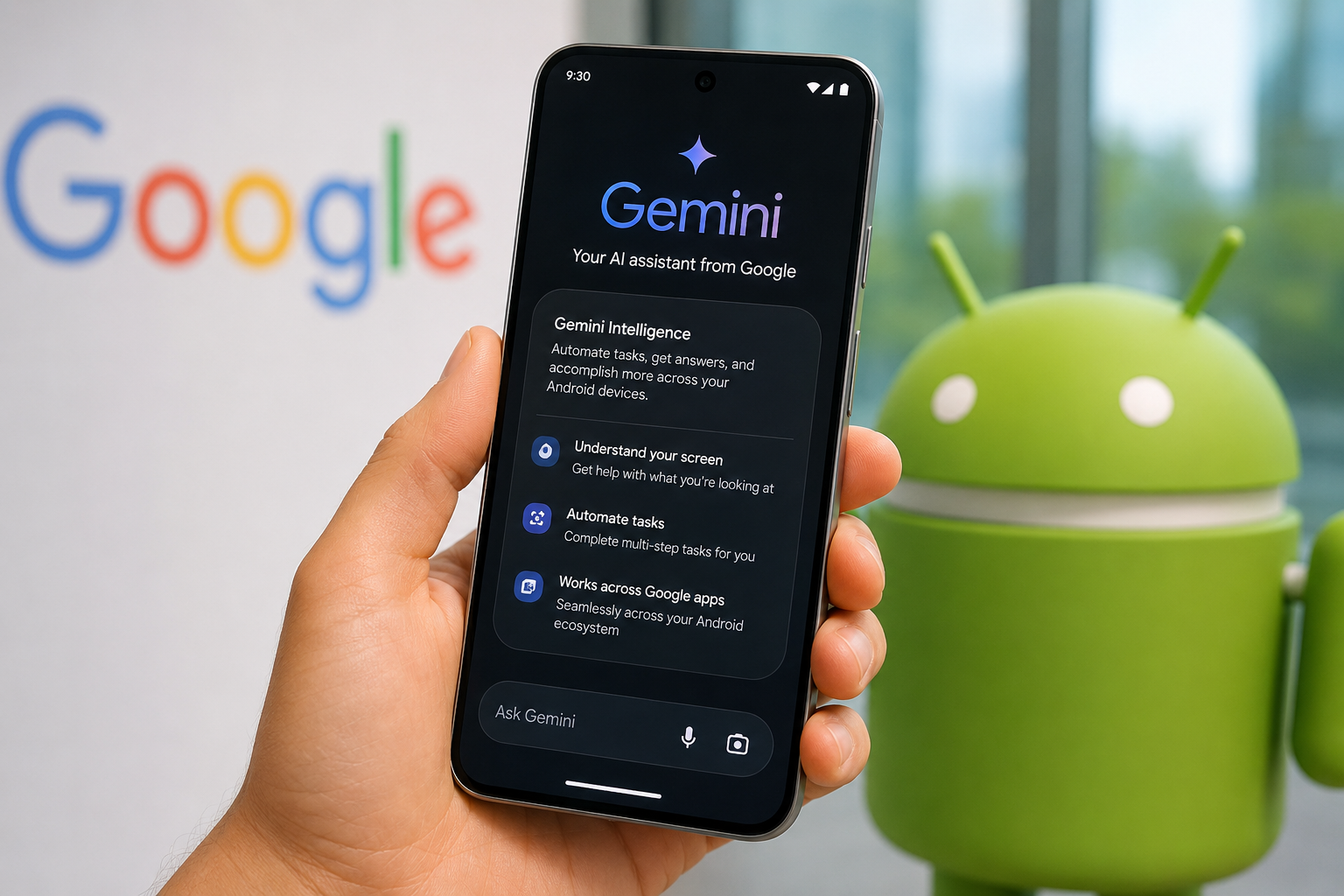
Google says the system can understand what is currently on a user’s screen, interpret visual information, and perform multi-step actions across multiple apps. The company demonstrated scenarios where Gemini could transform a grocery list into a shopping cart for delivery or analyze a travel brochure photo and search Expedia for matching tours for six people.


In another example, Gemini could pull information from Gmail, locate a study syllabus, and automatically add required textbooks to an online shopping cart. Users can monitor these tasks live through notifications while the AI works in the background.
Importantly, Google says Gemini will stop before completing purchases or transactions without explicit user approval.
Sameer Samat, who oversees Google’s Android ecosystem, described the company’s broader vision in a recent interview:
“We’re transitioning from an operating system to an intelligence system.”
That statement captures the scale of Google’s ambitions. Android is no longer being positioned merely as software that runs apps. Instead, Google wants AI to become the central layer coordinating everything users do on their devices.


Gemini Intelligence Expands Beyond Smartphones
Google’s announcement makes clear that smartphones are only the starting point.
The company says Gemini Intelligence will eventually extend across Android-powered watches, cars, glasses, and laptops later this year.
This broader ecosystem approach is particularly important because Google is trying to establish Gemini as a universal AI assistant that follows users everywhere rather than remaining confined to a single device.
Android Auto is receiving one of the biggest upgrades in this strategy. Google says more than 250 million Android Auto-compatible cars are already on the road, and Gemini will soon power features such as:
- Ordering food while driving
- Handling reservations
- Providing immersive 3D navigation
- Offering contextual assistance during trips
The redesign also introduces Material 3 Expressive styling, bringing Android’s evolving design language into vehicles.
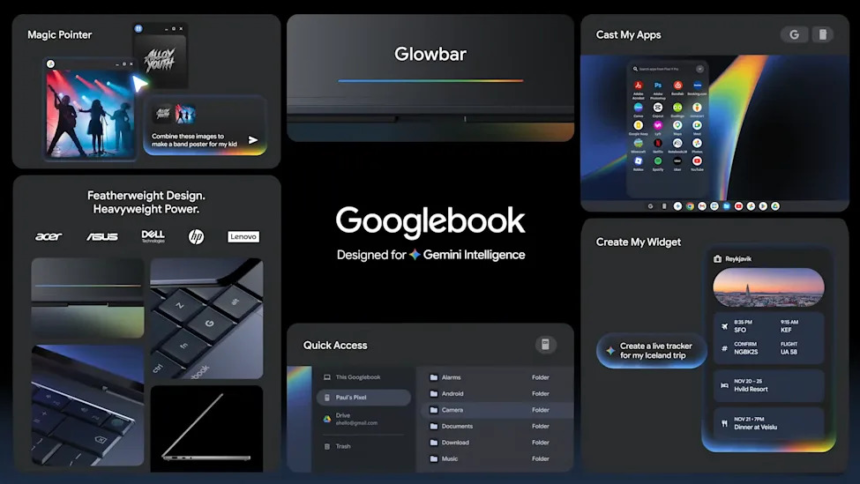
Meanwhile, Google’s newly teased “Googlebook” AI-focused laptops appear designed around Gemini Intelligence from the ground up. The laptops will reportedly allow users to generate dashboards, custom widgets, and AI-powered workspaces using natural language prompts.
Chrome on Android Is Becoming AI-Powered
One of the most significant practical upgrades arrives in Chrome for Android.
Starting in late June, Gemini integration inside Chrome will help users:
- Summarize webpages
- Compare information across sites
- Research topics
- Automate repetitive online tasks
Google also introduced “Auto Browse,” a feature that can reserve parking spots or book appointments on behalf of users.
This signals Google’s push into so-called “agentic AI” — systems capable of independently completing actions rather than merely responding with information.
Gemini in Chrome will also reportedly add details from webpages directly into calendars and assist with online shopping modifications and social media tasks, though Google says users will still need to confirm external actions before they are finalized.
The Chrome rollout is expected to support Android 12 devices and newer models with at least 4GB of RAM.
Rambler Wants to Fix Voice Typing
Among the more consumer-friendly additions is a new Gboard feature called Rambler.
Traditional voice typing often struggles when people hesitate, switch languages, or correct themselves mid-sentence. Google says Rambler is designed to process natural speech patterns — including pauses, “ums,” repetitions, and conversational corrections — and convert them into polished text automatically.
The feature also supports multilingual speech within the same sentence, which could be especially useful in multilingual regions where code-switching is common in daily communication.
Google says Rambler operates in real time and does not store audio, though cloud processing is still required. The feature will visibly indicate whenever it is enabled.
Smarter Autofill Raises Both Convenience and Privacy Questions
Google is also enhancing Autofill with Google by connecting it to Gemini’s “Personal Intelligence” system.
This feature can reportedly pull contextual details from apps such as Gmail, Google Photos, and browsing history to complete forms more intelligently across Android apps and Chrome.
For users, that could eliminate the frustration of repeatedly filling out long forms on mobile devices. But it also raises important privacy considerations because the AI would need broader access to personal data.
Google is attempting to address those concerns by making the feature entirely opt-in.
According to the company, users must explicitly grant access to apps and permissions individually, and Gemini will not receive unrestricted access to all data by default.
Sameer Samat emphasized this point directly:
“The human is always in the loop.”
Google also says users will be able to track AI activity through a Privacy Dashboard showing what Gemini is currently doing and what actions it completed during the previous day.
AI-Created Widgets and Personalized Interfaces
Another notable feature is “Create My Widget,” which allows users to generate custom Android and Wear OS widgets through simple text prompts.
Rather than manually configuring widgets, users could request personalized dashboards tailored to specific activities or trips. Google demonstrated examples where Gemini combined travel dates, flight details, and countdown information pulled from Gmail into a single custom widget.
The move reflects a larger trend in generative AI: replacing manual configuration with conversational interfaces.
Google is also refreshing Android’s visual identity with what it describes as a more functional and purposeful design language intended to reduce distractions and improve focus.
Google’s AI Race Against Apple and OpenAI
The timing of the announcement is significant.
Google unveiled Gemini Intelligence just weeks before Apple’s expected AI announcements at WWDC, where Apple is reportedly preparing a major reboot of Apple Intelligence — potentially powered in part by Gemini itself.
That creates an unusual dynamic where Google is simultaneously competing against Apple while also supplying technology for some of Apple’s AI ambitions.
Alphabet is also under pressure from Wall Street to prove Gemini can become central to everyday consumer computing. Investors have rewarded the company’s AI strategy aggressively, with Alphabet shares rising sharply over the past year.
At the same time, competition in consumer AI is intensifying:
- OpenAI continues expanding ChatGPT into productivity tools
- Anthropic is growing rapidly with Claude
- Amazon is rebuilding Alexa around generative AI
- Apple is attempting to modernize Siri
Google’s advantage may ultimately come from Android’s enormous scale. Unlike standalone AI apps, Gemini Intelligence can potentially operate at the operating-system level across billions of devices.
AI Fatigue and User Skepticism Still Exist
Despite Google’s aggressive AI push, public reaction remains mixed.
Some users responding to the announcement expressed concerns about “AI fatigue,” while others questioned whether increasingly automated devices could become overwhelming or intrusive.
Those concerns reflect a broader challenge facing the tech industry: convincing consumers that AI features genuinely improve everyday life rather than adding unnecessary complexity.
Google appears aware of that skepticism. Features such as Pause Point — a tool designed to reduce doomscrolling by forcing short delays before opening distracting apps — suggest the company is also trying to position Android AI as a wellness and productivity tool, not merely an engagement engine.
The Beginning of an AI-First Android Era
Gemini Intelligence may ultimately represent the biggest philosophical change Android has undergone since its launch.
Instead of simply organizing apps and notifications, Android is evolving into a proactive AI platform capable of understanding context, predicting intent, and coordinating tasks across digital services.
Whether users embrace that future will depend largely on trust, reliability, and privacy safeguards. But one thing is already clear: Google is betting that the next era of computing will not revolve around apps alone — it will revolve around AI systems capable of acting on behalf of users.
And with Gemini Intelligence rolling out across phones, browsers, cars, and laptops later this year, Google is positioning Android at the center of that transformation.