

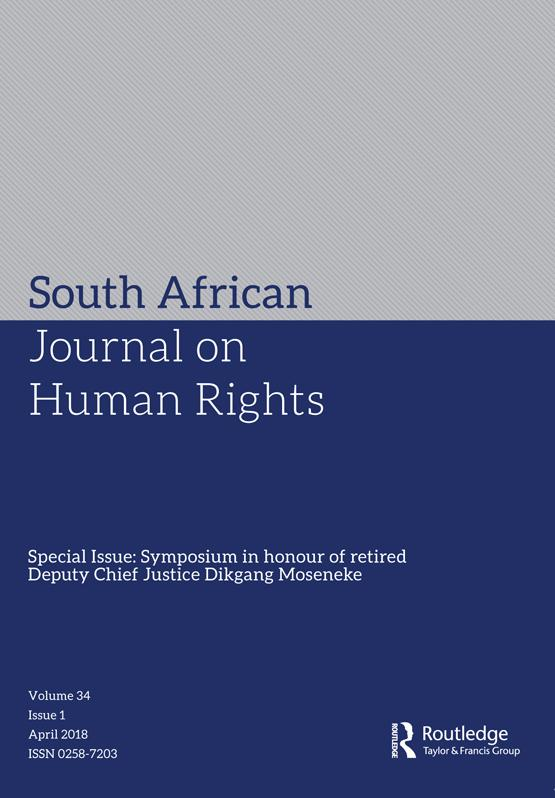
SAJHR Bursaries 2027 Open New Opportunities for Human Rights Law Students in South Africa
For postgraduate law students passionate about constitutional justice and human rights, the newly announced South African Journal on Human Rights (SAJHR) Bursaries 2027 could provide a major academic and financial boost. The programme is aimed at supporting promising LLM candidates whose research focuses on constitutional law, human rights law, and broader justice-related legal issues in South Africa.
With funding of up to R50,000 available through a once-off postgraduate top-up bursary, the initiative highlights the continuing importance of legal scholarship in a country where constitutional rights and social justice remain central public concerns.
The bursary programme, administered through the South African Journal on Human Rights, also reflects a broader effort to strengthen academic participation among Black South African and African postgraduate students in legal fields tied to equality, justice, and democratic development.
A Bursary Focused on Constitutional and Human Rights Scholarship
The SAJHR bursary is specifically designed for students pursuing an LLM degree at a public university in South Africa. Unlike broad-based financial aid programmes, this bursary targets a specialized academic area — postgraduate legal research connected to constitutional governance and human rights.
Students conducting research in the following areas are encouraged to apply:
- Human Rights Law
- Constitutional Law
- Justice-related Law
The funding aims to support students whose work contributes to legal scholarship and public discourse in South Africa’s evolving constitutional democracy.
The bursary provides financial support of up to R50,000, although the exact amount awarded will vary according to each applicant’s personal and financial circumstances.
Why SAJHR Matters in South African Legal Scholarship
The South African Journal on Human Rights has long held a respected position within South Africa’s legal and academic landscape.
Founded in 1985 by the Centre for Applied Legal Studies (CALS), SAJHR is based at the School of Law at the University of the Witwatersrand. Over the decades, the journal has become one of South Africa’s leading public law publications.
Its work focuses heavily on:
- Constitutional development
- Human rights protection
- Justice-related legal scholarship
- Public law debates
- Democratic governance
The bursary programme aligns closely with the journal’s broader mission of advancing critical legal scholarship that addresses inequality, constitutional rights, and social justice issues affecting South African society.
Who Can Apply for the SAJHR Bursary?
The bursary comes with several academic and institutional eligibility requirements intended to identify students with both academic promise and commitment to justice-centered legal research.
Applicants must:
- Be Black South African or African students
- Have completed an LLB qualification at a South African university
- Achieve a minimum overall average of 65% during LLB studies
- Be registered for an LLM degree at a public university in South Africa
- Be in either the first or second (final) year of LLM studies
- Conduct research related to constitutional law, human rights law, or justice-related legal issues
The programme is particularly interested in supporting students whose work may contribute to future legal reform, constitutional interpretation, or access to justice initiatives.
Universities Receiving Preference Consideration
Although the bursary is open to qualifying students at public universities across South Africa, SAJHR has indicated that preference will be given to applicants from specific institutions.
These include:
- University of Fort Hare
- University of Venda
- University of Limpopo
- University of Zululand
- University of the Western Cape
- Walter Sisulu University
The preference criteria suggest a deliberate effort to expand access to postgraduate legal scholarship among students from historically significant and regionally important universities.
In addition to institutional preference, students demonstrating strong academic performance and genuine financial need are expected to receive stronger consideration during the selection process.
Documents Applicants Must Prepare
Students applying for the bursary will need to compile a detailed application package that demonstrates both academic capability and personal motivation.
Required supporting documents include:
- Certified copy of South African ID, passport, or permanent residence permit
- Full academic transcript
- Updated curriculum vitae (CV)
- Contact details for two contactable references
- Motivational letter
The motivational letter plays an especially important role in the application process. Applicants are expected to explain:
- Their financial need
- Interest in constitutional or human rights law
- Academic and professional goals
- Commitment to justice-related legal scholarship
For many postgraduate funding opportunities, the motivational letter often becomes the deciding factor when academic records among candidates are closely matched.
Application Deadline and Submission Details
Applications for the SAJHR Postgraduate Top-Up Bursary 2027 close on:
31 May 2026
Applicants must submit all required documentation via email to:
The required email subject line is:
“SAJHR top-up bursary 2026”
Incomplete applications or incorrectly labelled submissions could affect consideration, making careful preparation essential.
When Applicants Can Expect Feedback
According to the bursary announcement, successful applicants will be notified by the end of June 2026.
Students who do not receive communication by that time should consider their applications unsuccessful.
Because postgraduate bursaries in South Africa are highly competitive, applicants are often encouraged to pursue multiple funding opportunities simultaneously rather than relying on a single programme.
Growing Demand for Postgraduate Legal Funding
The launch of the SAJHR bursary comes at a time when postgraduate funding pressures continue to affect many South African students.
LLM studies can involve substantial costs beyond tuition, including:
- Research expenses
- Accommodation
- Academic materials
- Internet and technology access
- Conference participation
- Field research
For students pursuing socially important but financially less commercial legal fields such as constitutional law and human rights law, funding opportunities remain especially valuable.
Programmes like the SAJHR bursary help ensure that important legal scholarship is not limited only to students with independent financial resources.
The Broader Importance of Human Rights Research
South Africa’s constitutional democracy remains globally recognized for its progressive legal framework, yet many issues connected to inequality, access to justice, discrimination, and governance continue to shape public debate.
This makes ongoing academic research in constitutional and human rights law particularly significant.
Postgraduate scholars supported through initiatives like the SAJHR bursary may contribute to future developments in areas such as:
- Socio-economic rights
- Equality law
- Gender justice
- Freedom of expression
- Land rights
- Access to education
- Administrative justice
- Constitutional litigation
By investing in legal researchers today, programmes like this may help shape future public policy, court decisions, and human rights advocacy across South Africa.
Final Thoughts
The South African Journal on Human Rights Bursaries 2027 offer more than simple financial assistance. The programme represents an investment in the next generation of constitutional and human rights scholars who may influence South Africa’s legal and democratic future.
For eligible LLM students committed to justice-centered research, the bursary provides both practical support and academic recognition from one of the country’s most respected legal publications.
With the application deadline approaching on 31 May 2026, interested students will need to prepare their documents carefully and present a compelling case for why their research matters within South Africa’s constitutional landscape.


