From Canvas to Carpet: The Story Behind Emma Chamberlain’s Met Gala 2026 Transformation
A Night Where Fashion Became Fine Art
On the first Monday of May, the Met Gala once again transformed New York’s Metropolitan Museum of Art into a living exhibition of creativity. In 2026, the theme “Costume Art” — paired with the dress code “Fashion Is Art” — pushed celebrities to blur the line between clothing and artistic expression.
- A Night Where Fashion Became Fine Art
- The Concept: A Living Painting on the Red Carpet
- A Personal Story Painted in Fabric
- Artistic Influences: From Van Gogh to Mugler’s Archive
- The Design Journey: From Vision to Reality
- A ‘Blank Canvas’ Philosophy
- A Veteran of the Met Gala Stage
- Why This Look Resonated Globally
- The Broader Cultural Impact
- Conclusion: When Fashion Becomes Identity
Among the night’s most striking interpretations was Emma Chamberlain, who didn’t just wear a gown — she became one. Her appearance stood out not only for its visual impact but for the deeply personal and artistic narrative woven into every brushstroke.
The Concept: A Living Painting on the Red Carpet
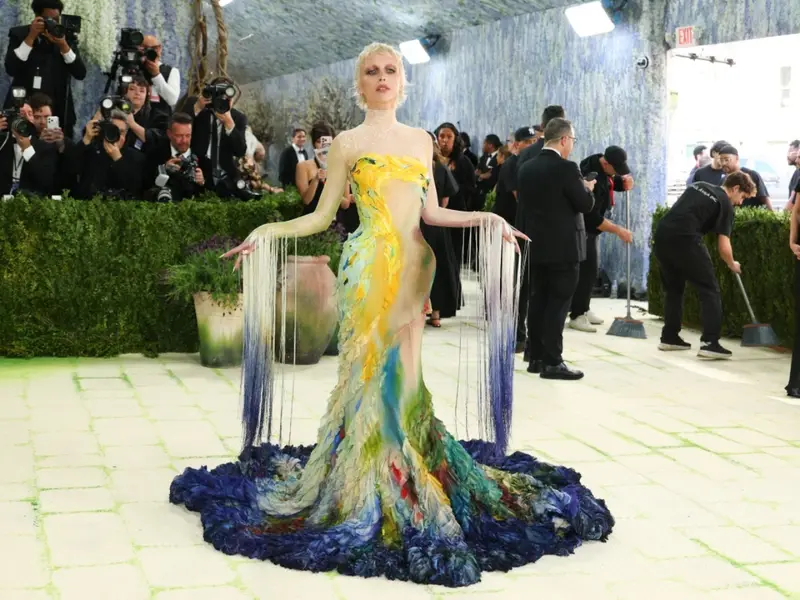
Emma Chamberlain arrived in a custom Mugler creation designed by creative director Miguel Castro Freitas. The gown, however, was far more than a couture garment. It was hand-painted by artist Anna Deller-Yee, transforming fabric into a moving canvas layered with bold, expressive color.


The design featured sweeping brushstrokes of red, blue, green, and yellow — reminiscent of classic paintings — running across the entire silhouette.
The result was a piece that embodied the Met Gala’s central question: can fashion function as fine art? In Chamberlain’s case, the answer was unequivocal.


A Personal Story Painted in Fabric
Behind the visual spectacle lies a deeply personal inspiration. Chamberlain’s connection to art began at home.
“My dad is an oil painter and a watercolour painter, and I grew up in a very creative household with art all over my house,” she explained.
This upbringing shaped her perspective on fashion, which she views not merely as style but as a medium for storytelling.
“I’m somebody who really believes that fashion is art,” she said — a philosophy that guided every element of her Met Gala look.

The gown’s aesthetic draws heavily from this background, combining soft watercolor textures with darker emotional undertones. Chamberlain described it as having “a creepy, sort of ominous undertone to the gown, like the way that it moves,” reflecting her personal artistic taste.
Artistic Influences: From Van Gogh to Mugler’s Archive
The design process was meticulous and collaborative. Chamberlain and her stylist, Jared Ellner, curated a collection of references — including works by Vincent van Gogh and Edvard Munch — and presented them to Freitas.
They then spent three hours discussing how to translate these artistic inspirations into wearable couture.
In addition to fine art, the gown also paid homage to fashion history. Archival Mugler designs, including the iconic 1997 “Chimera” or butterfly dress, served as structural inspiration.
The final piece merged these influences seamlessly — part gallery painting, part high-fashion sculpture.
The Design Journey: From Vision to Reality
The origins of the collaboration itself feel almost serendipitous. Chamberlain met Miguel Castro Freitas at a Vogue cocktail event during Paris Fashion Week, just before his Spring/Summer 2026 debut.
What began as a conversation quickly evolved into a creative partnership. Once the Met Gala theme was announced, the direction became clear.
“When they heard the dress code was Fashion Is Art, everything clicked,” the collaboration intensified, culminating in a gown that required both technical precision and artistic interpretation.
The finished look included intricate details such as fringe sleeves and a dramatic train — so elaborate that two people were needed to carry it as Chamberlain exited her hotel.
A ‘Blank Canvas’ Philosophy
For Chamberlain, the most compelling aspect of fashion is transformation — the ability to become something entirely new.
“I really am someone who enjoys fashion the most when I get to be a complete blank canvas,” she said.
That philosophy is evident in every element of her Met Gala appearance. Rather than overshadowing the gown with dramatic styling, she leaned into authenticity, allowing the artwork itself to take center stage.
Even her beauty look followed the same principle. Her luminous, “glassy” skin — achieved using tools like the Shark FacialPro Glow — complemented the gown’s artistic fluidity, creating a cohesive visual narrative.
A Veteran of the Met Gala Stage
While the look may feel like a breakthrough moment, Chamberlain is no newcomer to the Met Gala. The 2026 event marked her sixth appearance, and she continues to play a dual role as both attendee and Vogue’s special correspondent.
Her journey from YouTube vlogger to high-fashion mainstay is emblematic of a broader shift in the fashion industry. Once defined by traditional celebrity hierarchies, the Met Gala now embraces digital creators as cultural influencers in their own right.
Chamberlain, known for her “anti-influencer” authenticity, has become a bridge between internet culture and luxury fashion — a role she reinforces with each appearance.
Why This Look Resonated Globally
In a night filled with elaborate and conceptual designs, Chamberlain’s gown sparked particular attention for its emotional depth.
Unlike purely aesthetic creations, her look told a story — one rooted in personal history, artistic heritage, and creative collaboration.
Social media reactions echoed this sentiment, with many suggesting the dress belonged in a museum rather than on a red carpet.
It was not just fashion to admire, but art to interpret.
The Broader Cultural Impact
Chamberlain’s Met Gala moment reflects a larger cultural evolution in how fashion is perceived.
The 2026 theme encouraged designers and celebrities to treat garments as artistic mediums, and her look exemplified this approach at its most literal.
By incorporating hand-painted elements and fine art references, the gown blurred boundaries between disciplines — fashion, painting, performance, and identity.
It also highlighted a shift toward personalization in couture. Rather than following trends, the most compelling looks now draw from individual narratives — something Chamberlain executed with precision.
Conclusion: When Fashion Becomes Identity
Emma Chamberlain’s Met Gala 2026 appearance was more than a red carpet moment. It was a statement about the power of fashion as a storytelling tool.
By merging personal history, artistic inspiration, and couture craftsmanship, she transformed herself into a living artwork — a concept perfectly aligned with the night’s theme.
In an era where the Met Gala continues to redefine the boundaries of style, Chamberlain’s “canvas to carpet” journey stands as one of the most compelling interpretations yet — a reminder that the most memorable fashion is not just worn, but felt.