
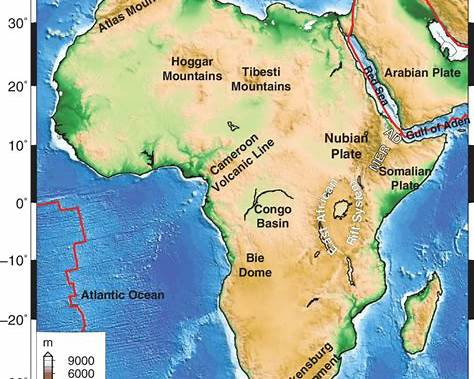
The African Plate: A Continent in Motion and a Future Ocean in the Making
A Dynamic Foundation Beneath Africa
The African Plate—one of the largest tectonic plates on Earth—is far from static. Spanning approximately 61.3 million square kilometers, it underlies most of the African continent, extends into the surrounding Atlantic Ocean, and even reaches parts of the Mediterranean region.
While it may appear stable on human timescales, the African Plate is undergoing a profound transformation deep beneath the surface. Geological research now shows that the continent is slowly splitting apart, a process that could eventually reshape Africa’s geography and create a new ocean basin.
This transformation is centered in one of the most geologically active regions on Earth: the East African Rift System.
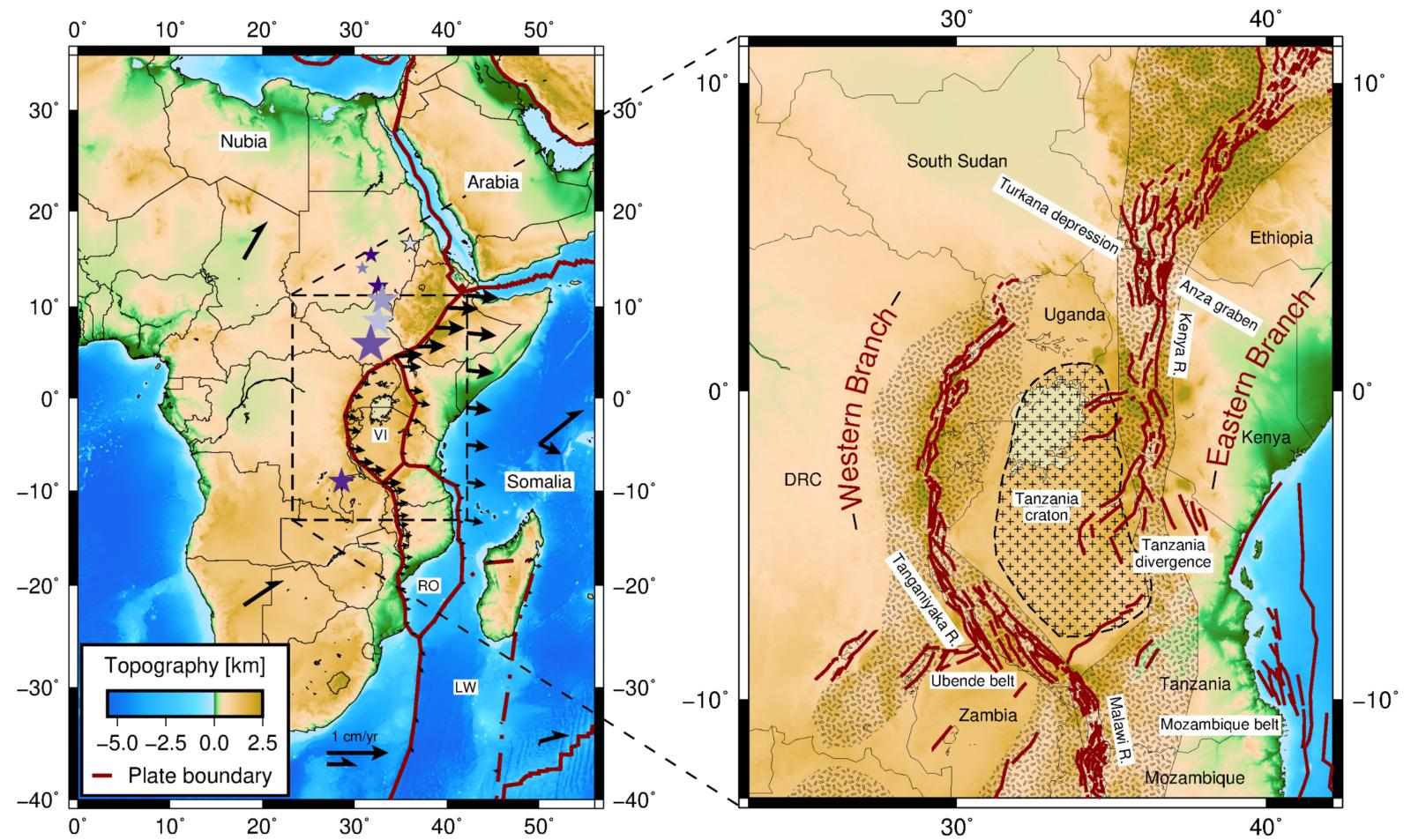
The East African Rift: Where the Continent Is Dividing
Stretching thousands of kilometers from the Afar Depression in Ethiopia to Mozambique, the East African Rift System is a massive fracture zone where tectonic forces are actively pulling the continent apart.
At its core, the African Plate is dividing into two major components:
- The Nubian Plate (to the west), which carries most of Africa
- The Somali Plate (to the east), including parts of East Africa and Madagascar
These plates are drifting apart at a rate of about 4.7 millimeters per year, a seemingly small movement that accumulates over millions of years.
This divergence creates tension within the Earth’s crust, causing it to stretch, crack, and thin—a process known as continental rifting.
The Turkana Rift: A Geological Turning Point
Within this vast rift system lies the Turkana Rift Zone, a region spanning roughly 500 kilometers across Kenya and Ethiopia.
Recent research has revealed that this area has reached a critical stage in the rifting process known as “necking.”
What Is Necking?
Necking occurs when the Earth’s crust becomes extremely thin—typically below about 15 kilometers. In the Turkana Rift, the crust has been measured at approximately 13 kilometers thick at its center, compared to more than 35 kilometers at the edges.
This thinning marks a decisive phase:
- The crust weakens significantly
- Deformation becomes concentrated along the rift axis
- The likelihood of complete continental breakup increases dramatically
As geoscientist Christian Rowan explains:
“The thinner the crust gets, the weaker it becomes, which helps promote continued rifting.”
Researchers now believe the Turkana Rift has crossed a “critical threshold”, meaning that the eventual separation of the continent in this region is effectively inevitable—though still millions of years away.
From Rift to Ocean: How a New Sea Will Form
The breakup of the African Plate will not happen overnight. Instead, it follows a well-understood geological sequence:
1. Stretching Phase
The crust begins to pull apart, forming faults and valleys.
2. Necking Phase
The crust thins dramatically and weakens—this is the current stage in Turkana.
3. Oceanization
Eventually, the crust becomes so thin that magma rises from beneath, solidifying to form a new oceanic crust.
At this point:
- A basin forms
- Water from the Indian Ocean flows in
- A new ocean begins to take shape
This process has already started in the Afar Depression, making it one of the few places on Earth where scientists can observe the early stages of ocean formation in real time.
A Window Into Earth’s Deep History
The African Plate’s current transformation is not an isolated event. It is part of a broader cycle that has shaped Earth for billions of years.
More than 200 million years ago, all continents were joined in a supercontinent known as Pangaea. Over time, tectonic forces broke it apart, forming today’s continents.
The ongoing rifting in East Africa represents another chapter in this cycle—one that may eventually lead to the formation of entirely new landmasses and oceans.
The Surprising Link to Human Evolution
Beyond geology, the African Plate’s movement has had profound implications for human history.
The Turkana Rift is one of the richest fossil regions in the world, yielding over 1,200 hominin fossils, representing about one-third of all such finds in Africa.
For decades, scientists believed this region was a central hub of human evolution. However, new research offers a different perspective.
A Preservation Advantage
Rather than being uniquely important for evolution itself, the Turkana Rift may simply have been exceptionally good at preserving fossils.
Around 4 million years ago, as the rift entered the necking phase:
- The land subsided (sank downward)
- Sediments accumulated rapidly
- Fossil preservation conditions improved dramatically
Researchers note:
“The temporal coincidence between this tectonic transition and the onset of continuous, thick fossil-bearing strata suggests that the necking phase provided critical conditions for fossil preservation.”
This suggests that geology—not just biology—played a key role in shaping the fossil record of early humans.
Why the African Plate Matters Today
The evolution of the African Plate is not just a distant geological curiosity. It has broader implications for:
1. Earth Science Research
The Turkana Rift is the first known active rift undergoing necking, offering a rare opportunity to study how continents split.
2. Climate and Landscape Evolution
Rifting influences topography, rainfall patterns, and ecosystems over long timescales.
3. Natural Resources and Hazards
Rift zones are associated with volcanic activity, earthquakes, and mineral deposits.
Looking Ahead: A Continent Still Evolving
Although the African Plate’s breakup will take millions of years, the process is already underway and accelerating in geological terms.
Scientists now view the East African Rift System as having crossed a critical threshold—one that ensures the continued progression toward continental separation and ocean formation.
As research advances, the region will remain a key natural laboratory for understanding:
- Plate tectonics
- Continental breakup
- The interplay between geology and life
Conclusion: The African Plate in Perspective
The African Plate is not merely the foundation of a continent—it is an active, evolving system shaping Earth’s future.
From the gradual splitting of East Africa to the potential birth of a new ocean, the processes unfolding beneath the surface highlight the dynamic nature of our planet. At the same time, they remind us that the forces shaping continents also influence life itself, from landscapes to the preservation of human history.
In the grand timeline of Earth, Africa’s transformation is already underway—quiet, slow, and unstoppable.


