
A Royal Reunion: How Queen Camilla Completed the Winnie-the-Pooh Story After Nearly a Century
A Missing Character Returns to the Hundred Acre Wood
For decades, one of literature’s most beloved ensembles remained quietly incomplete. Visitors to the New York Public Library could see the original toys that inspired Winnie-the-Pooh—Pooh, Piglet, Tigger, Eeyore, and Kanga—but one figure was absent: Roo, the young kangaroo whose presence is central to the charm of A.A. Milne’s stories.
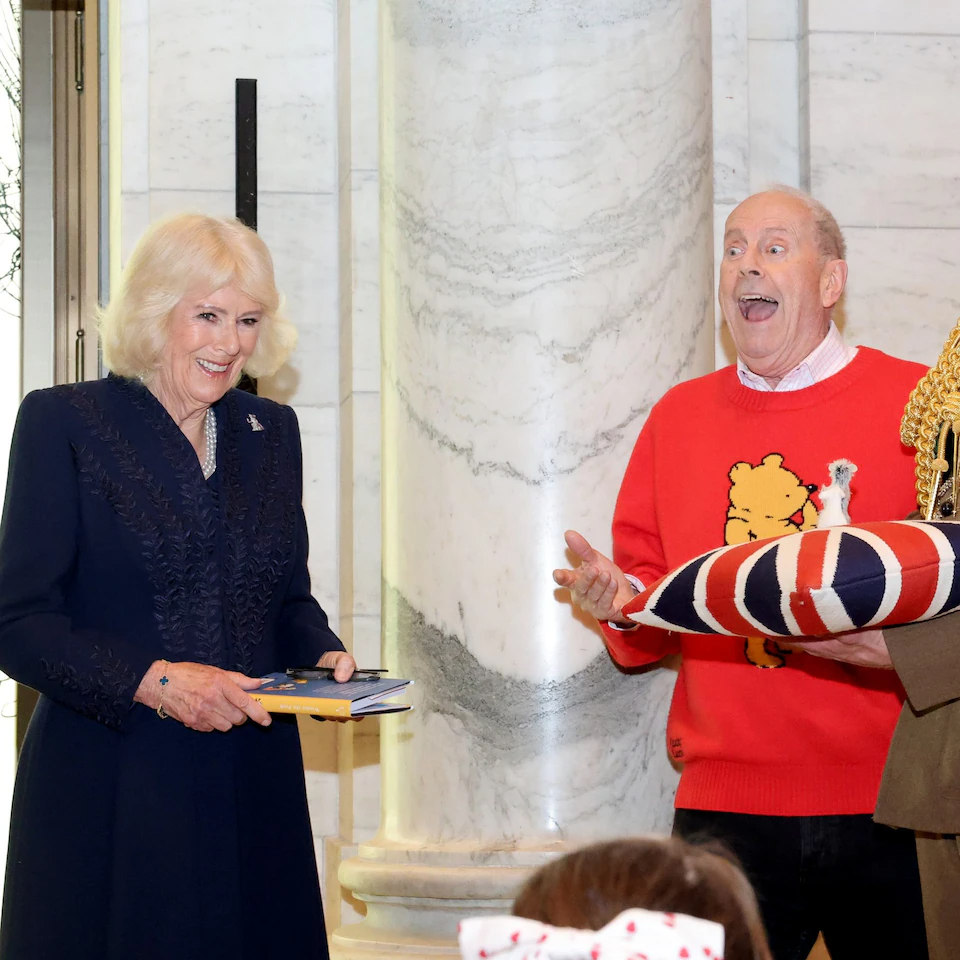
That gap, dating back nearly a century, has now been filled in a symbolic and carefully orchestrated gesture. During an official visit to the United States, Queen Camilla presented a newly crafted “Roo” plush toy to the library on April 29, completing the historic collection for the first time.
The moment was not simply ceremonial—it marked the closing of a narrative loop that began in the 1920s.
The Origins: From Christopher Robin’s Toys to Global Icons
The story of Winnie-the-Pooh begins with a father’s imagination and a child’s playthings. A.A. Milne drew inspiration from the stuffed animals belonging to his son, Christopher Robin Milne. These toys became the basis for characters that would go on to define children’s literature.
The original set included:
- Winnie-the-Pooh (a teddy bear purchased at Harrods in 1921)
- Piglet
- Tigger
- Eeyore
- Kanga
- Roo
While the other toys were eventually preserved, Roo’s original doll was lost in an orchard in the 1930s, leaving the collection incomplete for generations.
The remaining toys traveled to the United States in 1947 and were later placed on permanent display at the New York Public Library in 1987, becoming a cultural attraction visited by millions each year.
The Royal Gesture: “Soft Toy Power” in Action
Queen Camilla’s gift was more than a simple addition—it was a carefully curated act of cultural diplomacy.
The new Roo was:
- Crafted by Merrythought, the same British company that produced the original toys in the 1920s
- Designed to match the historical aesthetic of the original collection
- Presented on a cushion adorned with the Union flag, underscoring its symbolic value
Royal insiders described the gesture as an example of “royal soft (toy) power,” highlighting its role in strengthening cultural ties between the United Kingdom and the United States.
In a literal sense, Roo’s journey mirrored a diplomatic mission: the toy traveled from Buckingham Palace to New York in the Queen’s care, even earning its own whimsical “passport” along the way.
A Centennial Celebration with Deeper Meaning
The timing of the gift is significant. The year 2026 marks the 100th anniversary of the publication of Winnie-the-Pooh, first released on October 14, 1926.
By completing the set during this centenary year, the royal visit transformed a historical curiosity into a powerful commemorative moment. The Queen reinforced this connection by reading from the book to children during her visit, linking past and present through storytelling.
Anthony W. Marx, president and CEO of the New York Public Library, emphasized the enduring appeal of the collection:
“People from all over the world visit every year to meet the real Winnie-the-Pooh and friends… we welcome Roo to New York City.”
Why Roo Was Missing for So Long
The absence of Roo is rooted in a simple yet poignant story. Unlike the other toys, Roo was lost during Christopher Robin’s childhood and was never recovered.
This loss had lasting consequences:
- The original set sent to the United States lacked one character
- The incomplete display became part of the collection’s identity
- Efforts to reunite or return the toys sparked periodic debate
In 1998, a British member of parliament even argued that the toys should be returned to the UK. The proposal was rejected by then-New York Mayor Rudy Giuliani, ensuring the collection remained in New York.
The absence of Roo became, in effect, a historical footnote—until now.
A Broader Royal Visit with Complex Undertones
The Roo presentation formed part of a broader royal itinerary in New York.
On the same day:
- King Charles III and Queen Camilla visited the 9/11 Memorial & Museum
- They laid flowers and met families of victims
- Public speeches were deliberately avoided in line with convention
The visit also intersected with political discourse. New York Mayor Zohran Mamdani, who attended the memorial, previously stated he would urge the King to return the Koh-i-Noor diamond—an artifact tied to colonial history and contested by multiple nations.
While unrelated to the Pooh collection, this moment underscored the complex historical context that often accompanies royal engagements.
Cultural Significance: Literature, Memory, and Identity
At first glance, the return of a stuffed toy may appear trivial. But the act carries layered meaning across cultural, historical, and emotional dimensions.
1. Literary Legacy
The Pooh stories remain among the most influential works in children’s literature, shaping generations of readers worldwide.
2. Cultural Diplomacy
The gift symbolizes shared heritage between the UK and the US—two countries bound by language, literature, and history.
3. Emotional Continuity
For many visitors, seeing the “complete” set provides a sense of closure to a story that began nearly a century ago.
4. Institutional Value
The New York Public Library strengthens its role as a custodian of cultural memory, offering a fully realized exhibit for future generations.
The Final Piece of a Timeless Puzzle
With Roo now joining Pooh and his companions, the collection reflects the full imaginative world that A.A. Milne created from his son’s toys.
What was once an incomplete narrative—missing its smallest member—is now whole again.
In an era defined by rapid change and digital transformation, this quiet, symbolic act reminds us of something enduring: stories matter, and so do the objects that bring them to life.
As Queen Camilla herself remarked during the visit:
“We all need stories. And therefore we all need books.”


