


Judgment Day for Julius Malema: A Defining Moment in South Africa’s Political and Legal Landscape
A High-Stakes Sentencing That Extends Beyond One Man
South Africa’s political and legal arenas converged dramatically as Julius Malema, leader of the Economic Freedom Fighters (EFF), returned to court for sentencing in a long-running firearm case that has drawn national attention.
The proceedings, unfolding at the KuGompo City Magistrate’s Court, mark the culmination of an eight-year legal journey. What is at stake is not merely Malema’s personal fate, but broader questions about leadership accountability, public safety, and the application of justice in politically sensitive cases.
With supporters gathering in large numbers and law enforcement on high alert, the atmosphere surrounding the sentencing reflects both political loyalty and public tension.
The Incident at the Center of the Case
At the heart of the case lies an incident dating back to 2018, during the EFF’s fifth anniversary celebrations in Mdantsane. During the rally, attended by more than 20,000 people, Malema discharged a semi-automatic firearm into the air.
This act led to his conviction in October 2025 on five counts under the Firearms Control Act. His co-accused, Adriaan Snyman, was acquitted after the court determined his role did not warrant conviction.
According to court proceedings, the firearm was handed to Malema during the event, and he held it briefly—less than a minute—before firing multiple shots and returning it.
Inside the Courtroom: Competing Narratives
The Prosecution’s Position
State prosecutor Advocate Joel Cesar presented a forceful argument for a severe sentence. He described the firearm as an assault rifle capable of causing catastrophic harm and emphasized the risks posed to the large crowd.
Cesar argued that Malema’s actions placed thousands in danger, citing video footage as a “silent witness” that showed people running and individuals positioned within the line of fire.
The state is seeking a prison sentence of up to 15 years. Alternatively, it proposed 10 years’ imprisonment, with three years suspended, alongside financial penalties.
A key point raised by the prosecution was Malema’s role as a public leader. Cesar argued that such conduct sets a dangerous precedent, particularly when carried out by an influential political figure.
The Defence’s Argument
Malema’s legal team, led by Advocate Laurance Hodes and supported by Advocate Tembeka Ngcukaitobi, pushed strongly for a non-custodial sentence.
They framed the incident as a single, brief episode lasting less than two minutes, arguing that imprisonment would be disproportionate.
Hodes highlighted several mitigating factors:
- Malema has no prior criminal record
- He was 37 at the time of the incident and is now 45
- He has lived what was described as a “blameless life”
- No similar incidents have occurred since 2018
The defence also emphasized that the firearm was licensed and not obtained illegally, and that Malema had no intent to cause harm.
In support of their case, they referenced other incidents where individuals discharged firearms in public but received suspended sentences or fines rather than imprisonment.
Legal Context: Discretion and Uncertainty
Legal expert Ulrich Roux noted that the offences in question do not fall under South Africa’s Minimum Sentences Act. This gives the presiding magistrate broad discretion in determining an appropriate penalty.
The court must weigh several factors:
- The seriousness of the offence
- Malema’s personal circumstances
- The need for deterrence
- The broader message sent to society
Roux also pointed to a complicating factor: Malema’s lack of expressed remorse. Despite the conviction, Malema has maintained his innocence, including earlier claims that the firearm may not have been real—an argument rejected by the court after ballistic evidence confirmed the use of live ammunition.
Political Pressure and Public Mobilization
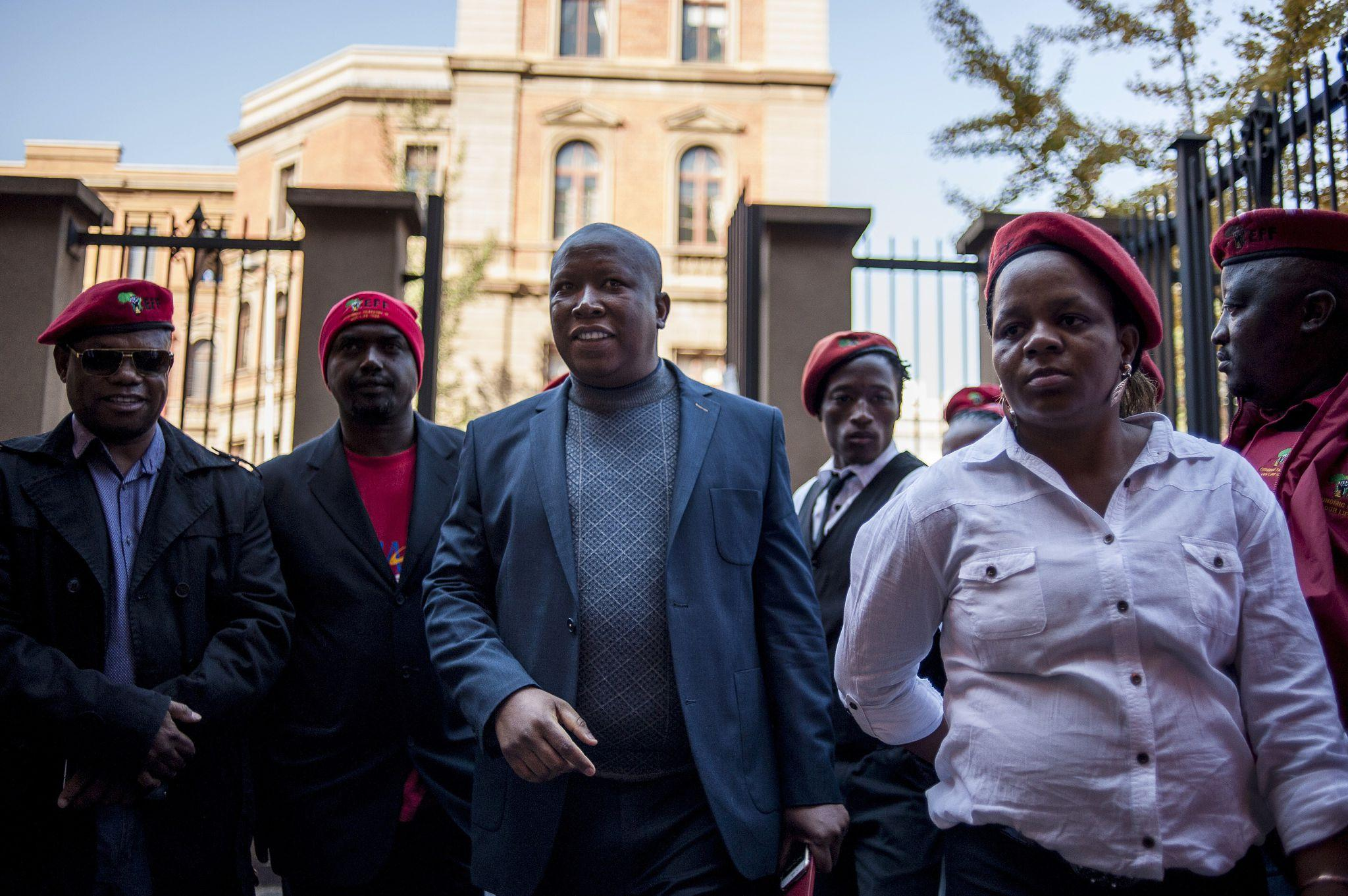
Outside the courtroom, the case has taken on a distinctly political dimension. Supporters of the Economic Freedom Fighters gathered in large numbers, marching toward the court and expressing solidarity with their leader.
Malema addressed supporters directly, reinforcing his defiance:
“We have received a lot of letters, messages, from people, churches saying they are praying for us, so everything goes according to the will of God. We don’t take anything for granted.”
He further signaled his willingness to challenge the outcome:
“There is nothing that will disrupt the revolution. No one has reason to panic. I will appeal this case up to the highest court.”
Police confirmed heightened security measures, stating they were prepared to maintain public order and ensure safety for all involved.
Potential Consequences: More Than Just a Sentence
The implications of the sentencing extend well beyond the courtroom.
One critical threshold lies in the length of any custodial sentence. If Malema is sentenced to more than 12 months in prison without the option of a fine, he risks losing his seat in Parliament.
This introduces a direct political consequence that could reshape the leadership dynamics within the EFF and influence the broader South African political landscape.
A Case That Tests the Rule of Law
This case has evolved into a test of how the justice system balances equality before the law with the realities of political influence.
The prosecution has emphasized Malema’s status as a public figure as a reason for harsher punishment, while the defence has argued that he should be treated as an ordinary citizen.
This tension highlights a central question: should leadership amplify responsibility in sentencing, or should it remain legally irrelevant?
What Happens Next?
With arguments concluded and judgment imminent, the magistrate’s ruling will set a precedent not only for firearm-related offences but also for cases involving high-profile political figures.
Legal observers suggest a suspended sentence with a fine is a plausible outcome, given Malema’s clean record and the nature of the incident. However, the final decision remains uncertain.
What is clear is that the outcome will resonate far beyond this single case—shaping public discourse on accountability, leadership, and justice in South Africa.
Conclusion: A Moment of Reckoning
The sentencing of Julius Malema represents a critical moment at the intersection of politics and law.
It encapsulates broader societal questions about responsibility, the limits of political conduct, and the role of the judiciary in maintaining public trust.
As the country awaits the final ruling, the case stands as a reminder that the rule of law must navigate both principle and pressure—especially when power, influence, and public expectation collide.


