


Arsenal vs Sporting CP: Discipline, Atmosphere, and a Night of European Progress
A European Night Defined by Control, Not Chaos
When Arsenal F.C. faced Sporting CP in the UEFA Champions League quarter-final second leg on April 15, 2026, the stakes were clear: history was within reach.
The match at the Emirates Stadium did not deliver goals, but it delivered something arguably more valuable in knockout football—control, composure, and progression.
A 0-0 draw on the night was enough for Arsenal to secure a 1-0 aggregate victory, sending them into the Champions League semi-finals for a second consecutive season—a milestone the club had never achieved before.
“History in Our Sights”: The Atmosphere That Set the Tone
Before a ball was kicked, the message inside the Emirates Stadium was unmistakable.
Arsenal supporters unveiled a massive tifo stretching across the stands, emblazoned with the words:
“History in our sights.”
Accompanied by images of key players like Bukayo Saka, Declan Rice, Martin Ødegaard, Noni Madueke, and Leandro Trossard, the display captured the significance of the moment.
The choreography wasn’t merely aesthetic—it was strategic. It elevated the emotional intensity of the night and reinforced the stakes for Mikel Arteta’s squad, who were attempting to reach uncharted territory in European competition.
Tactical Reality: A Game of Margins
First Half: Arsenal Control Without Breakthrough
The opening 45 minutes reflected a cautious but structured contest.
Arsenal held a slight edge in possession (56%) and attacking metrics, registering:
- 8 shots to Sporting’s 3
- Expected goals (xG): 0.28 vs 0.09
- More corners and final-third entries
Despite the statistical advantage, the breakthrough never came.
Sporting remained dangerous, with Geny Catamo striking the woodwork—an early reminder that the tie was still finely balanced.
Second Half: Defensive Discipline Takes Over
As the match progressed, the dynamics shifted subtly.
Sporting CP increased urgency, needing a goal to force extra time. Arsenal, in response, leaned into defensive structure and risk management.
Key late moments included:
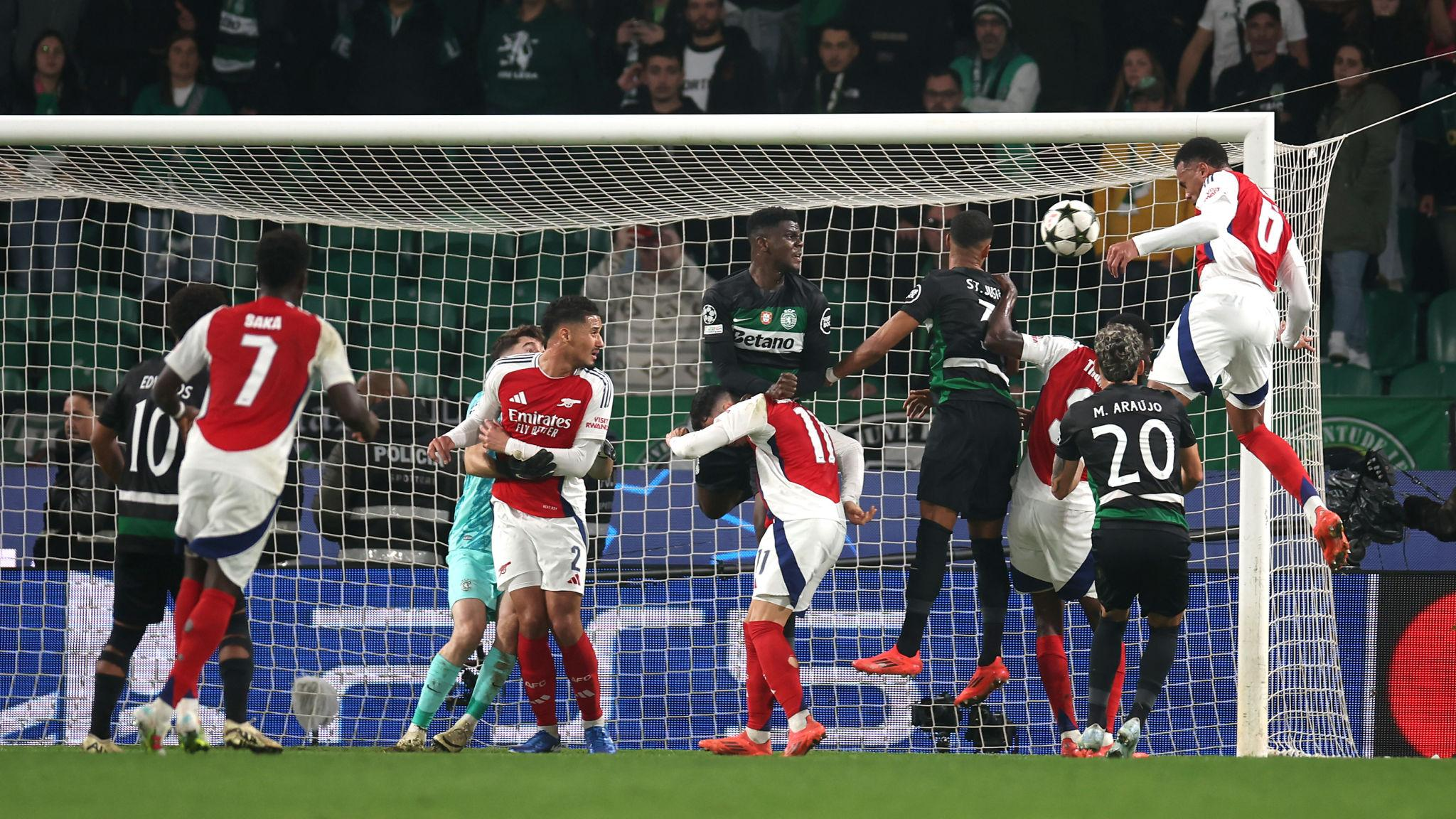
- A header from Leandro Trossard that hit the post
- A close-range opportunity for Sporting that drifted wide in stoppage time
Neither side found the net, but Arsenal didn’t need to.
Their first-leg advantage—secured by Kai Havertz’s late winner in Lisbon—remained decisive.
Match Statistics: Structure Over Flair
The numbers underline the nature of the contest:
- Possession: 50% – 50%
- Shots: Arsenal 15 – Sporting CP 8
- Expected Goals (xG): Arsenal 0.66 – Sporting CP 0.29
- Final Score: 0-0
This was not a game defined by attacking brilliance. It was defined by efficiency, defensive positioning, and tactical clarity.
Key Performers and Player Impact
Arsenal Standouts
- Martín Zubimendi delivered a composed midfield performance, dictating tempo and progressing play effectively.
- Declan Rice anchored the midfield, combining defensive screening with distribution.
- Gabriel Magalhães and William Saliba ensured structural stability at the back.
Sporting CP Highlights
- Morten Hjulmand led with discipline, contributing both defensively and in possession.
- Eduardo Quaresma helped maintain defensive resistance under sustained pressure.
Despite moments of promise, Sporting lacked cutting edge in decisive situations.
Lineups and Tactical Setup
Both teams deployed structured systems reflecting modern European football principles.
Arsenal (4-2-3-1)
- David Raya
- Saliba, Mosquera, Hincapié, Gabriel
- Rice, Zubimendi
- Eze
- Martinelli, Madueke, Gyökeres
Sporting CP (4-2-3-1)
- Rui Silva
- Quaresma, Inácio, Hjulmand
- Catamo, Trincão, Araújo
- Morita, Pedro Gonçalves
- Luis Suárez
The mirrored systems resulted in a congested midfield battle, limiting space and reducing the quality of chances.
Game Management: The Defining Factor
Arsenal’s approach was pragmatic.
Rather than chasing goals, they:
- Controlled tempo through midfield
- Maintained defensive compactness
- Limited Sporting to low-quality opportunities
Substitutions—Kai Havertz, Gabriel Jesus, and Leandro Trossard—were introduced not to dominate, but to stabilize and manage phases of the game.
This is the hallmark of a team evolving in European competition: knowing when not to force the game.
What This Means for Arsenal’s Champions League Campaign
Reaching the semi-finals in consecutive seasons represents a structural shift for Arsenal.
Historically, the club had only reached this stage twice (2006, 2009). Now, under Arteta, they are demonstrating:
- Tactical maturity
- Squad depth
- Psychological resilience in knockout football
The next challenge will test whether this progression is sustainable against elite opposition, including a potential clash with Atlético Madrid.
Sporting CP: Competitive, But Lacking Precision
Sporting CP exit the competition with credibility intact.
They:
- Matched Arsenal tactically
- Created moments of danger
- Maintained defensive organization
However, their inability to convert key chances across both legs ultimately defined the outcome.
At this level, margins are unforgiving.
Conclusion: A Different Kind of Victory
This was not a night of spectacle.
It was a night of control, discipline, and strategic execution.
Arsenal did not overwhelm Sporting CP—they outmanaged them.
In the context of the Champions League, that distinction matters. It signals a team transitioning from potential to genuine contender.


