

Jonathan Quick’s Final Chapter: Rangers vs Panthers Ends a Legendary NHL Era
A Night That Meant More Than the Score
In a league defined by speed, precision, and relentless competition, certain moments transcend the scoreboard. The final meeting between the New York Rangers and the Florida Panthers on April 14, 2026, became one of those rare occasions—an emotional farewell to one of hockey’s most iconic goaltenders, Jonathan Quick.
The Panthers secured a narrow 3–2 victory, but the result itself quickly became secondary. What mattered most was that this game marked the final NHL appearance of a player whose career spanned nearly two decades and reshaped the goaltending position.
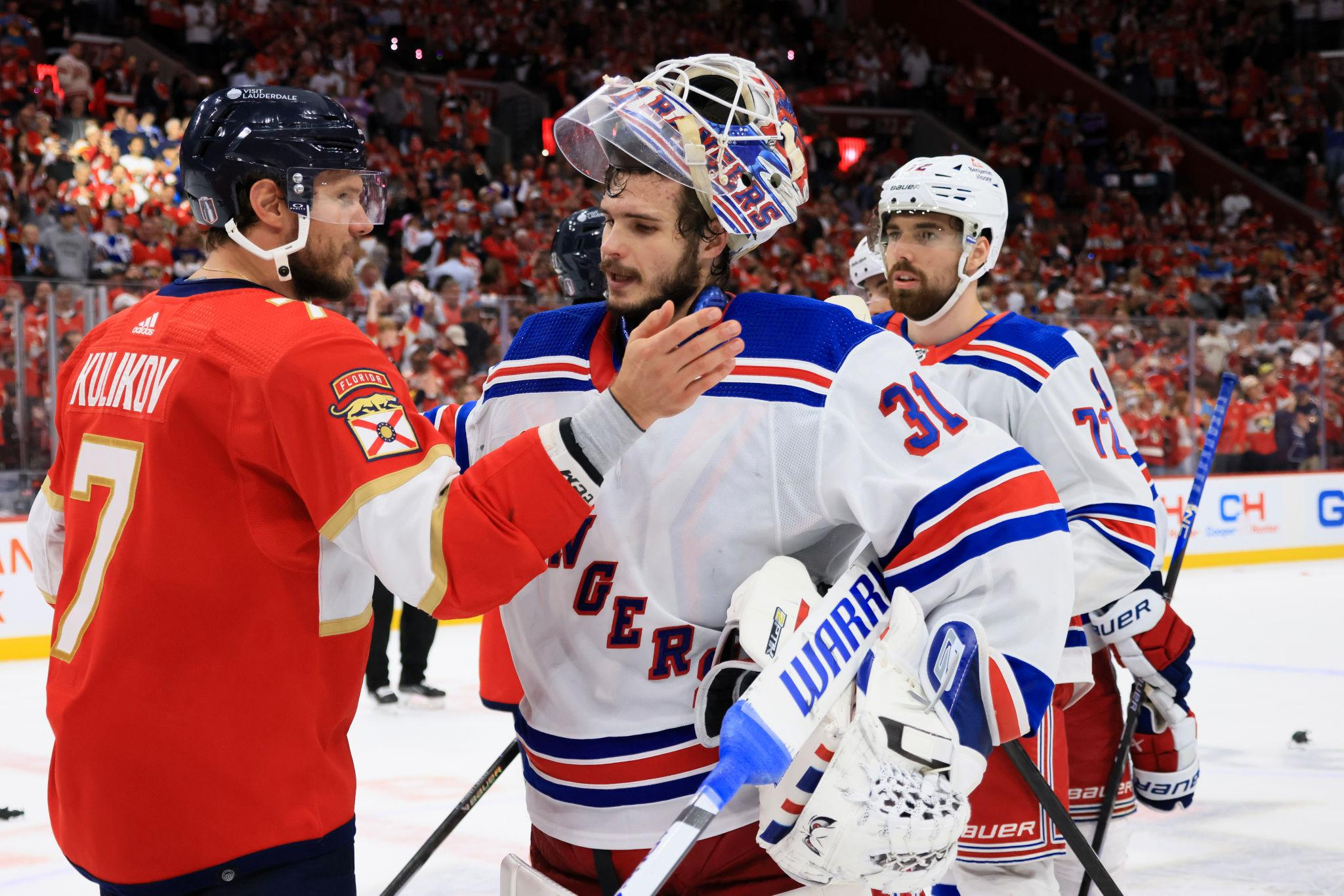
Game Breakdown: Panthers Edge Rangers in Tight Contest
The matchup unfolded with competitive intensity despite both teams already being eliminated from playoff contention. The Panthers struck early, building a 2–0 lead in the first period through goals from Mackie Samoskevich and Cole Reinhardt.
Reinhardt’s performance stood out—he delivered the first two-goal game of his career, including the decisive strike late in the third period. His game-winner, scored with just 1:50 remaining, sealed the 3–2 result.
The Rangers responded with resilience. Rookie contributions from Matthew Robertson and Gabe Perreault brought New York level at 2–2 midway through the game. However, the Panthers’ defensive composure and timely goaltending from Daniil Tarasov—who recorded 24 saves—proved decisive in the closing minutes.
Quick, starting in what would become his final NHL appearance, made 14 saves. While the stat line may appear modest, it reflected a veteran goaltender still capable of competing at the highest level.
The Emotional Weight of the Final Whistle
As the game concluded, the atmosphere shifted from competitive urgency to collective reflection. The Panthers, recognizing the significance of the moment, called Quick back onto the ice for a curtain call. He reportedly wiped away tears as he acknowledged the crowd—an understated but powerful conclusion to an extraordinary career.
Earlier that day, Quick had already confirmed what many suspected: this would be his final game in the NHL.
“I feel like you guys have a good idea what I’m about to say here… tonight will be my last game in the league.”
The statement carried the weight of finality, but also a sense of closure. Quick was not forced out by circumstance—he chose his moment.
A Career Defined by Excellence and Evolution
Jonathan Quick’s legacy cannot be measured solely by wins and losses, though his numbers are formidable. Over 19 seasons, he established himself as one of the most accomplished American-born goaltenders in NHL history.
His career highlights include:
- Three Stanley Cup championships (2012, 2014, 2023)
- Conn Smythe Trophy winner in 2012
- Over 400 career wins, among the highest for U.S.-born goalies
- More than 900 career appearances across regular season and playoffs
His 2012 postseason run remains one of the most dominant ever recorded by a goaltender, combining elite reflexes with tactical awareness. Analysts often point to that performance as a turning point in modern goaltending strategy.
The “Quick Style” and Its Lasting Impact
Quick’s influence extended beyond trophies. His playing style—aggressive positioning, explosive lateral movement, and exceptional recovery speed—forced offensive systems across the league to adapt.
Coaches and players spent years attempting to solve what became informally known as the “Quick style.” Younger goaltenders began modeling their approach on his techniques, particularly his ability to challenge shooters and maintain composure under pressure.
This tactical evolution is part of his enduring legacy. Quick did not simply succeed within the system—he altered it.
Rangers, Panthers, and the Context of the Game
From a team perspective, the matchup represented a transitional moment for both franchises.
- The Rangers (33–39–9, 75 points) closed out a difficult season with an emphasis on developing younger talent.
- The Panthers (39–38–4, 82 points), recent Stanley Cup champions in 2024 and 2025, continued to demonstrate depth and organizational stability.
While the game had no playoff implications, it highlighted emerging players such as Reinhardt and Perreault—indicating the next generation already stepping into prominent roles.
Beyond the Numbers: Longevity and Professionalism
Quick’s final season with the Rangers also illustrated a different dimension of his career. Transitioning from a franchise cornerstone with the Los Angeles Kings to a veteran presence in New York, he embraced a mentorship role.
This adaptability is often overlooked but critical. Sustaining a career in the NHL for nearly two decades requires not just physical durability, but psychological resilience and a willingness to evolve.
Even in his final appearance, Quick nearly pushed the game to overtime, demonstrating the competitive edge that defined his career.
What Comes Next for the NHL
The retirement of Jonathan Quick signals more than the end of an individual career. It represents a generational shift within the NHL.
The league continues to move toward:
- Faster-paced gameplay
- Younger rosters
- Increased reliance on analytics and technology
Yet, the foundational qualities Quick embodied—discipline, adaptability, and competitive intensity—remain central to success.
His departure leaves a gap not easily filled, particularly in the intangible aspects of leadership and experience.
Conclusion: A Legacy That Extends Beyond the Ice
The Rangers vs Panthers game will be recorded as a 3–2 result in the standings. But in a broader sense, it will be remembered as the final chapter of a career that influenced an entire era of hockey.
Jonathan Quick exits the NHL not as a fading veteran, but as a benchmark. His career offers a clear framework for excellence: sustained performance, tactical innovation, and the ability to adapt over time.
As the league moves forward, his imprint remains embedded in the way the position is played—and understood.


