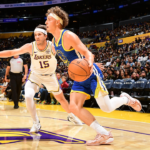
Cavaliers vs Warriors Prediction: Why Cleveland Holds the Edge in a High-Stakes Clash
A Data-Driven Showdown in San Francisco
The upcoming matchup between the Cleveland Cavaliers and the Golden State Warriors is shaping into one of the most analytically intriguing games on the NBA calendar. Set at the Chase Center, this contest blends playoff urgency, roster imbalances, and statistical indicators pointing strongly in one direction.
- A Data-Driven Showdown in San Francisco
- The Numbers Behind the Prediction
- Cleveland Cavaliers: Offensive Cohesion and Playoff Intent
- Golden State Warriors: A Team Searching for Stability
- Key Tactical Matchups
- Betting Market Interpretation
- Prediction: Cleveland Controls the Game Flow
- What This Game Signals Moving Forward
While both teams enter with different motivations, the predictive models, betting markets, and recent performance trends converge around a clear narrative: Cleveland is the more complete and reliable side heading into this clash.

The Numbers Behind the Prediction
Modern NBA predictions rely heavily on simulations, efficiency metrics, and injury-adjusted modeling. In this case, the data paints a decisive picture.


A leading predictive model assigns the Cavaliers a 79% probability of victory, with a projected scoreline of 119–110 in favor of Cleveland . That margin aligns closely with betting spreads hovering around double digits, reinforcing the expectation of a controlled Cavaliers win.
Key betting indicators:


- Cavaliers favored by approximately -10 to -10.5 points
- Total points projection around 227–230
- Slight lean toward the under based on simulation trends
From a purely statistical standpoint, this is not a coin-flip matchup—it is a scenario where one team consistently grades higher across predictive variables.
Cleveland Cavaliers: Offensive Cohesion and Playoff Intent
A Balanced Offensive Machine
Cleveland enters with a strong 47–29 record, reflecting both consistency and upward trajectory . Their offensive profile is particularly notable:
- 119.3 points per game (PPG)
- 118.2 offensive rating (6th in the league)
- 28.3 assists per game, indicating strong ball movement
The integration of James Harden has significantly elevated their offensive structure. His playmaking complements the scoring explosiveness of Donovan Mitchell, who is projected to deliver around 27 points in this matchup .
Meanwhile, Evan Mobley anchors the interior, contributing both defensively and on the boards, with strong recent rebounding trends that exploit opponent weaknesses.


Strategic Motivation
Cleveland’s urgency is also contextual. Sitting just 1.5 games behind a higher playoff seed, the Cavaliers are not merely playing for form—they are positioning themselves for postseason advantage .
That competitive pressure often translates into sharper execution, particularly against weakened opponents.
Golden State Warriors: A Team Searching for Stability
The Impact of Absences
The Warriors’ outlook is heavily influenced by injuries—most notably the continued absence of Stephen Curry.
Without Curry, Golden State’s identity shifts dramatically:
- Offensive efficiency drops
- Shot creation becomes inconsistent
- Defensive vulnerabilities increase
They currently average 114.7 PPG while allowing 115.1, reflecting a team struggling to maintain equilibrium on both ends .
Additional absences—including key rotational players—have further destabilized lineup continuity, forcing reliance on emerging contributors like Brandin Podziemski.
Structural Weaknesses
Beyond injuries, the Warriors exhibit clear statistical deficiencies:
- Ranked 22nd in defensive rating post-All-Star break
- Allow high three-point volume and guard scoring
- Struggle significantly in rebounding, particularly on the defensive glass
This combination creates matchup problems against a Cavaliers team built around perimeter scoring and interior dominance.
Key Tactical Matchups
1. Backcourt Advantage: Mitchell vs Warriors Defense
Golden State’s defensive metrics against guards suggest a favorable environment for Donovan Mitchell. Opposing backcourts have consistently generated high scoring outputs, and Mitchell’s recent form indicates he is well-positioned to capitalize.
2. Interior Battle: Mobley’s Opportunity
The Warriors’ frontcourt issues—exacerbated by injuries—leave them vulnerable to rebounding dominance. Mobley, averaging close to 9 rebounds per game, has exceeded key thresholds in consecutive outings and is projected to control the paint .
3. Perimeter Variance: Podziemski’s Role
Golden State’s offensive ceiling may depend on Podziemski’s three-point efficiency. He has demonstrated strong shooting volume and accuracy, but relying on perimeter variance introduces volatility rather than stability.
Betting Market Interpretation
What the Odds Signal
Markets align closely with predictive models:
- Cavaliers: Heavy favorites (-475 moneyline range)
- Warriors: Significant underdogs (+350 range)
- Spread suggests a double-digit margin expectation
Interestingly, while Cleveland is favored to win, models suggest the Warriors have a slightly better-than-even chance to cover the spread, indicating potential late-game variance.
Best Value Angles
Based on combined data and trends:
- Cleveland to win outright remains the most statistically supported outcome
- Player props lean toward:
- Mitchell scoring overs
- Mobley rebounding overs
- Total points slightly favor the under, reflecting defensive inconsistencies offset by pace control
Prediction: Cleveland Controls the Game Flow
When combining all variables—team form, injury reports, statistical models, and tactical matchups—the projection is consistent:
Cleveland Cavaliers 119, Golden State Warriors 110
This is not merely a prediction driven by recent results; it is supported by:
- Superior offensive efficiency
- More stable roster health
- Stronger rebounding and interior presence
- Clear motivational edge tied to playoff positioning
The Warriors, while capable of isolated scoring bursts, lack the structural consistency required to sustain performance over four quarters in their current state.
What This Game Signals Moving Forward
Beyond a single result, this matchup highlights broader trends:
- Cleveland is evolving into a serious playoff contender with balanced scoring and depth
- Golden State’s reliance on star availability underscores their fragility without Curry
- Data-driven predictions are increasingly aligning with traditional basketball analysis, reinforcing confidence in advanced models
If these trajectories hold, Cleveland’s ceiling continues to rise, while Golden State faces a narrowing margin for postseason competitiveness.