
Inter Miami’s Messi Era Is No Longer Just a Show — It Is a Statement
Inter Miami began as one of Major League Soccer’s most ambitious modern projects. But in the Lionel Messi era, the club has become something larger than a franchise chasing wins. It is now a sporting spectacle, a commercial machine, a cultural export and, increasingly, a serious championship force.
- A Night in Cincinnati That Captured Modern Inter Miami
- Messi Remains the Center of the MLS Economy
- Why the Messi-De Paul Axis Matters
- The Numbers Behind Miami’s Rise
- Guillermo Hoyos and the Message Behind the Win
- From Florida Franchise to MLS Standard-Setter
- What the Cincinnati Match Reveals About MLS
- The World Cup Shadow
- The Future of Inter Miami’s Project
- Conclusion: A Club Living in the Moment, Building for More
The latest evidence came in Cincinnati, where Inter Miami turned a difficult away match into another Messi-driven headline. In an eight-goal MLS thriller, Miami came from behind to beat FC Cincinnati 5-3, with Messi again at the center of the drama. Depending on the scoring interpretation, his night was first celebrated as a hat-trick performance before the final goal was later recorded as an own goal off goalkeeper Roman Celentano. What did not change was the bigger picture: Messi decided the rhythm, the pressure and the emotional direction of the match.
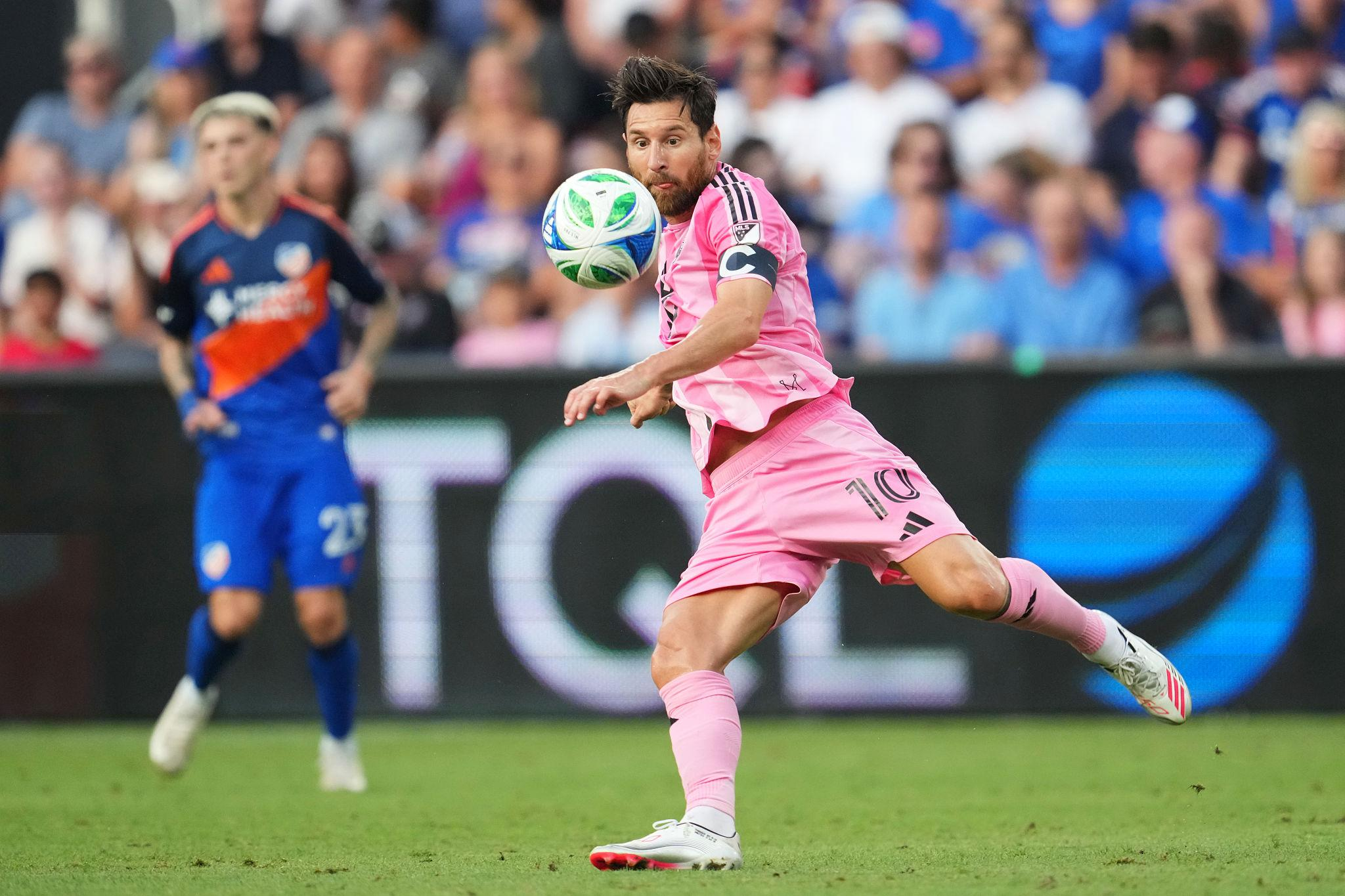
A Night in Cincinnati That Captured Modern Inter Miami
For much of the match, Inter Miami looked vulnerable. Messi opened the scoring in the 24th minute, but FC Cincinnati responded through Kevin Denkey’s 41st-minute penalty. Pavel Bucha then put the hosts ahead early in the second half, only for Messi to strike again in the 55th minute after a cross from Rodrigo De Paul.


Cincinnati’s Evander made it 3-2 in the 64th minute, giving the home side control heading into the final stages. But Miami’s comeback arrived with force. Messi set up young Argentine Mateo Silvetti for the 79th-minute equalizer, German Berterame scored in the 84th minute, and the final blow came in the 89th minute when Messi forced the ball toward goal before it deflected in off Celentano.
The result was more than three points. It was a reminder of what Inter Miami have become: a team capable of winning imperfectly, explosively and dramatically.


Messi Remains the Center of the MLS Economy
Messi’s influence is not only visible in goals and assists. It is also reflected in the financial structure of MLS.
According to salary figures released by the MLS Players Association, Messi remains the highest-paid player in Major League Soccer, with an annual base salary of $25m (£18.5m). His overall deal is worth $28.3m (£20.9m) in guaranteed compensation. The figures reflect the contract extension he signed with Inter Miami in October, and they do not include endorsement income or his option to acquire a stake in Inter Miami, the club co-owned by David Beckham.
That salary puts Messi far ahead of the league’s next-highest earner. LAFC’s Son Heung-min is listed second on a base salary of $10.4m (£7.7m), with $11.2m (£8.3m) guaranteed. Inter Miami’s Rodrigo De Paul and San Diego FC’s Hirving Lozano are also among the top earners.
For MLS, Messi is not simply a player cost. He is an investment in visibility, ticket demand, broadcast interest and global relevance.


Why the Messi-De Paul Axis Matters
One of the most important developments in Miami’s evolution has been the growing role of Rodrigo De Paul. The midfielder’s connection with Messi gives Miami more than star power; it gives the team a familiar Argentine partnership built on trust, timing and shared international experience.
In Cincinnati, that relationship was visible again when De Paul supplied the cross for Messi’s second goal. It was a moment that showed why Miami’s project is not just about placing famous names on a team sheet. The club’s strongest version depends on chemistry, especially between players who understand how to create decisive moments under pressure.
Messi and De Paul are also among the top three earners in MLS, reinforcing Miami’s strategy: build around elite talent, accept the financial weight, and turn individual quality into collective authority.
The Numbers Behind Miami’s Rise
Inter Miami’s statistical profile supports the idea that the club is now one of the league’s defining contenders. Before the Cincinnati match, Miami had won five, lost one and drawn four of their previous 10 league games. They were averaging 2.2 goals from 16.0 attempts and 6.8 shots on goal, while holding an average of 57.2% possession.
Messi’s output remains extraordinary. He entered the Cincinnati fixture as Miami’s leading scorer, and after the match he was credited with 11 goals in 12 MLS matches this season. Miami’s victory lifted them into second place in the Eastern Conference with 25 points, while other data placed them fourth in the overall league table at the same points total.
The club’s attacking ecosystem is also broader than Messi alone. Luis Suarez, German Berterame, Telasco Segovia, Mateo Silvetti and De Paul all feature in a team designed to overwhelm opponents with movement, experience and technical quality.
Guillermo Hoyos and the Message Behind the Win
Miami manager Guillermo Hoyos framed the Cincinnati comeback as proof of character and ambition.
“It’s brilliant what they did today,” Hoyos said after the match. “It was an incredible game with ups and downs. We are very happy and comfortable that we can play football at a high level.”
After the game, he also praised Messi’s wider influence.
“There are players that truly improve and make the league better,” Hoyos said. “First, because of the player and person [Messi] is. He puts in a lot of work … They left everything on the field today.”
Those comments matter because they reflect Miami’s current identity. The club is no longer selling the idea that Messi’s presence alone is enough. It is trying to prove that the surrounding structure — coaching, supporting cast, resilience and tactical maturity — can turn celebrity into sustained dominance.
From Florida Franchise to MLS Standard-Setter
Messi joined Inter Miami in 2023. Since then, the club’s profile has changed dramatically. He has scored 59 goals in 64 regular-season MLS games, helped Miami win the MLS Cup in 2025, led the league with 29 goals last season, and was named Most Valuable Player in both 2024 and 2025.
Those achievements have shifted expectations. Inter Miami are now judged less like an expansion-era project and more like a major club expected to win every week.
That pressure can be heavy. Every dropped point becomes a story. Every Messi performance is measured against history. Every big contract invites scrutiny. But the Cincinnati comeback showed the advantage of carrying that weight: Miami have players accustomed to moments that would overwhelm others.
What the Cincinnati Match Reveals About MLS
The 5-3 result also says something about the league itself. MLS is increasingly a competition where global stars, young South American talent, established domestic players and ambitious ownership groups intersect.
Cincinnati entered the match as a serious opponent, not a backdrop. Kevin Denkey, Pavel Bucha and Evander all punished Miami’s defensive weaknesses. Evander’s long-range strike was his seventh goal in six matches, a reminder that the league has difference-makers beyond Miami’s marquee names.
That is what makes Miami’s position so compelling. They are the league’s biggest attraction, but not its only story. Their matches create attention because opponents are increasingly capable of turning those nights into genuine contests.
The World Cup Shadow
There is also a broader international context. With the 2026 FIFA World Cup approaching in North America, Messi’s form carries significance beyond Miami. At 38, he remains in excellent rhythm, producing goals, assists and match-defining actions.
His recent run included 4 goals and 5 assists across three matches, while he also became the fastest player in MLS history to reach 100 career goal contributions.
For Inter Miami, that creates both opportunity and uncertainty. A sharp Messi makes them one of the league’s most dangerous teams. But the World Cup calendar and the physical demands on an aging superstar will continue to shape their season.
The Future of Inter Miami’s Project
Inter Miami’s next challenge is sustainability. The club has already built a team that can dominate attention. The harder task is remaining competitive through schedule congestion, injuries, defensive lapses and the inevitable transition beyond Messi’s peak years.
Still, the present is powerful. Miami are winning, Messi is producing, De Paul is integrating, and the club’s commercial value continues to rise. The Cincinnati comeback was not a perfect performance, but it was the kind of performance that tells supporters why this era feels different.
Inter Miami are no longer just the club that signed Lionel Messi. They are the club trying to turn his final years at the top into a lasting MLS legacy.
Conclusion: A Club Living in the Moment, Building for More
Inter Miami’s story is now built around a rare combination: superstar magnetism and competitive substance. The latest win over FC Cincinnati showed both sides. There was vulnerability, yes, but also control, nerve and the unmistakable presence of Messi when the match demanded a final act.
For MLS, Miami remain the league’s brightest global symbol. For opponents, they remain a dangerous and sometimes chaotic test. For supporters, they are something even more valuable: a team capable of making the ordinary league night feel like an event.