RCB vs KKR: Kohli’s Masterclass Turns High-Stakes IPL Clash Into Bengaluru Statement
Royal Challengers Bengaluru’s meeting with Kolkata Knight Riders in Raipur had all the ingredients of a late-season IPL pressure test: rain in the air, playoff arithmetic in the background, a tricky surface under lights, and two sides carrying very different kinds of momentum.
By the end of the night, it belonged to Virat Kohli.
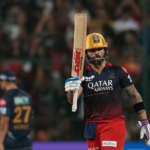
RCB defeated KKR by six wickets in Match 57 of IPL 2026, chasing 193 with five balls remaining after Kolkata had posted 192/4. Kohli, coming into the match after two successive ducks, produced an unbeaten 105 off 60 balls to guide Bengaluru to 194/4 in 19.1 overs and lift them back to the top of the points table.


A Rain Delay, Then a Full-Blooded Contest
The match at Shaheed Veer Narayan Singh International Stadium began under uncertain skies. Rain delayed the toss, covers stayed on the field, and inspections pushed the start back by 75 minutes. Crucially, no overs were lost, allowing the contest to remain a full 20-over match.
Before the first ball, the match carried serious consequences. RCB entered the fixture looking to strengthen their position near the top and edge closer to playoff qualification. KKR, meanwhile, had revived their campaign with four consecutive wins after a difficult start, but still needed results to keep their playoff hopes alive. Pre-match projections had given RCB a slight advantage, with one model rating Bengaluru’s win probability at 56% compared to KKR’s 44%.


RCB captain Rajat Patidar won the toss and chose to bowl, expecting the surface to offer variable bounce similar to their previous Raipur match. He explained the decision clearly: “Obviously, we’ll bowl first. I think it’s a similar wicket that we played last match, so I think it will behave in the same way.”
KKR Build a Competitive 192
Kolkata’s innings began aggressively but unevenly. Finn Allen struck 18 off just eight balls before Bhuvneshwar Kumar removed him, while Ajinkya Rahane made 19 before Josh Hazlewood dismissed him with a return catch. KKR were 56/2 after the powerplay, having scored quickly but lost both openers.
The innings found its structure through Angkrish Raghuvanshi. The young keeper-batter made 71 off 46 balls, hitting seven fours and three sixes, and gave KKR the anchor they needed after early wickets. Cameron Green added 32 off 24, while Rinku Singh’s unbeaten 49 off 29 helped Kolkata finish on 192/4.
RCB’s seamers did enough to prevent KKR from crossing 200. Bhuvneshwar Kumar, Josh Hazlewood and Rasikh Salam each took one wicket, while Raghuvanshi was run out off the final ball of the innings.


On a surface that had been expected to challenge batters, 192 looked more than respectable. Rahane later said, “I mean, we thought 190 was actually a competitive total on that wicket.”
Kohli Answers Pressure With Precision
The chase began with one obvious question: how would Kohli respond after back-to-back ducks?
He answered immediately. After getting off the mark in the first over, he attacked Vaibhav Arora in the second, striking four boundaries and giving RCB early momentum. The powerplay ended at 66/1, with Bengaluru ahead of the required rate and Kohli already looking settled.
Jacob Bethell fell for 15 to Kartik Tyagi, but Devdutt Padikkal joined Kohli and transformed the chase. Their 92-run partnership for the second wicket became the decisive passage of the match. Padikkal made 39 off 27 balls, while Kohli controlled both tempo and risk with the authority that has long defined his best T20 chases.
Kohli reached his fifty off 32 balls and later brought up his ninth IPL century off 58 balls. He finished unbeaten on 105 from 60 deliveries, with 11 fours and three sixes. RCB reached the target at 194/4 in 19.1 overs.
Dropped Chances Hurt Kolkata
KKR had moments to change the match. Rovman Powell dropped Kohli when he was on 21, a costly miss that became more painful with every passing over. Padikkal was also put down during the chase, and Kolkata’s fielding errors undermined the work done by Kartik Tyagi and Sunil Narine.
Tyagi was KKR’s best bowler, taking 3/32 from four overs. He dismissed Bethell, Padikkal and Tim David, the last of those wickets coming after a spectacular one-handed catch by Manish Pandey. Narine remained economical, taking 1/31 from four overs, but KKR lacked consistent pressure from the rest of the attack.
The absence of Varun Chakravarthy mattered. Before the match, KKR captain Rahane confirmed, “Varun is out, Saurabh comes in for him.” That left Kolkata more dependent on Narine in the middle overs and reduced their spin control on a surface where variation could have been influential.
“Pressure Is a Privilege”
Kohli’s post-match comments gave the innings a deeper frame. He admitted that his recent failures had affected him, but described pressure as something that sharpened his preparation.
“Well, there’s a reason why people say pressure is a privilege. It actually keeps you humble, keeps you focused, makes you work hard at practice again. You can’t take things for granted,” Kohli said.
He also emphasized that the century mattered most because it helped RCB secure two points.
“Century or no century, I think the more important thing is finishing the game, making sure that I was out there till the end to get those two points, which again, puts us at the top of the table,” he said.
For a player whose career has been defined by run chases, the innings added another chapter. The match also marked significant milestones: Kohli became the fastest to 14,000 T20 runs, reaching the mark in 409 innings, ahead of Chris Gayle, David Warner, Jos Buttler, Alex Hales and Kieron Pollard.
What the Result Means for RCB
The win pushed RCB to 16 points and placed them at the top of the table, level with Gujarat Titans but ahead on net run rate. It also gave Bengaluru another major step toward playoff qualification, though the commentary made clear they still had not officially secured the “Q” next to their name.
Patidar praised the collective nature of the campaign, saying, “Of course, it feels great. You know, you’ve play well in the tournament and I think everyone came in the different stage and doing [well] for the team. I think that’s a great sign.”
RCB’s balance was also notable. Their seam-heavy selection suited the Raipur surface, while Padikkal’s impact-player role gave the batting order flexibility. The chase showed not only Kohli’s brilliance but also the value of having controlled support around him.
What the Defeat Means for KKR
For Kolkata, the loss ended a four-match winning streak and pushed their playoff hopes into danger. Even if they win their remaining matches, their path is no longer straightforward.
The defeat was not caused by batting failure. A total of 192/4, powered by Raghuvanshi and Rinku, gave them a real chance. The problem was execution with the ball and in the field. Their inexperienced seam attack struggled to sustain pressure, and the dropped chances against Kohli proved decisive.
Rahane identified that moment clearly: “While defending the total, catch of Virat Kohli sometimes, you know, you want to hang on to one of the catch because this wicket was slightly tricky, not an easy wicket to a new batter. That was the difference, I felt.”
The Bigger Picture: RCB’s Chase, KKR’s Warning
RCB vs KKR was more than another league-stage result. It clarified the late-season direction of two campaigns.
Bengaluru look increasingly like a side built for knockout pressure: experienced batting, disciplined seam bowling, and a captain willing to adapt to conditions. KKR still have match-winners, but this game exposed how thin their bowling resources can look without Varun Chakravarthy and when the fielding drops below standard.
Most importantly, the match reaffirmed Kohli’s enduring role in RCB’s identity. After two ducks, he did not merely return to form; he restored order in a chase that could have become complicated. Bengaluru needed 193 on a damp, variable Raipur night. Kohli made it look controlled, almost inevitable.
Conclusion
RCB’s six-wicket win over KKR was a result shaped by context, pressure and execution. Kolkata produced a competitive score through Raghuvanshi and Rinku, but Bengaluru’s seamers kept the total within reach and Kohli delivered one of the defining innings of the IPL 2026 league stage.
For RCB, the victory strengthened their top-two ambitions and moved them closer to the playoffs. For KKR, it turned a revival into a race against time. In a match that began with rain and uncertainty, Kohli provided the clarity: when the chase demanded composure, he still had the game, the nerve and the hunger to finish it.