


NYT Connections May 13 Puzzle Turns Everyday Words Into a Viral Brain Challenge
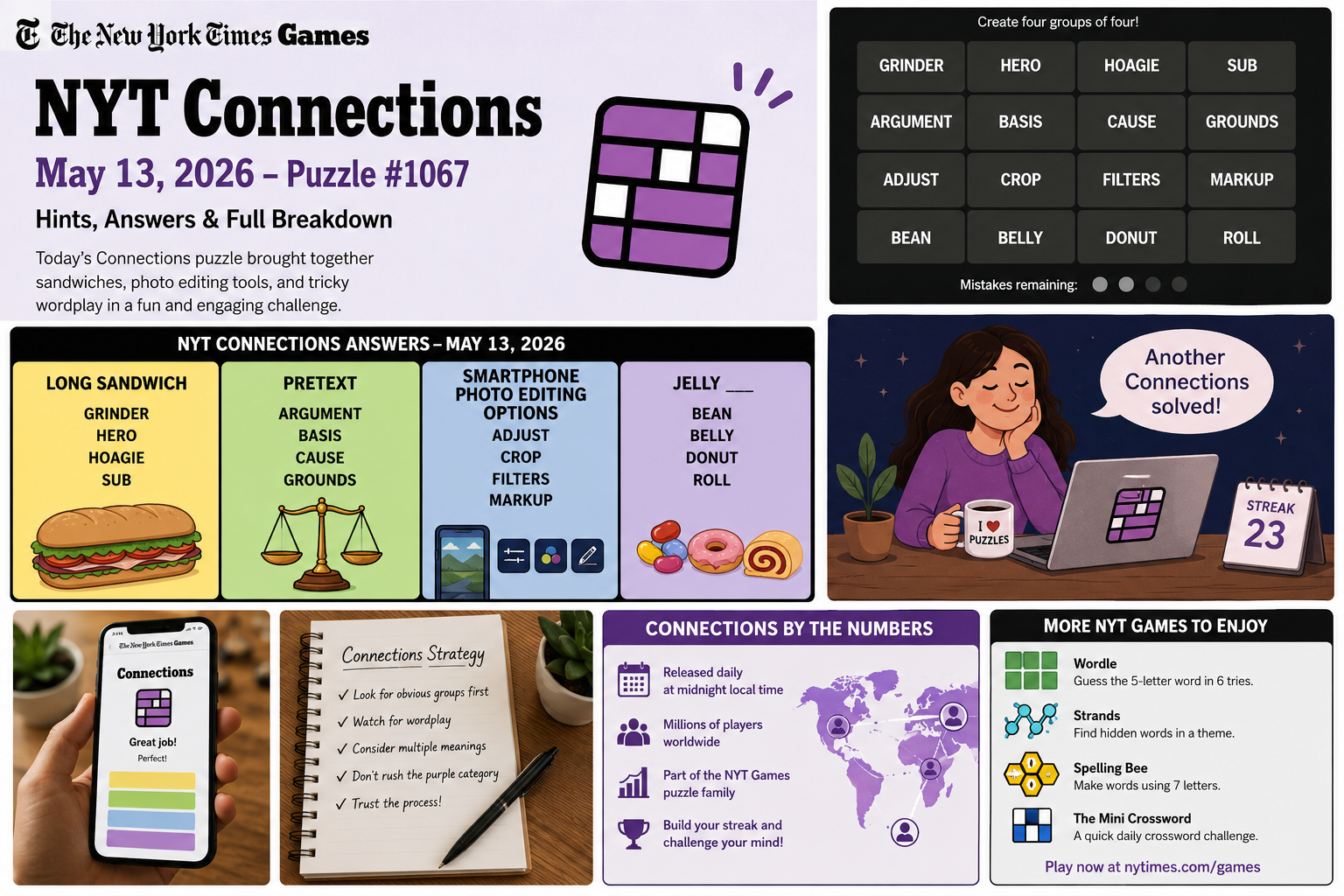
The New York Times continued its streak of highly engaging daily puzzle releases with Connections Puzzle No. 1,067, published on Wednesday, May 13, 2026. The latest edition of the increasingly popular word-association game challenged players to sort 16 seemingly unrelated words into four hidden categories — a deceptively simple format that has helped Connections become one of the internet’s fastest-growing daily games.
While veteran players often expect complicated linguistic traps and obscure references, the May 13 puzzle leaned into accessibility. Official testers rated the game 2.2 out of 5 in difficulty, making it one of the easier recent editions, though many players still found themselves second-guessing categories involving sandwiches, smartphone editing tools, and jelly-themed wordplay.
Why Connections Continues to Explode in Popularity
Connections has evolved from a niche New York Times word game into a daily ritual for millions of puzzle enthusiasts worldwide. Much like Wordle before it, the game thrives on simplicity: players receive a 4×4 grid containing 16 words and must correctly group them into four related sets.
But beneath that straightforward structure lies the real appeal. Connections rewards:
- Pattern recognition
- Lateral thinking
- Cultural knowledge
- Language flexibility
- Awareness of double meanings
The May 13 puzzle demonstrated exactly why the format works so well. Several categories appeared obvious at first glance, only to overlap with misleading alternatives designed to confuse players.
The New York Times released the puzzle globally at midnight local time, continuing its timezone-based rollout system. According to the official companion forum, two live discussion threads are maintained daily to accommodate international audiences.
The Four Categories That Defined Puzzle #1067
The completed solution revealed four distinct themes that mixed food culture, everyday technology, and playful language associations.
Yellow Category: Long Sandwich
The easiest category of the day revolved around regional sandwich terminology:
- GRINDER
- HERO
- HOAGIE
- SUB
This category resonated strongly with American players familiar with regional deli vocabulary. However, some international solvers reportedly struggled with “grinder,” a term more commonly used in parts of the Northeastern United States.
Gaming publications described the category using clues such as “Lunch time” and “Deli terminology,” helping players recognize the food connection without directly revealing the answer.
Green Category Focused on Motivation and Justification
The second category grouped words connected to justification or reasoning:
- ARGUMENT
- BASIS
- CAUSE
- GROUNDS
Official hints described this category with phrases like “On shaky ground” and “Pretext,” nudging players toward legal or explanatory terminology.
This group demonstrated a classic Connections strategy: using words with broad meanings that can easily fit multiple categories. “Cause,” for example, could have pointed toward activism, science, or emotional motivation depending on the player’s interpretation.
Smartphone Editing Tools Reflected Modern Digital Culture
One of the puzzle’s most contemporary categories centered on smartphone photo-editing features:
- ADJUST
- CROP
- FILTERS
- MARKUP
The category highlighted how modern technology vocabulary has become mainstream enough to appear in word puzzles alongside traditional linguistic themes.
Writers covering the puzzle noted that terms such as “filters” and “markup” are instantly recognizable to smartphone users familiar with social media platforms and photo-editing apps.
Several hint guides described the category as:
- “An influencer’s best friend”
- “Change your images”
- “Smartphone photo editing options”
These clues reflected how Connections increasingly incorporates digital-age language into its puzzles.
Purple Category Delivered the Trickiest Wordplay
As usual, the purple category provided the hardest challenge of the puzzle.
Players had to identify words that complete compound phrases beginning with “jelly”:
- BEAN
- BELLY
- DONUT
- ROLL
Together they formed:
- Jelly bean
- Jelly belly
- Jelly donut
- Jelly roll
The category relied heavily on associative thinking rather than direct semantic relationships. Purple categories often frustrate players because the connection exists outside the individual meanings of the words themselves.
Hints such as “Sweet endings” and “Not peanut butter” guided users toward dessert-related interpretations without giving away the solution outright.
Official Companion Forum Encouraged Community Participation
The New York Times once again paired the puzzle with its “Connections Companion” discussion thread, where players could compare solving experiences and discuss difficult categories.
The forum invited readers to:
- Share solve grids
- Compare scores
- Discuss solving strategies
- Receive hints
- Debate category logic
The publication also reminded players that comments are moderated for civility and encouraged users to report technical issues through in-game settings.
The companion article additionally promoted the expanding NYT Games ecosystem across Instagram, WhatsApp, and Threads, where puzzle-solving communities continue to grow rapidly.
Connections Sports Edition Expanded the Franchise Further
The same day also featured Connections Sports Edition #597, a separate sports-focused version developed through a partnership between The New York Times and The Athletic.
The sports edition included categories such as:
- Utah sports teams
- Hall of Fame baseball managers
- Golf-related wordplay
The growing number of Connections variants reflects how successful the franchise has become. What began as a single word-association game has expanded into a broader puzzle ecosystem targeting specialized audiences.
Why Easier Puzzles Still Spark Debate
Despite its relatively low official difficulty score, Puzzle #1067 still generated extensive discussion online.
That contradiction highlights one of Connections’ defining characteristics: difficulty is deeply subjective.
A player familiar with:
- deli culture,
- smartphone editing apps,
- or candy terminology
may find the puzzle trivial, while others encounter entirely unfamiliar references.
The New York Times acknowledged this variability directly in its companion article, noting that player experiences may differ significantly from tester ratings.
The Rise of Daily Puzzle Culture
Connections now sits alongside:
- Wordle
- Strands
- Spelling Bee
- Mini Crossword
as one of the dominant daily digital puzzle experiences.
Its growth reflects broader trends in online engagement:
- short-form daily challenges,
- social sharing,
- streak culture,
- and collaborative solving communities.
Media outlets across gaming, technology, and entertainment increasingly publish daily hint guides, answer breakdowns, and solving strategies tied to each new puzzle release. Publications including Parade, Mashable, TechRadar, Forbes, and others now routinely cover Connections content.
A Puzzle Built for the Internet Era
The May 13 edition of Connections showed why the game continues to resonate with modern audiences.
The puzzle blended:
- regional food vocabulary,
- smartphone terminology,
- classic word association,
- and layered phrase construction
into a format accessible enough for casual players while still challenging dedicated fans.
That balance — approachable yet mentally stimulating — remains the core reason Connections has become one of the defining digital puzzle games of the decade.


