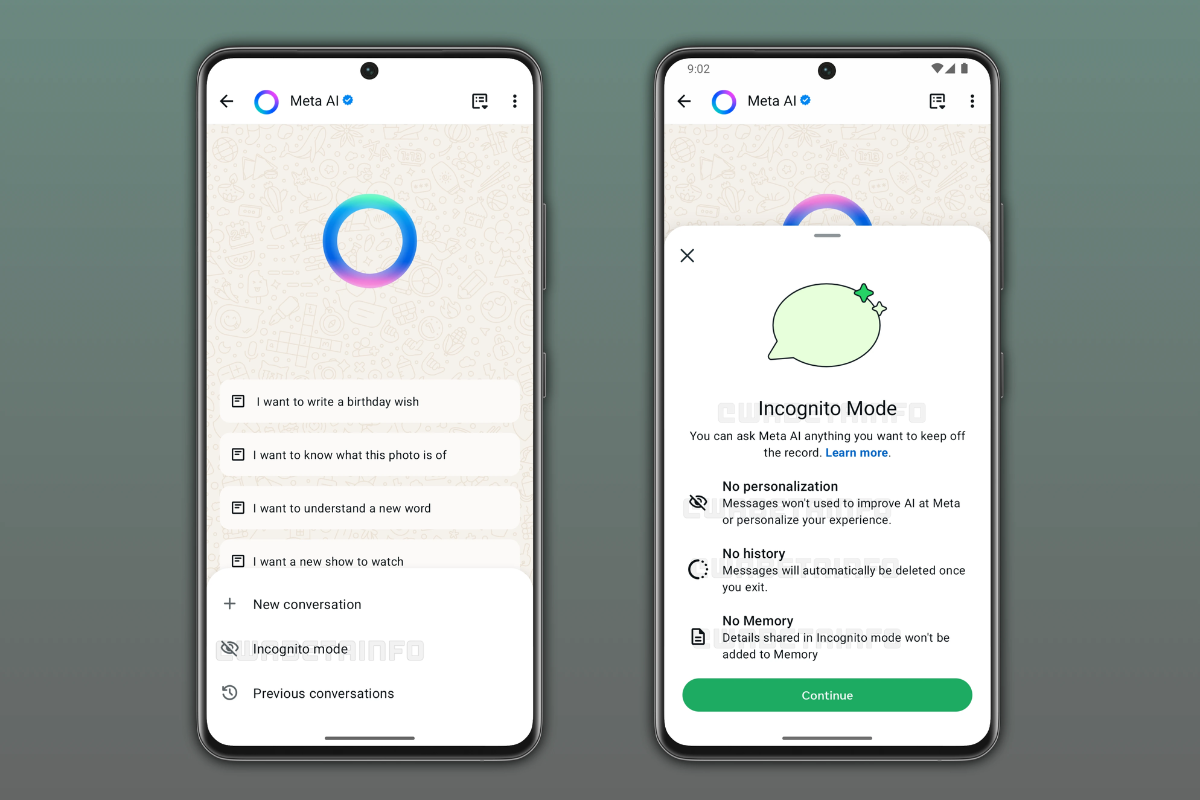
WhatsApp Launches Incognito Chats With Meta AI

10 Min Read

WhatsApp’s New Incognito AI Chats Signal a Major Privacy Shift

WhatsApp is taking a bold step deeper into artificial intelligence while attempting to answer one of the biggest concerns surrounding AI chatbots: privacy.

On May 13, 2026, Meta announced the launch of “Incognito Chat with Meta AI,” a new feature for WhatsApp and the Meta AI app that promises fully private conversations with artificial intelligence. According to Meta, these chats are designed so that “no one — not even Meta — can read your conversations.”

The announcement positions WhatsApp at the center of a growing battle between AI convenience and digital privacy, as millions of users increasingly rely on chatbots for sensitive discussions involving health, finances, relationships, work, and personal advice.

The feature is now rolling out gradually and represents one of the most ambitious privacy-focused AI initiatives introduced by a major technology company.

WhatsApp has launched Incognito Chat with Meta AI, offering private AI conversations that even Meta says it cannot access.

A New Kind of AI Conversation

Meta describes Incognito Chat as a “completely private way to interact with AI.” Unlike traditional chatbot sessions that may be logged, stored, or used for future model training, WhatsApp says these conversations are processed inside a secure environment inaccessible even to Meta itself.

The company emphasized that conversations:

  • are temporary by design
  • are not saved
  • disappear automatically by default
  • cannot be accessed by Meta employees
  • remain visible only to the user

Meta stated that the system is built on top of WhatsApp’s “Private Processing” technology, extending the platform’s long-standing focus on privacy beyond ordinary messaging and into AI interactions.

“Ten years ago we brought the world end-to-end encryption and now we are extending this privacy to chats with Meta AI,” WhatsApp said in its official announcement.

The company also directly contrasted its system with rival AI platforms, arguing that many competing “incognito-style” AI modes still allow providers to see user prompts and AI responses.

“Other apps have introduced incognito-style modes, but they can still see the questions coming in and the answers going out,” Meta said. “Incognito Chat with Meta AI is truly private.”

Why Meta Thinks Private AI Matters

The launch reflects a broader shift in how people are using AI systems.

Chatbots are no longer just novelty tools for casual questions. Increasingly, users are discussing deeply personal issues with AI assistants, including:

  • mental health concerns
  • financial stress
  • medical symptoms
  • relationship advice
  • career decisions
  • workplace problems

Will Cathcart, head of WhatsApp, said many users wanted the benefits of AI without sacrificing confidentiality.

“We’ve heard from a lot of people that they feel some discomfort about sharing [personal] information with the company, yet they want the answers,” Cathcart explained.

Meta CEO Mark Zuckerberg also framed the feature as a major technological milestone, describing it as:

“the first major AI product where there is no log of your conversations stored on servers”.

The company appears eager to position itself as the leading provider of privacy-centric AI experiences at a time when concerns about surveillance, data harvesting, and AI training practices continue to grow worldwide.

How Incognito Chat Works

When users start an Incognito Chat, the interaction opens as a private temporary AI session inside WhatsApp or the Meta AI app.

Meta says the messages are processed in a secure isolated environment using Private Processing infrastructure. According to the company, this means even Meta cannot inspect the contents of the conversation.

Unlike normal chatbot interactions that may be stored indefinitely, Incognito Chats disappear automatically.

The feature is separate from WhatsApp’s traditional end-to-end encryption system, though Cathcart described it as “the equivalent” in terms of protection.

Initially, Incognito Chat will only support text interactions. Meta says image-based AI processing may arrive later, but the company wants to move cautiously while implementing safety guardrails.

The company also noted that Meta AI will refuse requests that appear harmful or illegal, with moderation systems designed to “err on the side of caution.”

The Next Step: “Side Chat”

Meta also revealed another AI feature currently in development called “Side Chat protected by Private Processing.”

Expected to arrive in the coming months, Side Chat would allow Meta AI to privately assist users within ongoing WhatsApp conversations without interrupting the main chat thread.

According to Meta, Side Chat will:

  • understand the context of ongoing conversations
  • provide AI assistance privately
  • remain protected by the same Private Processing technology
  • avoid disrupting group or individual chats

Meta described it as:

“private help with any chat, with context of what’s being discussed, without disrupting the main conversation.”

The announcement signals Meta’s intention to deeply integrate AI assistance throughout WhatsApp’s ecosystem while attempting to preserve the platform’s privacy-first identity.

A Delicate Balance Between Privacy and Accountability

While the announcement has been welcomed by privacy advocates, it has also triggered skepticism and criticism.

Online reactions immediately reflected public distrust toward Meta’s privacy promises, especially given the company’s history involving user data controversies.

Some commenters questioned whether users should trust Meta’s claim that even the company itself cannot access conversations.

Others raised concerns about accountability.

Professor Alan Woodward, a cyber security expert at Surrey University, warned that disappearing AI conversations could create problems if harmful advice or dangerous interactions occur.

“Personally I think what you ask an AI should remain private as some people ask it very personal matters – but you are placing a great deal of trust in the AI not to lead users astray,” he said.

The concern is particularly significant as AI companies face increasing scrutiny over harmful chatbot behavior. Several AI firms, including OpenAI and Google, have already faced lawsuits related to alleged AI-generated harm and wrongful death claims.

If chats disappear permanently and cannot be retrieved by users or Meta, investigators could struggle to determine whether AI interactions contributed to dangerous outcomes.

That creates a difficult ethical question:

How can companies guarantee both total privacy and meaningful accountability at the same time?

Meta’s Massive AI Investment Push

The rollout also arrives during an enormous AI spending race among major technology companies.

Meta has committed massive resources toward AI infrastructure, aiming to compete aggressively with OpenAI, Google, Anthropic, and Microsoft.

According to investment analyst Susannah Streeter from Wealth Club:

“Meta is on track to shell out $145bn [£107bn] on AI infrastructure in 2026, and investors want to see a lot more bang for those mega bucks.”

She added that Meta hopes AI integration across its apps could significantly strengthen its advertising and commerce business.

The stakes are high.

Meta AI reportedly reached one billion users across Meta’s apps in 2025, according to Zuckerberg, making WhatsApp one of the world’s largest AI distribution platforms.

With billions of WhatsApp users globally, even small AI feature changes could reshape how ordinary people interact with artificial intelligence every day.

WhatsApp’s AI Expansion Continues

The incognito feature represents another major step in WhatsApp’s transformation from a simple messaging app into a broader AI-powered communication platform.

In recent years, WhatsApp has added:

  • Meta AI integration
  • AI-powered chat assistance
  • business automation tools
  • enhanced media capabilities
  • cloud backup improvements
  • subscription features
  • interface redesign experiments

At the same time, the platform has faced criticism from some users who disliked the growing presence of AI features and the inability to fully disable Meta AI inside the app.

Still, Meta appears determined to position WhatsApp as a central hub for AI-assisted communication while differentiating itself through privacy-focused messaging.

The Bigger Picture for AI Privacy

The launch of Incognito Chat reflects a broader industry trend toward “private AI” systems.

As users become more dependent on AI assistants, pressure is increasing on technology companies to reassure people that highly personal interactions will not become training data, advertising profiles, or security liabilities.

Meta’s approach attempts to address those fears directly by removing stored records altogether.

Whether users trust that promise may determine how successful the feature becomes.

For now, WhatsApp’s Incognito Chat represents one of the clearest signals yet that privacy could become the next major battleground in the AI industry.

And as AI assistants move deeper into everyday life, the demand for confidential, secure, and temporary digital conversations is likely to grow rapidly.

Share This Article