

Tesla (TSLA) at a Crossroads: Big Bets on AI, Rising Costs, and Investor Doubts
A Defining Moment for Tesla
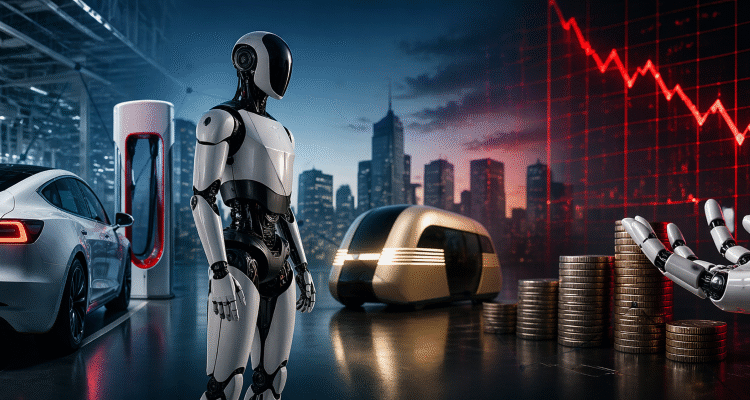
Tesla (TSLA) is entering a pivotal phase in its evolution—one where its identity is shifting from a dominant electric vehicle (EV) manufacturer to a broader artificial intelligence and robotics powerhouse. While the company’s latest earnings demonstrate resilience, investors are increasingly focused on a more pressing question: can Tesla’s ambitious long-term vision justify the mounting costs and uncertain returns?
Recent developments following Tesla’s Q1 2026 earnings report reveal a company willing to sacrifice near-term profitability in pursuit of transformative technologies. Yet, the market reaction has been cautious, even skeptical.
Strong Earnings, Weak Sentiment
On paper, Tesla’s first-quarter performance was solid. The company reported:
- Earnings per share growth of 52% year-over-year to $0.41, surpassing expectations of $0.37
- Revenue rising 16% to $22.39 billion
However, the interpretation of these results has been mixed. While some analysts saw a beat, others flagged a potential revenue miss depending on benchmark estimates.
The market’s reaction tells a clearer story. Tesla shares fell more than 3% following the earnings release, and the stock is now down roughly 14% year-to-date .
This disconnect between earnings performance and stock movement highlights a deeper concern: investors are no longer evaluating Tesla solely on financial results—they are scrutinizing its strategic direction.
The $25 Billion Bet on the Future
At the center of this debate is Tesla’s aggressive investment strategy. The company plans to spend over $25 billion in 2026, a dramatic increase from $8.53 billion the previous year .
This capital is being funneled into three key areas:
1. Artificial Intelligence
Tesla is doubling down on AI to power its autonomous driving systems and broader software ecosystem.
2. Robotaxis
The company’s robotaxi initiative is already in early rollout stages in select U.S. cities, with its futuristic Cybercab expected to enter volume production soon. However, meaningful revenue from this segment is not anticipated until 2027 .
3. Robotics (Optimus)
Tesla’s humanoid robot, Optimus, represents perhaps the most ambitious—and speculative—project. Elon Musk has suggested it could become a major value driver, though its commercial viability remains uncertain.
The Cost of Ambition: Negative Cash Flow Ahead
Despite a $1.44 billion surplus in Q1, Tesla now expects negative free cash flow for the rest of the year .
This shift marks a critical turning point. Tesla is effectively transitioning from a cash-generating company to one reinvesting heavily in future technologies.
The challenge? Unlike peers such as Microsoft, Alphabet, and Amazon—companies with stable, high-margin businesses—Tesla lacks a similarly strong financial cushion to support such aggressive spending.
Declining Returns Raise Red Flags
One of the most concerning indicators for investors is Tesla’s declining return on invested capital (ROIC). As spending rises, the efficiency of that capital is falling—suggesting diminishing short-term returns.
This dynamic is fueling debate among analysts:
“If you think that Elon Musk’s view that Optimus will be ultimately their most worthy, most value-creating platform, and you think you’re skeptical, then the capex doesn’t make sense,” said Seth Goldstein, an analyst at Morningstar.
“But if you think that Elon Musk has proven himself that he can make seemingly impossible things a reality, then you’re willing to take the leap of faith here.”
At the same time, concerns about strategic overreach are growing:
“Tesla is being pulled in too many different directions at once,” said Greg Basich of Counterpoint Research.
Market Sentiment Turns Neutral
Investor behavior reflects this uncertainty. Data from TipRanks’ Crowd Wisdom tool shows sentiment toward Tesla is currently Neutral, with minimal portfolio additions in recent weeks .
Compared to its “Magnificent Seven” peers, Tesla is lagging:
- Microsoft: Very Positive sentiment
- Alphabet, Meta, Nvidia, Apple: Positive sentiment
- Tesla: Neutral sentiment
This divergence suggests investors are favoring companies with clearer, more immediate AI monetization strategies.
Analyst Ratings: A Divided Wall Street
Wall Street’s outlook on Tesla reflects this uncertainty:
- 13 Buy ratings
- 11 Hold ratings
- 6 Sell ratings
The overall consensus? Hold
The average price target sits around $411–$412, implying a modest upside of roughly 6% .
In other words, analysts see limited near-term catalysts but acknowledge long-term potential.
Trading Dynamics: A Volatile Technical Picture
From a technical standpoint, Tesla stock is currently trading around $201, reflecting a “sharp reset” in pricing levels .
Key levels to watch include:
- Upside targets: $208 → $215 → $222
- Downside risks: $194 → $187 → $180
This range underscores the stock’s volatility and sensitivity to both macroeconomic data and company-specific developments.
The Bigger Picture: Vision vs. Execution
Tesla’s strategy is bold—perhaps more than ever before. The company is no longer just competing in the EV market; it is attempting to redefine multiple industries simultaneously:
- Transportation (robotaxis)
- Artificial intelligence (autonomous systems)
- Robotics (Optimus)
But this diversification comes with trade-offs. Investors must now weigh:
- High capital expenditure today
- Uncertain and delayed returns
- Execution risk across multiple fronts
Conclusion: A High-Stakes Gamble on the Future
Tesla’s current trajectory can best be described as a high-risk, high-reward transformation. The company is betting that its investments in AI, robotics, and autonomous mobility will redefine its business—and potentially entire industries.
For now, however, the market remains cautious.
The central question facing Tesla is no longer whether it can innovate—it clearly can. Instead, it is whether those innovations can translate into sustainable, scalable returns.
Until that answer becomes clearer, TSLA may remain a stock defined as much by belief as by fundamentals.


