


Roelf Meyer and Africa’s Diplomatic Moment: A Strategic Return to Negotiation Leadership
A Veteran Negotiator Steps Back Onto the Global Stage
South Africa has turned to one of its most experienced political figures at a critical diplomatic moment. President Cyril Ramaphosa has appointed Roelf Meyer as the country’s next ambassador to the United States, signaling a calculated effort to stabilize and rebuild strained international relations.
“I can confirm that President Cyril Ramaphosa has appointed Mr Roelf Meyer as South Africa’s Ambassador to the US,” said presidential spokesperson Vincent Magwenya.
The decision is not merely administrative. It reflects a broader strategy rooted in Meyer’s long-standing reputation as a negotiator capable of bridging ideological divides—an attribute that defined his role in one of Africa’s most transformative political transitions.
From Apartheid-Era Politician to Architect of Transition
Roelf Meyer’s political trajectory mirrors South Africa’s own complex evolution. Beginning his parliamentary career in 1979 under P.W. Botha, Meyer initially operated within the structures of apartheid governance. He later served under F.W. de Klerk as minister of defence and constitutional affairs.
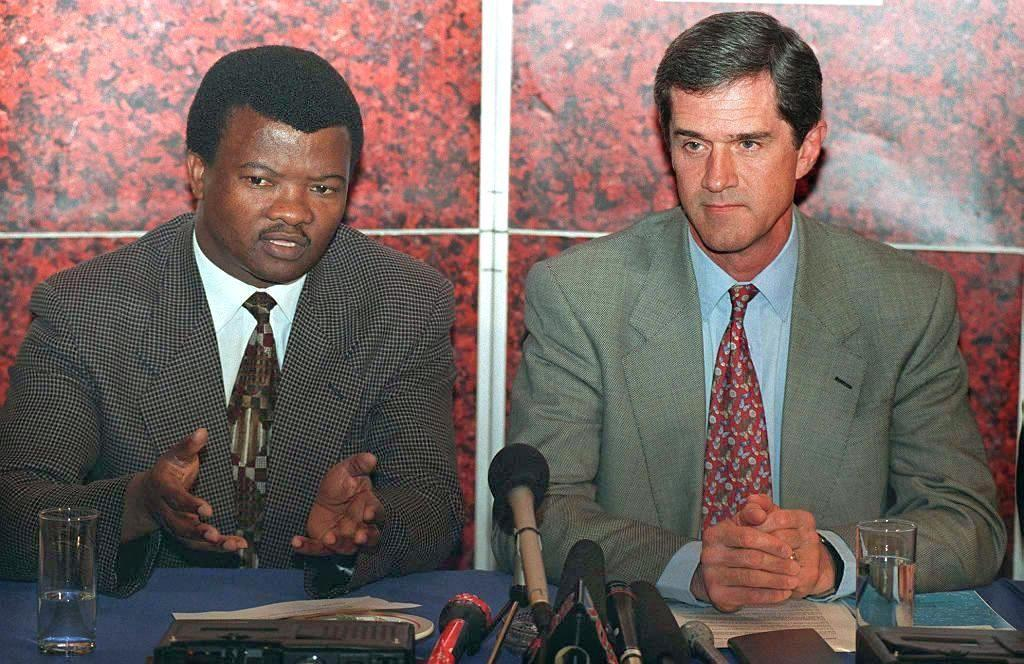
However, his defining contribution came during the early 1990s, when he became the chief negotiator for the National Party in talks to end white minority rule. Opposite him at the negotiating table was Cyril Ramaphosa, then representing the African National Congress.
The negotiations, particularly in 1993, were marked by deep mistrust and frequent deadlocks. Yet both leaders managed to steer discussions toward compromise, laying the groundwork for South Africa’s first democratic elections in 1994.
Ramaphosa has since described Meyer as “a true citizen committed to a non-racial South Africa,” underscoring the enduring respect between former adversaries turned collaborators.
Serving a New South Africa
Following the end of apartheid, Meyer transitioned into the democratic era, joining the government of national unity led by Nelson Mandela. This move cemented his reputation as a pragmatic figure willing to adapt to a radically changing political landscape.
His career demonstrates a consistent pattern: operating effectively in high-stakes environments where ideological divisions must be reconciled through negotiation rather than confrontation.
Now, at 78, Meyer returns to public service in a role that once again demands those same skills—this time on the international stage.
Why the United States Posting Matters Now
The timing of Meyer’s appointment is significant. South Africa has lacked an ambassador in Washington since Ebrahim Rasool was expelled in March 2025 following tensions with the administration of Donald Trump.
Relations between Pretoria and Washington have deteriorated during Trump’s second term. Points of contention include controversial claims by Trump regarding the treatment of South Africa’s white Afrikaner minority and the establishment of a refugee program that Pretoria views as preferential toward white citizens.
In this context, Meyer’s Afrikaner background, combined with his track record of negotiation, positions him uniquely. He is both a figure of historical continuity and a potential bridge between conflicting narratives.
A Diplomatic Strategy Rooted in Experience
Meyer’s appointment can be interpreted as a deliberate recalibration of South Africa’s diplomatic posture. Rather than opting for a career diplomat or a political newcomer, the government has chosen a figure associated with conflict resolution and institutional compromise.
Several strategic considerations underpin this decision:
1. Credibility in Negotiation
Meyer’s role in ending apartheid lends him international credibility. His experience in resolving one of the 20th century’s most entrenched conflicts carries symbolic and practical weight.
2. Political Balance
As an Afrikaner who later served under Mandela, Meyer embodies South Africa’s transition narrative—an asset in addressing sensitive issues involving race, identity, and policy.
3. Restoring Dialogue Channels
With bilateral relations strained, the priority shifts from policy alignment to communication restoration. Meyer’s history suggests an ability to reopen stalled conversations.
Africa’s Broader Diplomatic Context
While the appointment is specific to South Africa, its implications extend across Africa’s diplomatic landscape. The continent’s engagement with global powers—particularly the United States, China, and the European Union—has become increasingly complex.
South Africa, as one of Africa’s largest economies and a key political actor, often serves as a bellwether for broader regional dynamics. A successful diplomatic reset with Washington could influence trade, investment, and geopolitical positioning across the continent.
Conversely, continued tensions could reinforce fragmentation in Africa–US relations, particularly at a time when global alliances are being recalibrated.
What Comes Next
Meyer did not immediately respond to requests for comment following his appointment. However, expectations around his tenure are clear:
- Re-establish consistent diplomatic engagement between Pretoria and Washington
- Address contentious narratives affecting bilateral relations
- Position South Africa as a stable and credible partner on the global stage
Given his track record, the emphasis is likely to be on incremental progress rather than rapid breakthroughs.
Conclusion: A Calculated Return to Negotiation Politics
Roelf Meyer’s appointment is not simply about filling a diplomatic vacancy. It represents a strategic decision grounded in history, experience, and necessity.
At a time when South Africa’s relationship with the United States faces measurable strain, the government has opted for a figure whose career is defined by navigating precisely such complexities.
Whether Meyer can replicate his past success on an international scale remains to be seen. What is clear, however, is that South Africa is once again placing its confidence in negotiation as the primary instrument of political progress—both at home and abroad.


