


Inside the Ramaphosa–Wicknell Chivayo Meeting That Sparked Regional Controversy
A surprise meeting between South African President Cyril Ramaphosa and controversial Zimbabwean businessman Wicknell Chivayo has ignited political debate across Southern Africa, raising questions about diplomacy, regional power dynamics, corruption investigations, and the complex relationship between South Africa and Zimbabwe.
What was initially presented as a routine bilateral engagement between Ramaphosa and Zimbabwean President Emmerson Mnangagwa quickly turned into a political storm after photographs emerged showing Ramaphosa alongside Chivayo — a businessman whose assets have reportedly been frozen in South Africa and who is under investigation by the Hawks for alleged money laundering.
The controversy intensified after South Africa’s Presidency publicly distanced Ramaphosa from Chivayo, insisting the president had no prior knowledge that the businessman would attend the gathering.
The episode has since become one of the most closely watched political developments in the region, drawing criticism from opposition parties, triggering speculation about Zimbabwe’s internal political tensions, and reigniting scrutiny of wealthy businessmen linked to the ruling ZANU-PF establishment.
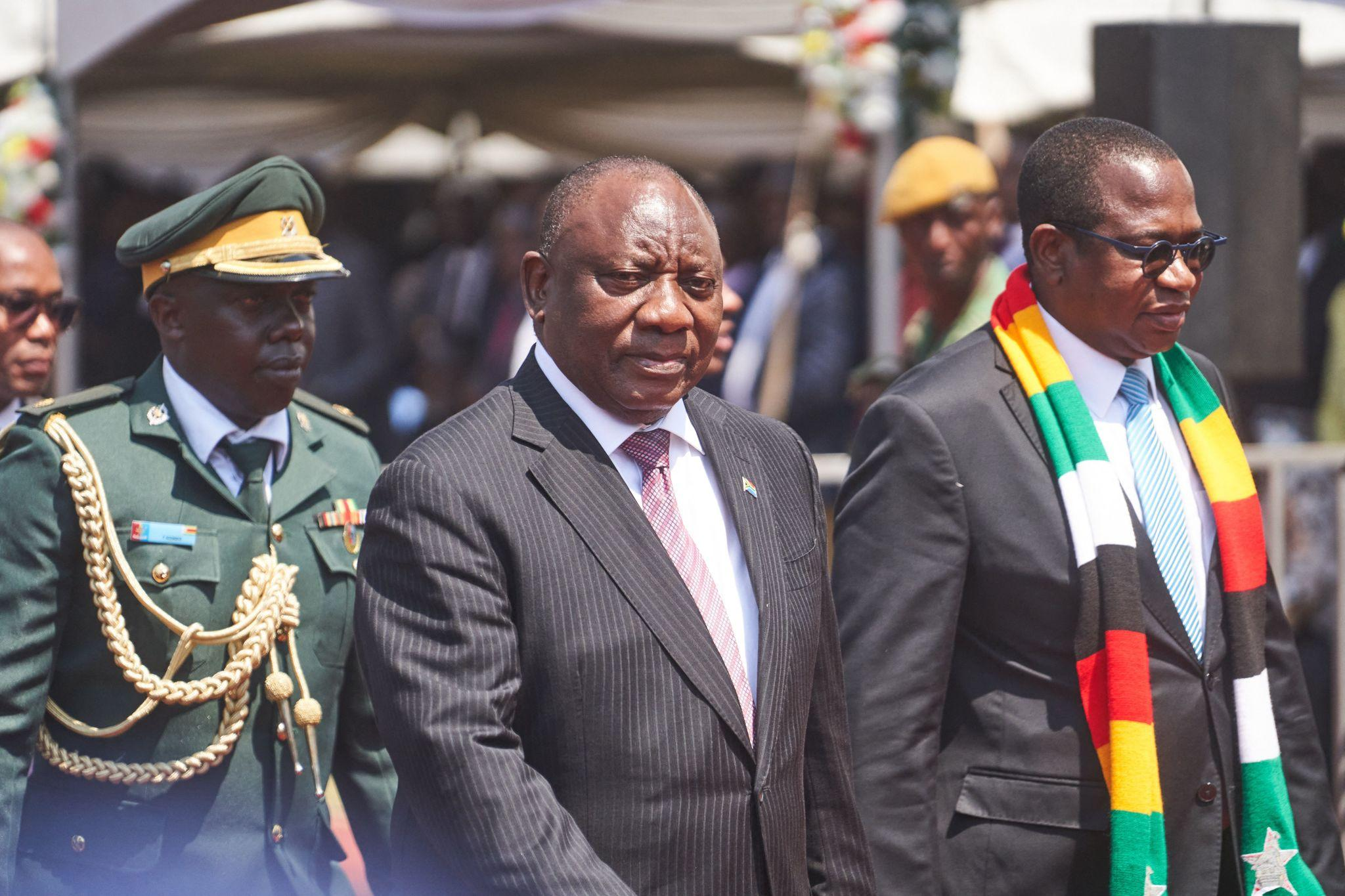
The Meeting at Mnangagwa’s Farm
The meeting took place during Ramaphosa’s visit to Zimbabwe on Sunday, where he travelled to President Emmerson Mnangagwa’s private Precabe Farm in Kwekwe.
According to official statements, the visit was intended to discuss “issues of mutual and bilateral interest” between South Africa and Zimbabwe. Presidency spokesperson Vincent Magwenya described the engagement as a “working visit” arranged in an informal environment to allow both leaders to speak openly about regional and bilateral matters.
However, public attention shifted rapidly after photographs circulated online showing Ramaphosa in the company of several influential Zimbabwean businessmen, including:
- Wicknell Chivayo
- Kudakwashe Tagwirei
- Paul Tungwarara
The presence of these figures transformed what might have been a low-profile diplomatic engagement into a major political controversy.
Presidency Says Ramaphosa Did Not Know Chivayo
Facing mounting criticism, Magwenya addressed the issue during a press briefing in Parliament.
He stated:
“President Ramaphosa had no prior knowledge of who will be present during the visit nor is he familiar with the said individual.”
He further added:
“The president flew to Zimbabwe for a meeting with his counterpart and nothing else.”
According to Magwenya, Ramaphosa only became aware of the controversy after returning to South Africa, when officials informed him that one of the individuals photographed during the meeting was a “person of interest” to South African law enforcement.
The Presidency also stressed that law enforcement agencies should continue investigating any ongoing matters involving such individuals “with no fear or hesitation.”
The remarks were intended to distance the South African president from any suggestion of political association or endorsement of Chivayo.
Who Is Wicknell Chivayo?
Wicknell Chivayo is one of Zimbabwe’s most controversial businessmen.
Known for his flamboyant public lifestyle, luxury spending, and close ties to Zimbabwe’s ruling elite, Chivayo has become a highly polarizing figure in Zimbabwean politics and business.
He is widely associated with:
- Government tenders
- Energy-sector contracts
- Political patronage networks
- Public displays of wealth
- Support for President Mnangagwa and ZANU-PF
One of the most notable projects linked to Chivayo is the Gwanda Solar Project, reportedly valued at approximately US$172 million. The project has faced longstanding controversy and scrutiny over implementation delays and financial transparency.
Recent reports indicate that Chivayo’s assets have been frozen in South Africa and that he is under investigation by the Hawks for alleged money laundering.
Despite the legal scrutiny, Chivayo remains influential in Zimbabwe’s political and business circles and frequently appears alongside senior ZANU-PF officials.
Why the Meeting Triggered Backlash
The backlash was driven by more than just Chivayo’s attendance.
Critics argued that the optics of a South African president appearing alongside controversial businessmen closely linked to Zimbabwe’s ruling establishment undermined South Africa’s anti-corruption positioning.
South Africa’s Democratic Alliance (DA) sharply criticized the visit, questioning both the purpose of the engagement and the presence of Chivayo and Tagwirei.
DA MP Ryan Smith reportedly referred to the businessmen as “the Zimbabwean Guptas,” invoking comparisons with South Africa’s state capture scandal.
The DA also argued that the meeting occurred during a politically sensitive period in Zimbabwe, where debates around constitutional amendments and presidential term extensions are intensifying.
Some critics claimed the visit risked signaling tacit support for Mnangagwa’s political agenda.
Speculation Over Zimbabwe’s Political Future
The controversy deepened further because of speculation surrounding Zimbabwe’s internal political tensions.
Reports circulating in Zimbabwe suggested that Ramaphosa’s visit may have included discussions about:
- Political stability
- Succession battles within ZANU-PF
- Constitutional amendment proposals
- Concerns about instability spilling into South Africa
Zimbabwean journalist Hopewell Chin’ono claimed Ramaphosa may have privately discussed concerns regarding efforts to extend Mnangagwa’s presidency beyond the constitutional limit of 2028.
Although these claims remain unconfirmed officially, they added another layer of intrigue to the meeting.
Magwenya declined to disclose the exact content of the discussions between Ramaphosa and Mnangagwa but acknowledged that issues related to developments in Zimbabwe would naturally have formed part of their discussions.
Economic and Regional Implications
The meeting also highlighted the deep economic ties between South Africa and Zimbabwe.
Zimbabwe remains heavily dependent on trade with South Africa, while South Africa continues to feel the economic and migration pressures generated by Zimbabwe’s instability.
According to statements shared after the meeting:
- Zimbabwe exported goods worth approximately US$581.9 million in March 2025
- South Africa accounted for nearly 24.4% of those exports
- South Africa’s exports to Zimbabwe reportedly reached US$4.3 billion in 2025
These figures illustrate why regional stability remains strategically important for Pretoria.
Migration, economic collapse, governance concerns, and political instability in Zimbabwe continue to affect South Africa directly through border pressure, labor migration, and diplomatic tensions.
The Optics Problem for Ramaphosa
Even though the Presidency insists Ramaphosa did not know Chivayo would attend the gathering, analysts say the images themselves created a damaging political narrative.
Photographs showing the South African president alongside controversial businessmen quickly spread across social media and regional news platforms, fueling:
- Corruption concerns
- Diplomatic criticism
- Questions about political alliances
- Renewed scrutiny of regional elites
For Ramaphosa — who has often presented himself as committed to anti-corruption reforms following the Zondo Commission — the association created uncomfortable comparisons to South Africa’s own state capture era.
Opposition voices argued that the incident demonstrated poor political judgment, even if accidental.
A Broader Story About Power and Influence in Southern Africa
Beyond the immediate controversy, the episode reflects a broader regional issue: the growing influence of politically connected business elites in Southern African politics.
Figures like Wicknell Chivayo and Kudakwashe Tagwirei symbolize the blurred lines between:
- Political power
- State contracts
- Wealth accumulation
- Regional diplomacy
- Elite patronage systems
Their visibility at high-level political gatherings reinforces perceptions that influential businessmen increasingly play informal but significant roles in shaping political and economic relationships across the region.
The Ramaphosa–Chivayo controversy therefore became about more than a single photograph — it evolved into a wider debate about governance, accountability, political influence, and regional diplomacy.
What Happens Next?
For now, the South African Presidency appears determined to contain the fallout by emphasizing that:
- Ramaphosa was unaware of Chivayo’s attendance
- Law enforcement investigations must continue independently
- The visit focused strictly on bilateral relations
However, scrutiny is unlikely to disappear soon.
Questions remain about:
- Who organized the guest list
- Why controversial businessmen were included
- Whether deeper political discussions took place
- How South Africa should engage Zimbabwe’s leadership moving forward
The controversy may also increase pressure on South African authorities to demonstrate that ongoing investigations involving Chivayo are being handled independently and transparently.
At the same time, the incident underscores how closely South Africa’s political future remains tied to developments inside Zimbabwe.
Conclusion
The meeting between Cyril Ramaphosa and Wicknell Chivayo has become one of the most politically sensitive diplomatic moments in recent Southern African politics.
What began as a bilateral engagement between neighboring presidents quickly evolved into a controversy touching on corruption allegations, regional diplomacy, political succession, migration pressures, and elite influence networks.
While the Presidency insists Ramaphosa had no knowledge that Chivayo would be present, the images from Mnangagwa’s farm continue to shape public perception and political debate.
The incident serves as a reminder that in modern politics, symbolism and optics can become as consequential as official policy itself.


