



Nationals Dominate Phillies as Early-Season Questions Deepen in NL East Clash
The early days of the 2026 MLB season rarely define a team’s destiny—but they can reveal patterns. In the latest chapter of the Washington Nationals vs. Philadelphia Phillies rivalry, one team delivered a clear message while the other was left searching for answers.
The Nationals overwhelmed the Phillies 13–2 at Citizens Bank Ballpark, combining relentless offensive production with composed pitching. The result was not merely a win—it was a structural dismantling that exposed early vulnerabilities in Philadelphia’s lineup and pitching execution.

How the Game Unfolded: From Early Surge to Complete Control
First Inning Shock Sets the Tone
The contest effectively tilted in the opening inning. Washington capitalized immediately on Phillies starter Taijuan Walker, stringing together disciplined at-bats and timely contact to produce a four-run first inning.
That early burst established two critical dynamics:
- The Nationals dictated tempo from the outset
- The Phillies were forced into reactive, rather than strategic, play
From that point forward, Philadelphia never regained control.
Sustained Offensive Pressure
Washington’s offense did not rely on power hitting alone. Instead, it executed a methodical approach—what analysts often describe as “dink-and-dunk” baseball—focused on contact and base progression.
- 17 total hits were recorded by the Nationals
- Seven players produced multi-hit performances
- Only three hits were doubles; none exceeded 100 mph exit velocity
This reflects a high-contact, situational hitting strategy that proved highly effective against Philadelphia’s pitching staff.
Joey Wiemer’s Record-Tying Start
A central figure in the game was Joey Wiemer, whose early-season form has drawn attention across the league.
- Reached base 10 consecutive times to begin the season
- Tied a Major League record previously set by Carlos Delgado (2002)
- Opened the game with an infield single after a successful challenge
His streak eventually ended in the fifth inning, but by then, the damage had already been done.
Pitching Performance: Stability vs. Struggle
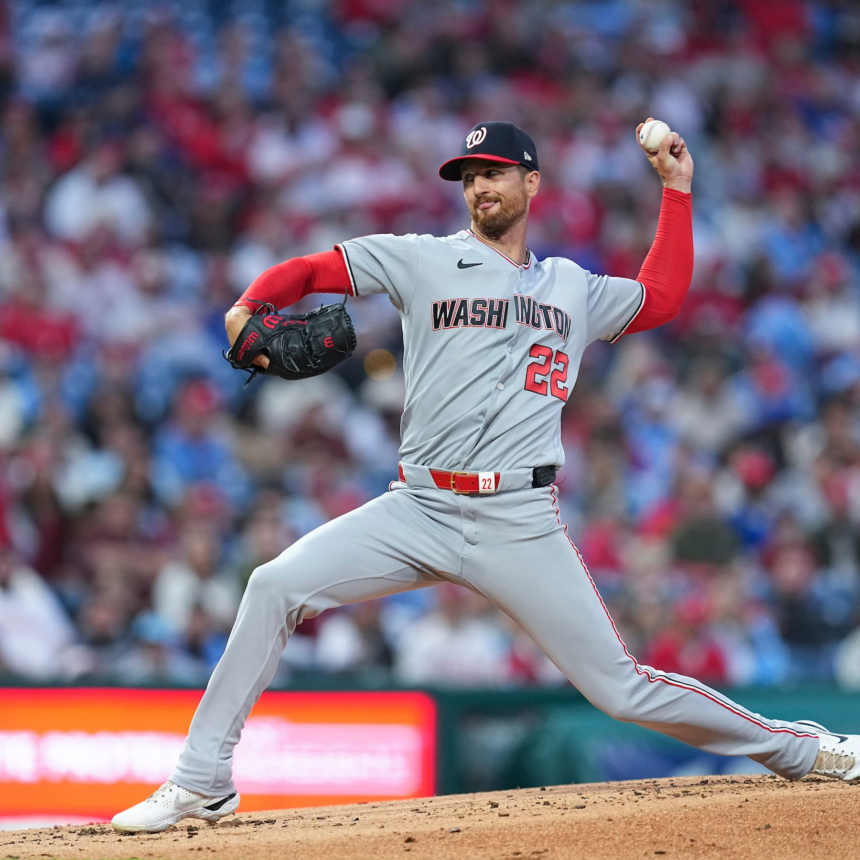
Foster Griffin Anchors Washington
Making his first MLB appearance since 2022, Foster Griffin delivered a composed outing:
- 5 innings pitched
- 2 runs allowed
- 5 hits conceded
He provided exactly what Washington needed: stability and control. The bullpen followed with four scoreless innings, ensuring the lead remained unchallenged.
Phillies’ Pitching Breakdown
In contrast, Philadelphia’s pitching unit failed to stabilize the game:
- Walker allowed seven runs (six earned) in under five innings
- Early traffic on bases set a persistent negative rhythm
- Lack of command forced defensive scrambling
The situation deteriorated to the point where the Phillies deployed a position player to pitch in the ninth inning, a rare move so early in a season and a clear indicator of damage-control mode.
Key Player Contributions
Nationals Standouts
- José Tena: 3 hits, consistent offensive presence
- Luis García Jr.: 3 RBIs, critical run production
- Bullpen (Brad Lord & Cole Henry): 4 scoreless innings
Phillies Highlights
- Rafael Marchán: Two-run home run (only Phillies runs)
- Bryce Harper: 0-for-5 performance, six runners left on base
Harper’s early-season numbers—1-for-16 through four games—underscore broader offensive inconsistencies within the Phillies lineup.
A Pattern Emerging for Philadelphia
The loss dropped the Phillies to 1–3, extending their early-season struggles.
Several recurring issues are becoming evident:
1. Offensive Inconsistency
Despite a strong 2025 campaign—featuring 212 home runs and 8.8 hits per game—the current lineup has struggled to convert opportunities.
2. Early-Game Pitching Instability
Games are slipping away in the first few innings, forcing the team into recovery mode rather than proactive control.
3. Lack of Momentum Recovery
Once behind, Philadelphia has shown limited ability to reset or generate counter-pressure.
These are not isolated problems. They mirror concerns observed late in the previous season, suggesting continuity rather than coincidence.
Nationals’ Momentum and Strategic Identity
For Washington, the win reinforces a promising start:
- Improved record to 3–1
- First divisional victory of the season
- Evidence of cohesive offensive execution
More importantly, the Nationals demonstrated a clear tactical identity:
- Emphasis on contact hitting over power
- Efficient bullpen usage
- Situational awareness in scoring opportunities
This approach may not generate headlines like home-run-heavy performances, but it is highly sustainable over a long season.
What Comes Next in the Series
The series continues with a compelling pitching matchup:
- Nationals: PJ Poulin (0-0, 0.00 ERA)
- Phillies: Andrew Painter (MLB debut)
Philadelphia enters the game attempting to break a three-game losing streak, while Washington aims to extend early dominance.
From a betting perspective:
- Phillies favored at -187
- Nationals at +155
- Projected total: 9 runs
These numbers reflect lingering confidence in Philadelphia’s roster quality, despite current form.
Broader Implications: Early Signal or Temporary Dip?
For the Nationals
This performance suggests:
- A potentially competitive trajectory in the NL East
- Strong clubhouse confidence following back-to-back series success
- A viable offensive system built on depth rather than reliance on star power
For the Phillies
The concerns are more structural:
- Early-season execution gaps
- Dependence on key players not yet producing
- Pressure on upcoming pitching performances, particularly rookie Andrew Painter
While it remains early in the 162-game schedule, performances of this nature tend to shape internal evaluations and strategic adjustments.
Conclusion: A Game That Revealed More Than the Scoreline
The 13–2 victory was not simply a lopsided result—it was diagnostic.
For the Nationals, it confirmed that their system—balanced offense, controlled pitching, and disciplined execution—can produce consistent outcomes.
For the Phillies, it raised immediate questions about resilience, depth, and early-season readiness.
As the series continues, the next matchup becomes more than just another game—it becomes a test of response.