


NYT Connections April 30, 2026: A Complete Guide to Puzzle #1054
Understanding Today’s Challenge
The New York Times’ Connections puzzle has steadily grown into one of the most engaging daily brain teasers for word enthusiasts. On April 30, 2026, puzzle #1054 continues that tradition, presenting players with a seemingly random set of words that demand sharp logic, creative thinking, and a keen eye for patterns.
Unlike traditional word games, Connections challenges players to group 16 words into four categories, each tied together by a shared theme. These categories range in difficulty—from straightforward (yellow) to highly abstract (purple)—making the puzzle accessible yet deceptively complex.
Today’s edition is a perfect example: some connections are immediately recognizable, while others rely on subtle linguistic cues and clever misdirection.
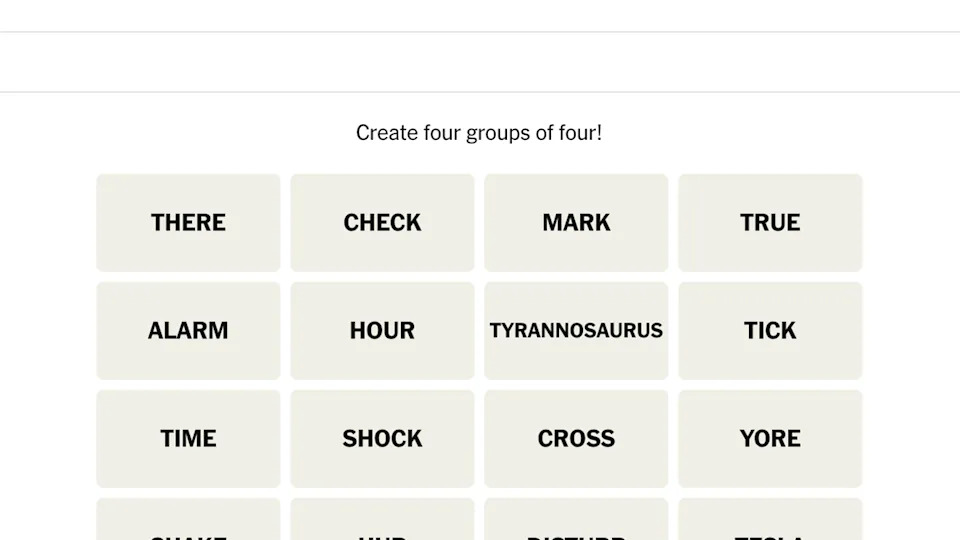
The Word List: A Puzzle Full of Possibilities
The April 30 puzzle features the following 16 words:
THERE, CHECK, MARK, TRUE, ALARM, HOUR, TYRANNOSAURUS, TICK, TIME, SHOCK, CROSS, YORE, SHAKE, HUR, DISTURB, TESLA
At first glance, the list appears chaotic. However, the key lies in identifying overlapping meanings, phonetic similarities, and contextual relationships.
Decoding the Categories: What Ties the Words Together
🟡 Yellow Group: Emotional Disturbance and Fear
ALARM, DISTURB, SHAKE, SHOCK
This category focuses on words associated with unsettling or startling someone emotionally. Each term conveys a sense of disruption or surprise, making it one of the more intuitive groups in today’s puzzle.
🟢 Green Group: Task Completion Actions
CHECK, CROSS, MARK, TICK
These words share a practical, everyday function: they are actions used when completing or removing items from a list. Whether ticking off tasks or crossing them out, this group reflects routine organizational behavior.
🔵 Blue Group: Meanings of the Letter “T”
TESLA, TIME, TRUE, TYRANNOSAURUS
Here, the puzzle takes a more abstract turn. Each word represents a different meaning or association of the letter “T”:
- Tesla – a unit of magnetic flux density
- Time – often abbreviated as “T” in physics
- True – commonly shortened to “T” in logic or notation
- Tyrannosaurus – a word beginning with the letter “T”
This category requires lateral thinking and familiarity with symbolic usage.
🟣 Purple Group: Homophones of Possessive Forms
HOUR, HUR, THERE, YORE
The most challenging category of the day, this group includes words that sound like possessive adjectives:
- Hour → “our”
- Hur → “her”
- There → “their”
- Yore → “your”
This phonetic twist is a classic example of how Connections uses sound rather than meaning to create links.
Why Today’s Puzzle Stands Out
Puzzle #1054 strikes a balance between accessibility and complexity. The yellow and green groups provide an easy entry point, while the blue and purple categories demand deeper reasoning.
What makes this edition particularly engaging is its reliance on multiple dimensions of language:
- Semantic meaning (emotional disturbance)
- Functional usage (task management)
- Symbolic interpretation (letter “T”)
- Phonetics (homophones)
This layered approach ensures that players must shift perspectives rather than rely on a single strategy.
Strategies to Solve Connections Effectively
To tackle puzzles like today’s, a structured approach can make all the difference:
1. Start with the Obvious
Identify the easiest group first. In today’s puzzle, emotional words like ALARM and SHOCK stand out quickly.
2. Watch for Double Meanings
Words such as CHECK or MARK can belong to multiple contexts. Testing different groupings is essential.
3. Think Beyond Definitions
Categories like the “T” group require symbolic or conceptual thinking, not just dictionary meanings.
4. Listen to the Words
The purple group highlights the importance of sound-based connections, a common trick in harder puzzles.
5. Step Away if Needed
A fresh perspective often reveals patterns that weren’t obvious at first glance.
The Broader Appeal of NYT Connections
Since its introduction, NYT Connections has become a daily ritual for puzzle lovers worldwide. Its appeal lies in its blend of logic, language, and creativity, offering a quick yet intellectually satisfying challenge.
For beginners, puzzles like April 30’s can feel tricky, especially when categories rely on abstract or phonetic links. However, with practice, players begin to recognize recurring patterns and develop a sharper instinct for grouping words.
Final Thoughts: A Puzzle That Rewards Curiosity
The NYT Connections puzzle for April 30, 2026 (#1054) is a strong example of what makes the game so compelling. It encourages players to think differently, question assumptions, and explore language from multiple angles.
Whether you solved it instantly or needed a few hints along the way, today’s puzzle reinforces a simple truth: the joy of Connections lies not just in finding answers, but in discovering how words relate in unexpected ways.


