The Los Angeles Lakers entered the 2026 NBA Playoffs believing they had finally assembled a roster capable of making a serious championship run around Luka Doncic and LeBron James. Instead, their season unraveled in painful fashion — ending with a brutal sweep at the hands of the defending champion Oklahoma City Thunder and raising major concerns about the future of the franchise’s new centerpiece.
What initially appeared to be a manageable hamstring injury for Doncic evolved into a devastating setback that reshaped the Lakers’ postseason hopes, sparked frustration toward media speculation, and forced the superstar guard into one of the most difficult offseasons of his career.
The Lakers did not simply lose a playoff series. In many ways, they lost their season the moment Doncic collapsed with injury on April 2 in Oklahoma City.
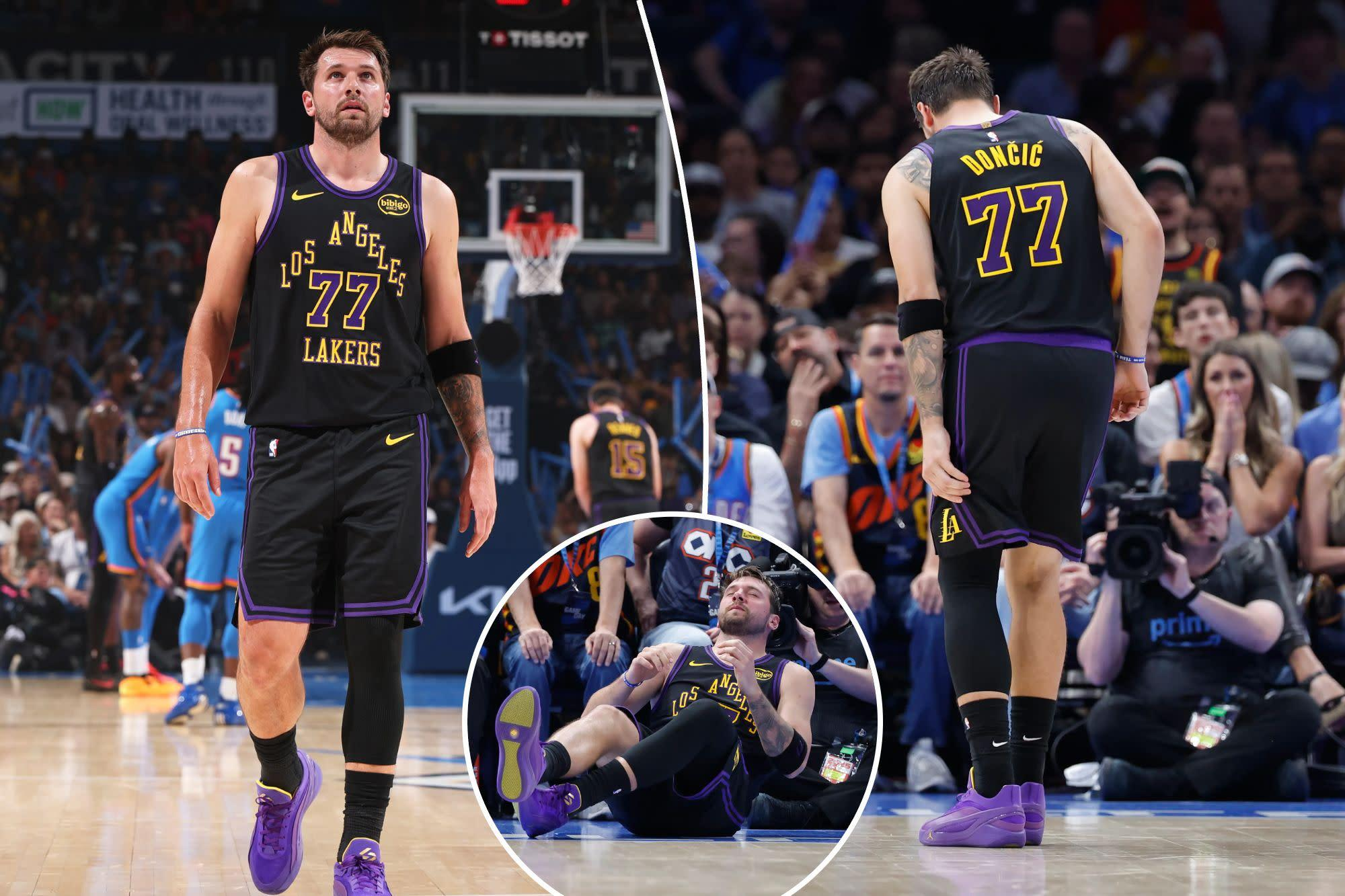
The Injury That Changed the Lakers’ Season
The turning point came during a regular-season matchup against the Thunder when Doncic suffered a Grade 2 left hamstring strain. At first, optimism surrounded the diagnosis. Initial reports suggested a six-to-eight-week recovery timeline, leaving the possibility that the Lakers star could return later in the postseason.
But that hope gradually disappeared.
As the playoffs unfolded, Doncic never advanced to full-contact basketball activities. The Lakers kept surviving, even managing to win a playoff series without their leading scorer — a remarkable feat considering no NBA team had previously accomplished that during the modern playoff era.
Still, the absence of Doncic became impossible to overcome against Oklahoma City’s relentless depth, athleticism, and championship-level execution.
The Thunder completed a dominant 4-0 sweep in the Western Conference semifinals with a 115-110 victory in Game 4 at Crypto.com Arena. By then, the emotional weight of Doncic’s absence had become one of the defining stories of the postseason.
According to later medical evaluations, the injury proved more severe than originally believed. While an MRI in Dallas identified a Grade 2 lower hamstring strain, additional evaluations conducted in Spain reportedly revealed deeper damage.
That revelation explained why Doncic never came close to returning despite widespread speculation throughout the series.
Luka Doncic Fires Back at Media Reports
One of the most revealing moments after the Lakers’ elimination came when Doncic publicly addressed rumors surrounding his recovery.
Throughout the playoffs, reports circulated suggesting the Slovenian superstar was making gradual progress and might return if the Lakers extended the series. Some reports even implied he was approaching basketball readiness.
Doncic strongly rejected those claims.
“I mean, yeah, it’s very frustrating,” Doncic said. “I know some people wanted me back, but obviously, I wasn’t close to clearing. You know, there was some stuff in the media that went out that wasn’t true. Nobody of those people saw my MRIs, knew nothing, so it wasn’t really true. If I could be out there, I would be 100%. Everybody in that room knows that.”
The frustration was understandable.
The Lakers’ fan base desperately wanted hope. Every positive update generated excitement, especially with the team fighting to stay alive against the Thunder. But internally, the reality was far different.
Doctors reportedly recommended an eight-week recovery timeline, and because this marked the second injury to the same hamstring during the 2025-26 season, the Lakers adopted an especially cautious medical approach.
Even aggressive treatment methods failed to accelerate the process.
Doncic traveled to Spain for platelet-rich plasma therapy in hopes of speeding up recovery, but despite improvements in light running and shooting drills, he never received clearance for full-speed basketball activities.
Oklahoma City Exposed the Lakers’ Biggest Weaknesses
The Thunder did more than eliminate the Lakers. They exposed the gap between a good playoff team and a true championship machine.
Oklahoma City’s combination of elite defense, depth, pace, and durability overwhelmed Los Angeles. While the Lakers fought competitively throughout the series, they lacked the offensive firepower and shot creation Doncic normally provides.
Shai Gilgeous-Alexander controlled the series and led Oklahoma City into the Western Conference Finals, while the Lakers struggled to generate consistent offense late in games.
The contrast was impossible to ignore.
The Thunder entered the postseason and immediately established themselves as one of the most dominant defending champions in recent NBA history, opening the playoffs with an 8-0 record. Meanwhile, the Lakers spent the series trying to survive without the player their entire roster was built around.
The result intensified questions surrounding roster construction in Los Angeles.
The Pressure Now Falls on the Lakers’ Front Office
Everything about the Lakers’ future revolves around Luka Doncic.
That reality became even clearer after the playoff exit.
LeBron James’ future remains uncertain. Austin Reaves could potentially become a trade asset. The franchise is expected to explore aggressive offseason moves in hopes of building a roster capable of competing with Oklahoma City and the rest of the Western Conference elite.
But none of those decisions matter unless the Lakers maximize Doncic’s championship window.
NBA history consistently shows that superstar players eventually demand organizational urgency. Franchises either build contenders quickly or risk long-term instability.
The Lakers understand that pressure.
Doncic is only 27 years old, but injuries are beginning to become a concerning trend. The hamstring strain that sidelined him this postseason marked the second injury-plagued season during what should be the physical prime of his career.
For Los Angeles, that raises two critical priorities:
- Protect Doncic’s long-term health
- Build a deeper roster that does not collapse without him
The Thunder provided a blueprint for exactly what a modern championship team looks like. Now the Lakers must figure out how to match it.
A Difficult Summer Beyond Basketball
The offseason will not simply be about rehabilitation for Doncic.
Following the Lakers’ elimination, the superstar made it clear that family would take precedence over basketball this summer.
“I want to spend time with my daughters,” Doncic said. “And that’s probably the only thing that is on my mind right now.”
Doncic later confirmed he will not represent Slovenia during the upcoming 2027 FIBA World Cup qualifiers. In a statement shared publicly, he explained that ongoing family responsibilities and efforts toward joint custody of his daughters influenced the decision.
“I have given everything to representing Slovenia and I am disappointed that I will not be able to play for my country this summer. But right now, my daughters and my responsibilities as a father are my priority.”
The announcement highlighted the emotional complexity surrounding this offseason.
Instead of preparing for international competition or a deep playoff run, Doncic now faces months focused on recovery, rehabilitation, and personal responsibilities away from basketball.
The NBA’s Growing Injury Problem
Doncic’s absence also became part of a larger and increasingly troubling playoff trend.
The 2026 postseason has been heavily impacted by injuries to star players across the league. Kevin Durant, Joel Embiid, Jayson Tatum, Anthony Edwards, Franz Wagner, Austin Reaves, Aaron Gordon, and several others dealt with major physical setbacks during the playoffs.
For the NBA, the conversation around durability is becoming unavoidable.
Teams are playing longer seasons, faster styles, and placing enormous workloads on franchise stars. As injuries continue affecting playoff outcomes, debates surrounding scheduling, rest management, and medical recovery timelines are only intensifying.
Doncic’s situation became one of the clearest examples of that tension.
Fans wanted him back immediately. Media speculation fueled hope. But medical reality ultimately won.
What Comes Next for Luka Doncic and the Lakers?
Despite the disappointing finish, there is optimism surrounding Doncic’s long-term outlook.
Reports indicate the Lakers expect him to enter offseason preparation without restrictions once recovery is complete. The organization still views him as the cornerstone capable of leading future championship runs.
That belief has not changed.
But the pressure surrounding next season already feels enormous.
The Lakers traded for Luka Doncic to compete for championships, not moral victories. Losing in the second round — especially while being swept — will only increase scrutiny on every roster decision moving forward.
For Doncic personally, the challenge is equally significant.
He must fully recover physically, avoid recurring hamstring problems, and return to the elite MVP-level form he displayed before the injury. If healthy, he remains one of the most dominant offensive players in basketball and one of the few superstars capable of reshaping an entire franchise’s future.
The Lakers are betting everything on that reality.
After this playoff exit, they have little choice.


