
Lakers vs Wizards: A Statement Night in Los Angeles
A One-Sided Contest That Told a Bigger Story
The March 30, 2026 matchup between the Los Angeles Lakers and Washington Wizards was more than just another regular-season game. It was a clear demonstration of two teams moving in completely different directions.
- A One-Sided Contest That Told a Bigger Story
- First Quarter Resistance: Wizards Show Early Fight
- Second Quarter Collapse: Lakers Seize Full Control
- LeBron James: Longevity Meets Elite Production
- Supporting Cast Steps Up in Absence of Key Star
- Wizards’ Reality: Development Over Results
- Third Quarter Response—But Not Enough
- Fourth Quarter Domination: Game Closed with Authority
- Tactical Breakdown: Why the Lakers Won
- Broader Implications: Playoff Readiness vs Rebuild Phase
- Conclusion: A Game That Reflected Two Different Futures
At Crypto.com Arena, the Lakers delivered a commanding 120–101 victory, reinforcing their status as one of the Western Conference’s most consistent contenders, while the Wizards continued to endure a difficult campaign nearing its conclusion.
From a competitive standpoint, the game began with promise. But as the night unfolded, it evolved into a showcase of depth, execution, and veteran leadership—qualities that define playoff-ready teams.
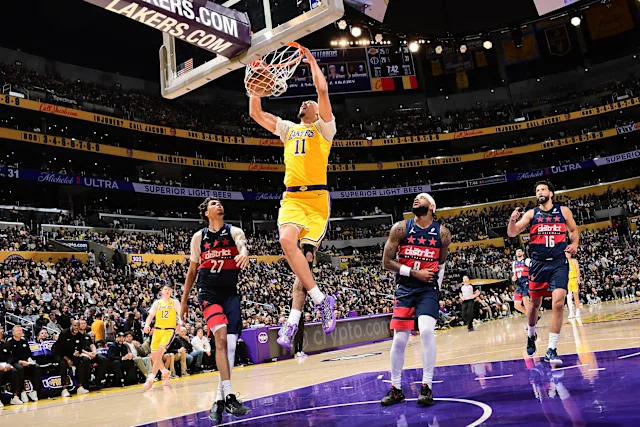
First Quarter Resistance: Wizards Show Early Fight
For a brief stretch, Washington appeared capable of disrupting expectations.
The Wizards came out with defensive intensity and composure, even taking a narrow 26–25 lead at the end of the first quarter.

Their early approach was structured:
- Tight defensive spacing
- Controlled pace
- Opportunistic scoring
This opening phase reflected a team still capable of competing, despite their struggles in the standings. However, maintaining that level against a disciplined Lakers side proved unsustainable.
Second Quarter Collapse: Lakers Seize Full Control
The turning point came decisively in the second quarter.
The Lakers unleashed a dominant run—most notably an 11–0 surge—that effectively broke the game open.
By halftime, the score stood at 65–44, with Los Angeles asserting control in multiple dimensions:
- Superior shot efficiency
- Dominance in the paint
- Defensive pressure forcing poor shooting (Washington hit just 7 of 24 attempts in the quarter)
This phase highlighted a key tactical difference: while the Wizards relied on bursts, the Lakers sustained structured offensive execution.
LeBron James: Longevity Meets Elite Production
At the center of the performance was LeBron James, who delivered yet another milestone night.
He recorded:
- 21 points
- 10 rebounds
- 12 assists
This marked the 125th triple-double of his career, further extending his own record as the oldest player to achieve the feat—at 41 years and 90 days.
The significance goes beyond numbers. His performance underscored:
- Elite game management
- Continued physical durability
- Tactical leadership in high-tempo systems
In a season where workload management is critical, James remains a central engine for the Lakers’ success.
Supporting Cast Steps Up in Absence of Key Star
Notably, the Lakers were without Luka Dončić, sidelined due to suspension. Yet, the team’s collective depth compensated effectively.
Key contributions included:
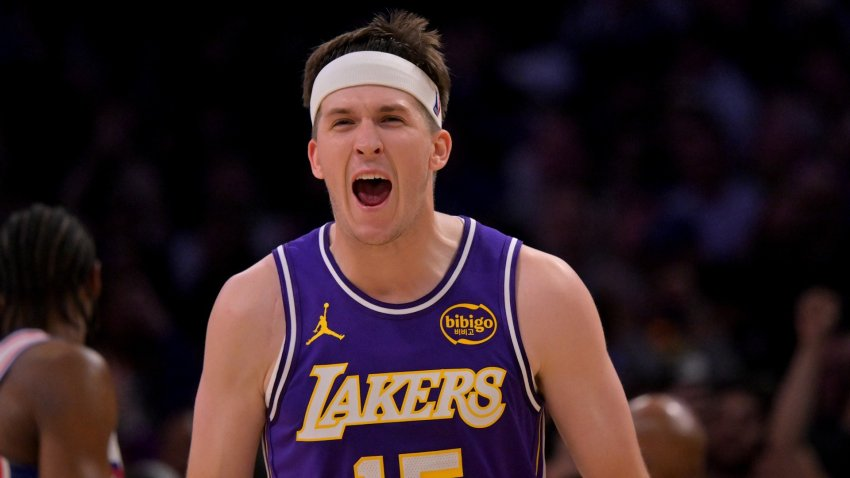
- Austin Reaves – 19 points and 9 assists
- Jaxson Hayes – 19 points (perfect 8-for-8 shooting)
- Luke Kennard – 19 points with efficient perimeter scoring
This balanced scoring distribution reflects a well-structured offensive system. Rather than reliance on a single star, the Lakers leveraged:
- Ball movement
- Transition scoring (21–6 fast-break advantage)
- Rebounding dominance (+15 margin)
Such metrics are typically associated with teams built for postseason success.
Wizards’ Reality: Development Over Results
For the Washington Wizards, the game reinforced ongoing challenges.
Entering the matchup:
- 13th in the Eastern Conference
- Eliminated from playoff contention
Despite flashes of competitiveness, structural issues persist:
- Inconsistent shooting
- Limited defensive stops
- Difficulty maintaining momentum across quarters
Top contributors included:
- Will Riley – 20 points
- Justin Champagnie – 18 points
- Tristan Vukcevic – 14 points
However, the broader trend is concerning: Washington has lost 19 of its last 20 games, highlighting systemic instability.
At this stage, the focus has shifted from results to development—particularly for younger players expected to shape future seasons.
Third Quarter Response—But Not Enough
To their credit, the Wizards attempted a comeback.
A 9–0 run narrowed the deficit to 81–71 late in the third quarter, briefly injecting uncertainty into the contest.
However, the Lakers’ response was immediate and decisive:
- Controlled tempo
- Efficient shot selection
- Defensive containment
By the end of the third quarter, Los Angeles maintained a 91–77 lead, effectively neutralizing any comeback momentum.
Fourth Quarter Domination: Game Closed with Authority
The final period removed any remaining doubt.
A rapid 13–1 run in just 1:44 extended the lead dramatically to 114–84.
From that point:
- The Lakers slowed the pace
- Rotations widened
- Control remained absolute
The closing minutes were procedural rather than competitive, reflecting a game fully decided well before the final buzzer.
Tactical Breakdown: Why the Lakers Won
Several structural advantages defined the outcome:
1. Paint Efficiency
Los Angeles consistently attacked inside, exploiting defensive gaps and converting high-percentage looks.
2. Rebounding Superiority
A +15 rebound differential created second-chance opportunities and limited Washington’s possessions.
3. Transition Advantage
Fast-break scoring (21–6) indicated superior pace control and defensive-to-offense conversion.
4. Depth Utilization
Multiple players scoring 19 points demonstrates a distributed offensive model, reducing predictability.
Broader Implications: Playoff Readiness vs Rebuild Phase
Lakers Outlook
With a 49–26 record and position near the top of the Western Conference, the Lakers are clearly optimizing for postseason success.
Their current trajectory suggests:
- Strong chemistry
- Tactical flexibility
- Depth capable of compensating for absences
Wizards Outlook
Conversely, Washington’s trajectory reflects a transitional phase:
- Emphasis on youth development
- Reduced competitive pressure
- Focus on long-term roster construction
Conclusion: A Game That Reflected Two Different Futures
The Lakers vs Wizards clash was less about rivalry and more about contrast.
On one side:
- A team refining its playoff identity
- Led by a veteran still redefining longevity
On the other:
- A rebuilding roster navigating inconsistency
- Seeking incremental progress rather than immediate success
The 120–101 result was not just a scoreline—it was a clear indicator of where both franchises stand in the 2025–26 NBA season.