


Julia Fischer Concerts 2026: A Season of Precision, Tradition, and Artistic Range
A European Tour That Maps Classical Excellence
The 2026 concert calendar of Julia Fischer presents a tightly structured and artistically coherent series of performances across Europe. Moving between chamber music and large-scale symphonic works, the season reflects both continuity and expansion—anchored in the classical canon while incorporating diverse orchestral collaborations.
At the center of this schedule is a carefully curated April tour with the Julia Fischer Quartett, followed by orchestral engagements in May and a high-profile symphonic appearance in December. The structure of the tour reveals a deliberate artistic narrative rather than a loose collection of engagements.
April 2026: A Chamber Music Arc Across Europe
A Consistent Program, Multiple Cities
The April segment forms the backbone of Fischer’s 2026 concert activity. Beginning on 15 April in Thessaloniki and concluding on 25 April in Tallinn, the tour spans major European cultural centers.
The repertoire remains largely consistent, centered on three works:
- Franz Schubert – Quartet Movement in C minor, D 703
- Dmitri Shostakovich – String Quartet No. 3 in F major, Op. 73
- Johannes Brahms – String Quartet No. 2 in A minor, Op. 51
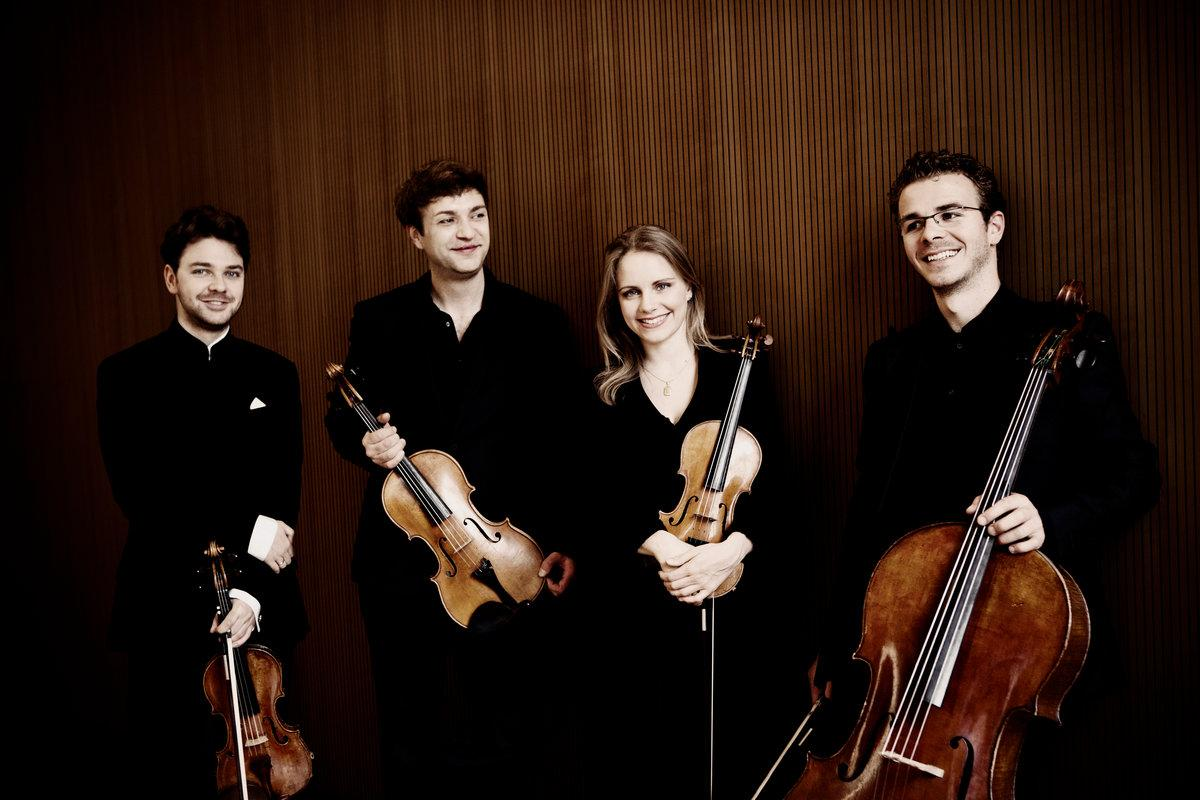
This program is performed by the Julia Fischer Quartett, consisting of:
- Julia Fischer – Violin
- Alexander Sitkovetsky – Violin
- Nils Mönkemeyer – Viola
- Benjamin Nyffenegger – Violoncello
The recurrence of the same repertoire across cities indicates a refined interpretative approach, allowing the ensemble to deepen its reading of each composition through repetition in different acoustic environments.
Key Tour Stops and Venues
The tour includes performances at prominent venues:
- Alte Oper Frankfurt (16 April)
- Wolfgang-Hoffmann-Saal (17 April)
- Prinzregententheater (18 April)
- Kleine Tonhalle (19 April)
- Wigmore Hall (20 April)
- Konzerthaus Berlin (22 April)
- Estonia Concert Hall (25 April)
One notable variation occurs in Zürich, where the Schubert work is omitted, leaving a program focused on Shostakovich and Brahms. This adjustment suggests a responsiveness to venue context or programming balance rather than strict uniformity.
Interpreting the Repertoire: A Structured Emotional Spectrum
The selected works are not arbitrary. They collectively represent a progression across eras and emotional registers:
- Schubert’s Quartet Movement introduces tension and fragmentation, often viewed as a transitional or incomplete statement.
- Shostakovich’s Third Quartet brings structural complexity and historical undertones, reflecting mid-20th-century turbulence.
- Brahms’s Second Quartet provides a dense, mature Romantic conclusion, grounded in formal rigor.
This sequencing creates a layered listening experience, moving from early Romantic instability through modernist reflection to late Romantic consolidation.
May 2026: Transition to Orchestral Scale
Following the chamber tour, Fischer shifts into orchestral collaborations, expanding both sonic scale and repertoire complexity.
Basel Performance (6 May 2026)
At the Stadtcasino Basel, Fischer appears as soloist with the Sinfonieorchester Basel under conductor Markus Poschner.
Program:
- Ottorino Respighi – Poema autunnale
- Josef Suk – Fantasy for Violin and Orchestra in G minor, Op. 24
- Pyotr Ilyich Tchaikovsky – Symphony No. 6 “Pathétique”
This program emphasizes expressive depth and late-Romantic orchestral color, positioning Fischer within a broader symphonic framework.
Reggio Emilia Performance (16 May 2026)
At the Valli Municipal Theater, Fischer collaborates with the Bamberger Symphoniker under Manfred Honeck.
Program:
- Josef Suk – Fantasy for Violin and Orchestra, Op. 24
- Antonín Dvořák – Romance for Violin and Orchestra, Op. 11
- Pyotr Ilyich Tchaikovsky – Symphony No. 5 in E minor
The inclusion of Dvořák introduces lyrical contrast, while Tchaikovsky’s Fifth Symphony adds structural weight to the program.
December 2026: A High-Profile Amsterdam Engagement
The final major highlight occurs in December at the Concertgebouw, where Fischer performs with the Royal Concertgebouw Orchestra under Fabio Luisi.
Dates:
- 9 December 2026
- 11 December 2026 (20:15 start)
Program:
- Sophie Meyer – Fleur de verres
- Hans Werner Henze – Il Vitalino raddoppiato
- Johannes Brahms – Symphony No. 2
Here, Fischer takes a central role in Henze’s violin concerto, described as a “lush, neo-Romantic look back on the Baroque period.” The program juxtaposes contemporary composition with Brahms’s established symphonic repertoire, reinforcing a dialogue between past and present.
Ticket pricing ranges from €20 to €99, with sales beginning June 1, and includes amenities such as pre-concert access and intermission refreshments.
Structural Observations: A Deliberate Artistic Strategy
The 2026 concert schedule reflects three distinct performance modes:
- Chamber Consistency (April):
A fixed repertoire explored across multiple venues, emphasizing interpretative depth. - Orchestral Expansion (May):
Broader collaborations introducing varied composers and symphonic structures. - Prestige Engagement (December):
A high-visibility concert integrating contemporary and classical works.
This progression suggests an intentional balance between artistic control (quartet performances) and collaborative scale (orchestral projects).
Broader Cultural and Artistic Implications
Fischer’s 2026 calendar underscores several trends in contemporary classical performance:
- Repertoire Stability: Core works by Schubert, Brahms, and Shostakovich remain central to programming.
- Hybrid Programming: Integration of modern composers such as Hans Werner Henze and Sophie Meyer alongside canonical figures.
- Geographic Concentration: A strong European circuit, focusing on established cultural capitals and acoustically significant venues.
The inclusion of both chamber and orchestral formats also reflects a dual identity—Fischer as both ensemble leader and soloist.
Conclusion: Precision Over Volume
Rather than an extensive global tour, the 2026 schedule prioritizes precision, cohesion, and artistic clarity. Each segment—April, May, and December—serves a defined purpose within a broader performance strategy.
The result is a season that emphasizes depth over breadth, allowing repertoire, collaboration, and venue selection to reinforce a consistent artistic identity.


