

The Soundtrack of Baseball: Why John Sterling’s Voice Defined Generations
For more than three decades, John Sterling’s voice did far more than narrate baseball games—it shaped how millions of fans felt the sport. His unmistakable delivery, filled with theatrical flair and emotional resonance, became inseparable from the identity of the New York Yankees. Now, following his passing at age 87, that voice has taken on a new dimension: memory, legacy, and cultural imprint.
This is not simply a story about a broadcaster. It is an exploration of how a voice can transcend commentary and become a defining element of a fan experience.
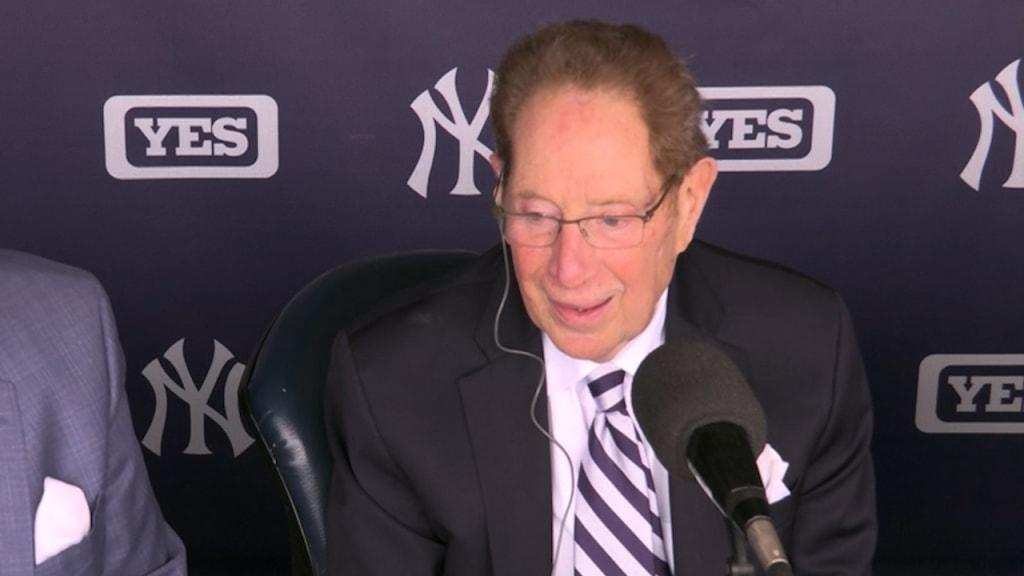
A Voice That Became Baseball Itself
John Sterling’s broadcasting career with the Yankees began in 1989 and extended until his retirement in 2024. Over that span, he called more than 5,400 regular-season games and over 200 postseason contests, including five World Series victories.
Yet statistics alone fail to capture the magnitude of his impact.
Sterling’s voice—often described as booming, melodic, and theatrical—was not merely descriptive. It was interpretive. It told listeners not just what happened, but how it mattered. His style turned routine plays into dramatic moments and victories into celebrations.
Fans didn’t just listen to Yankees games. They listened to John Sterling telling the story of Yankees baseball.
Signature Calls That Became Cultural Artifacts
Every great broadcaster develops trademarks, but Sterling elevated this into an art form.
His most iconic call—delivered after every Yankees win—was:
“Ballgame over! Yankees win! Theeeeeee Yankees win!”
The elongated “the” became more than a stylistic quirk. It was a signal of triumph, a cue that echoed through radios, living rooms, and even Yankee Stadium itself.
Similarly, his home run call:
“It is high, it is far, it is gone!”
became synonymous with excitement. Over time, he added personalized phrases for players—turning moments into miniature performances. Whether it was “Bern, baby, Bern!” or inventive wordplay for new stars, Sterling made each player’s success feel unique.
These calls weren’t just commentary—they were branding, storytelling, and entertainment combined.
The Ironman of the Broadcast Booth
Sterling’s commitment bordered on legendary. Between 1989 and 2019, he broadcast 5,060 consecutive games, a streak that underscored his endurance and dedication.
For fans, this consistency created a powerful psychological anchor. Seasons changed, rosters evolved, championships came and went—but Sterling remained.
His voice became:
- A nightly companion
- A constant across decades
- A bridge between generations of fans
In an era before streaming and highlights-on-demand, radio voices like Sterling were essential. He “painted the picture,” as he once described, allowing listeners to visualize every pitch, swing, and catch.
A Style That Divided—and Defined
Sterling’s approach was not universally praised. Critics often pointed to inaccuracies or his tendency toward dramatization. Some saw his embellishments as excessive.
But this criticism reveals something important: Sterling was never neutral.
He embraced subjectivity, passion, and personality—traits that made his broadcasts feel alive. In doing so, he rejected the idea of the detached announcer and instead embodied the role of a storyteller deeply invested in the outcome.
His style proved that sports broadcasting could be:
- Emotional rather than clinical
- Creative rather than purely factual
- Personal rather than distant
And for many fans, that made all the difference.
The Emotional Bond Between Voice and Memory
Perhaps the most striking aspect of John Sterling’s legacy is how deeply fans connected his voice to their personal lives.
Reactions following his passing reveal a consistent theme: nostalgia.
Listeners described his voice as:
- “The soundtrack of my childhood”
- “What made me a Yankees fan”
- “Something I fell asleep to for years”
This phenomenon is not accidental. Psychologically, repetitive auditory experiences—like listening to games over radio—create strong memory associations. Sterling’s voice became intertwined with:
- Family traditions
- Summer evenings
- Late-night listening rituals
- Major life stages, from childhood to adulthood
In effect, he didn’t just call games. He scored the emotional timeline of his audience’s lives.
A Career Built on Passion and Longevity
Before his Yankees tenure, Sterling worked across multiple sports and cities, including roles covering NBA, MLB, and NHL teams. His journey—from early radio work to national prominence—reflected a deep commitment to the craft of broadcasting.
Over time, his career achievements accumulated:
- 12 Sports Emmy Awards
- Decades of uninterrupted broadcasting
- Recognition as one of baseball’s most distinctive voices
But perhaps his greatest accomplishment was less tangible: he made radio broadcasting feel relevant in a television-dominated era.
The End of an Era—and What Comes Next
Sterling retired in 2024 and passed away in 2026, closing a chapter that spanned more than half a century in broadcasting.
His absence raises an important question: Can modern broadcasting replicate that kind of connection?
Today’s sports media landscape is fragmented:
- Streaming platforms replace radio
- Highlights replace full-game listening
- Social media clips replace long-form storytelling
While these innovations increase accessibility, they often reduce intimacy.
Sterling’s legacy suggests that what fans value most isn’t just access—it’s connection. And connection requires:
- Consistency
- Personality
- Authentic emotional investment
Conclusion: More Than a Voice
John Sterling’s voice was not simply an instrument of narration. It was an emotional conduit between the game and its audience.
He transformed baseball from a sequence of plays into a living narrative—one punctuated by rhythm, humor, and unmistakable flair.
Long after the final “Theeeee Yankees win!” has faded from live broadcasts, it will continue to echo in memory, recordings, and the collective identity of fans.
Because in the end, John Sterling didn’t just describe baseball.
He made it sound unforgettable.


