

Ben Shelton vs Alexander Blockx: A Munich Test That Said More Than the Score
Ben Shelton’s straight-sets win over Alexander Blockx in Munich looked tidy on paper, but the match itself was far more demanding than a quick glance at the scoreboard suggests. Shelton, the second seed and world number six, beat the Belgian wildcard 6-4, 7-6 (10-8) on April 15 to move into the quarter-finals of the ATP event in Munich. Yet this was not a routine passage into the last eight. It was the kind of clay-court examination that forced Shelton to defend, adjust, and finish under pressure.
That tension is what made the match significant. Shelton is still chasing his first clay-court title, and Munich carries extra weight because it was the site of his run to the 2025 final, where he lost to Alexander Zverev. Returning to the same tournament and surviving a tricky second-round contest against an improving opponent suggested that his comfort on the surface is still developing, but so is his resilience.
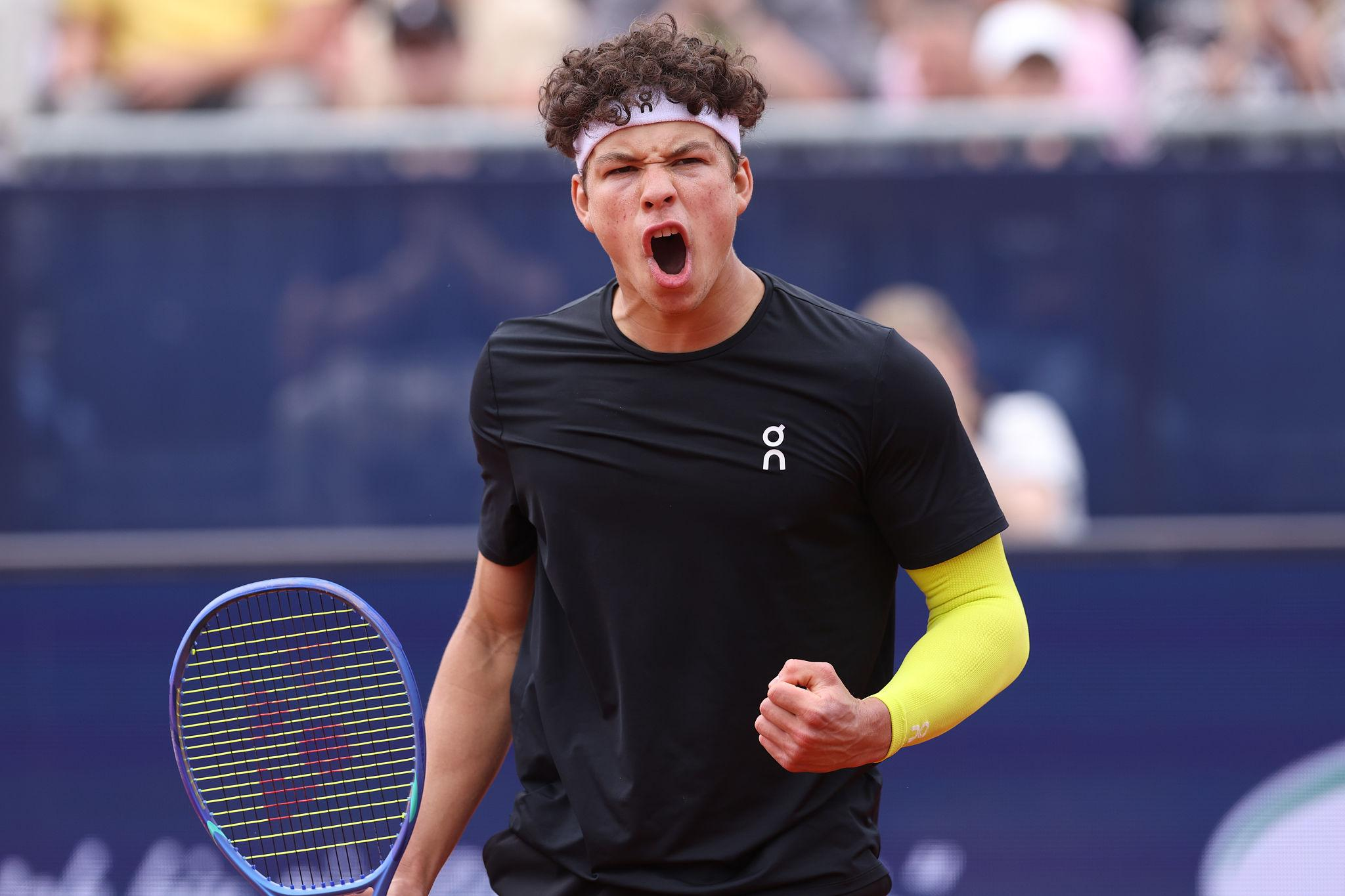
More Than a Straight-Sets Result
Shelton won in one hour and 45 minutes, but Blockx made him work for nearly every phase of the match. The 21-year-old Belgian, playing as a wildcard and ranked 72nd in the world, stayed close throughout and pushed the second set into a deep tie-break. Shelton eventually held his nerve, but only after being stretched well beyond the kind of clean, front-running performance top seeds often want in the early rounds.
The scoreline captured the balance of the contest. Shelton took the first set 6-4, then had to survive a much tighter second set before closing it out 10-8 in the tie-break. ATP coverage noted that he saved two set points in that breaker, a detail that sharpened the picture of a match decided as much by composure as by shot-making.
How Shelton Created the Edge
The statistical margin was narrow in some areas and decisive in others. Shelton hit four aces to Blockx’s zero, saved all three break points he faced, and converted one of his two break-point chances. His first-serve percentage was 64 percent to Blockx’s 61 percent, while Shelton won 77 percent of points behind his second serve compared with 55 percent for the Belgian. Those numbers help explain why Shelton was able to absorb pressure without letting the match slip.
At the same time, the match was not one-sided from the baseline. Blockx won 78 percent of points behind his first serve, slightly better than Shelton’s 76 percent, which underlined how effectively he stayed in contention whenever he landed his delivery. That is part of why the second set became such a struggle: Shelton had the heavier scoring weaponry, but Blockx had enough control and stability to keep forcing another question.
Why Alexander Blockx Came Out of the Match With Credit
For Blockx, the defeat still carried value. He had reached the round of 16 in Munich after beating Yannick Hanfmann 7-6(2), 6-2, and against Shelton he showed why his rise is being taken seriously. He did not produce a breakthrough win, but he did take a top-10-caliber opponent into uncomfortable territory on clay and nearly forced a deciding set.
Shelton’s own post-match assessment was revealing. He described Blockx as “a big talent” with “a pretty complete game,” adding that the Belgian moves well for his size, serves well, returns effectively, and “plays well from the ground.” Shelton also said he had watched some of Blockx’s Challenger matches over the last 12 to 18 months and already knew “that he was a problem.” Those remarks matter because they came from the player who had just spent nearly two hours trying to contain him.
Blockx’s performance also fit the broader pattern of his recent rise. ATP’s late-2025 profile on him highlighted two Challenger titles that season and his growing presence on the tour, while Munich offered another sign that he is becoming harder to dismiss as merely a prospect.
Munich Is Becoming a Real Clay Marker for Shelton
Shelton’s larger story in Munich is not just about one win. It is about whether this event can become the place where his clay credentials stop being treated as potential and start being treated as fact. He is now 6-1 in Munich across the past two editions, and ATP reported that this Blockx victory sent him into his fifth tour-level quarter-final of the 2026 season.
That matters because Shelton’s clay season before Munich had been mixed. His 2026 clay results included a win over Zhang Zhizhen in Houston followed by a quarter-final loss to Thiago Tirante, and he had needed three sets to get through Emilio Nava in his Munich opener. The Blockx match therefore looked like another test of adaptation rather than dominance. Shelton himself admitted there were moments when he thought he might lose the second set, but said holding his nerve in the big moments gave him confidence.
The Match Also Opened a More Intriguing Door
Shelton’s reward is a quarter-final against Joao Fonseca, one of the most watched young players on the ATP Tour. Fonseca reached the last eight by defeating Arthur Rinderknech 6-3, 6-2 in Munich after also beating him in Monte Carlo earlier in April. ATP noted that Fonseca saved all nine break points he faced in that win and had reached back-to-back ATP Tour quarter-finals for the first time.
Shelton appears fully aware of the appeal of that matchup. He called it “a great match-up” and said it was one he had been “anticipating” and “waiting for,” adding, “I think it should be a lot of fun, we’re both entertainers.” In competitive terms, that quarter-final is about much more than entertainment. It puts two of the sport’s most commercially appealing young figures into a first ATP Tour meeting, while also testing whether Shelton’s experience in Munich can offset Fonseca’s current momentum on clay.
A Small Match With Larger Meaning
This was not a final, not a semifinal, and not a seismic upset. But it still felt important. Shelton showed he could protect his advantage without playing perfect tennis. Blockx showed he belongs in tougher conversations than ranking alone might suggest. And Munich once again looked like a tournament where Shelton’s clay-court progress can be measured in real time.
For Shelton, the immediate takeaway is simple: he is still alive in a draw where he has recent history and unfinished business. For Blockx, the takeaway is almost as meaningful: he pushed a top seed deep enough into discomfort to confirm that his development is no longer theoretical. On a surface that exposes hesitation and rewards patience, both players left Munich’s second round having said something useful about where they are headed next.
Conclusion
Ben Shelton’s win over Alexander Blockx was a quarter-final qualifier, but it also worked as a diagnostic match. It showed Shelton’s durability under scoreboard stress, highlighted Blockx’s growing competitiveness against elite opposition, and set up a high-interest meeting with Joao Fonseca that could say even more about the shape of the clay season. In Munich, the result belonged to Shelton. The intrigue, however, now belongs to what comes next.


