

Machines on the Move: The Race That Redefined Limits
When a Robot Outran Humanity: Inside the Historic Half Marathon Breakthrough
A Finish Line No One Expected
In a moment that felt closer to science fiction than sport, a humanoid robot built by Honor sprinted into history by winning a half marathon—and not just against other machines, but against humans too. The robot completed the 21-kilometre race in an astonishing 50 minutes and 26 seconds, shattering the human world record previously set by Ugandan runner Jacob Kiplimo.
For decades, endurance running has been one of the clearest expressions of human physical excellence. That boundary has now been crossed—not by another athlete, but by a machine.
From Humiliation to Dominance in Just One Year
The scale of this achievement becomes clearer when viewed against the backdrop of the previous year’s race.
In 2025, humanoid robots struggled visibly. Only 6 out of 21 robots managed to finish the half marathon, with the fastest taking 2 hours and 40 minutes—far behind human competitors.
Fast forward to 2026, and the transformation is dramatic:
- Over 100 robots participated
- At least four robots completed the race in under one hour
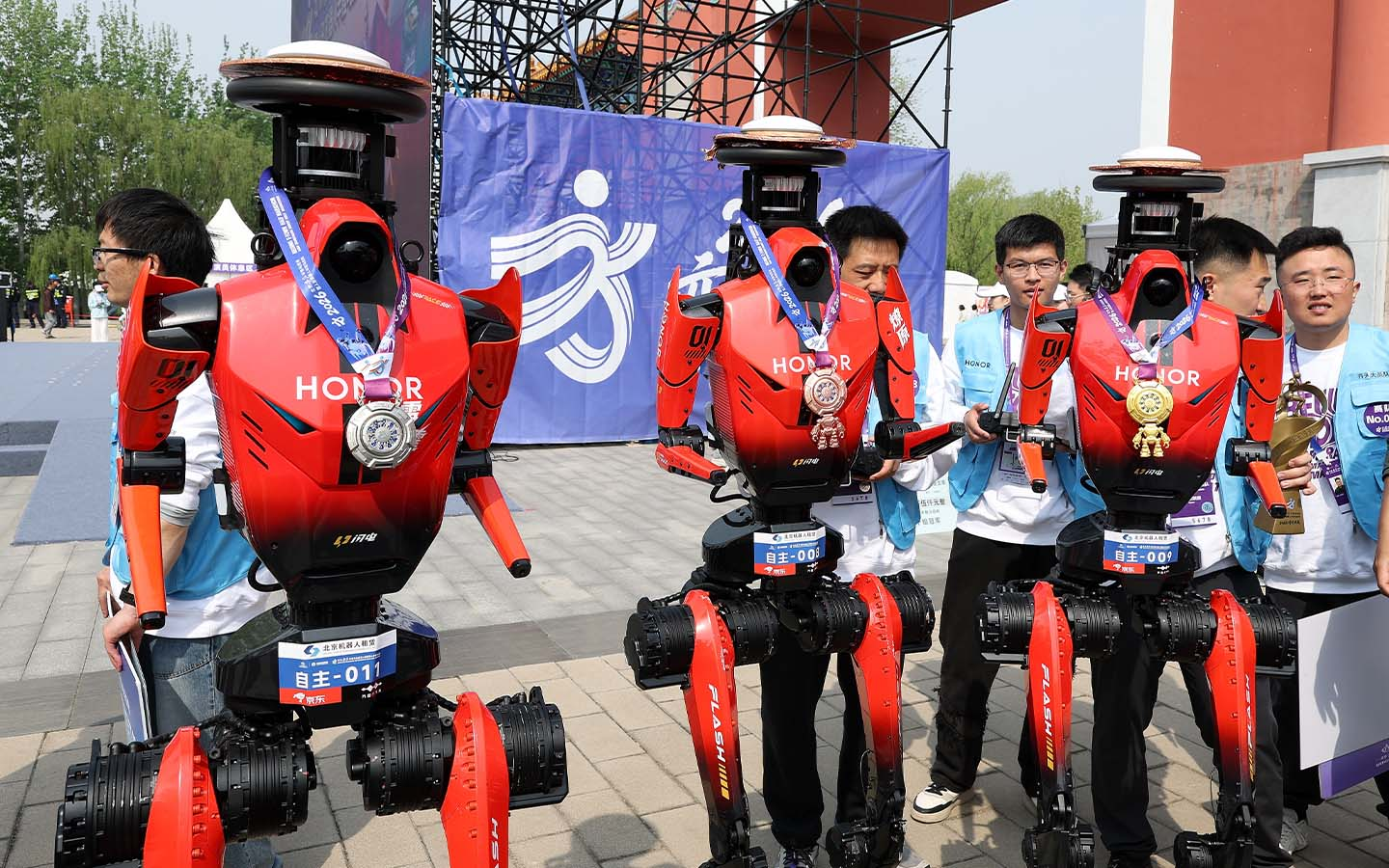
- Honor’s machines secured gold, silver, and bronze positions
- The winning robot beat 12,000 human runners
What was once a demonstration of robotic limitations has become a showcase of technological dominance.
Meet “Flash” (or “Lightning”): The Robot That Changed Everything
The winning humanoid robot—referred to as “Flash” in some reports and “Lightning” in others—was developed by Chinese smartphone maker Honor.
Its performance wasn’t accidental. Engineers designed it with features inspired directly by elite human athletes:
- Leg length of approximately 0.95 meters for stride efficiency
- Advanced gait algorithms for stable high-speed locomotion
- In-house liquid-cooling system to prevent overheating during prolonged exertion
These design choices allowed the robot to maintain an average speed of roughly 25 km/h, a pace that surpasses even elite human runners over long distances.
Not Just Speed: The Real Challenge Was Intelligence
This race wasn’t simply about running fast—it was about navigating the real world.
Around 40% of participating robots operated fully autonomously, handling:
- Turns and course changes
- Uneven terrain
- Environmental obstacles
The rest were remotely controlled, with adjusted scoring to reflect the technological advantage.
Event organizers emphasized that autonomous navigation is the key metric:
“Autonomous navigation represents a technological foundation for humanoid robots to be applied in more scenarios in our daily life towards the future.”
Under this framework, the autonomous Honor robot claimed overall victory—even though a remote-controlled version crossed the line slightly faster at 48 minutes and 19 seconds.
A Race Full of Drama—and Realism
Despite the breakthrough, the race was far from flawless. The course exposed both progress and limitations:
- One robot fell immediately after the start but continued with its body taped together
- Another crashed into a railing near the finish before recovering
- Some robots veered off course or fell into bushes
Even the winning robot required assistance after a collision before completing its run.
These incidents highlight a critical truth: while performance has surged, robustness and reliability still lag behind human adaptability.
Human Reaction: Awe, Shock, and Concern
For human competitors, the experience was surreal.
One runner described the robot’s pace vividly:
“It just went whoosh right past me.”
Spectators expressed a mix of excitement and unease. Some viewed the achievement as a symbol of technological security and progress, while others worried about the implications for jobs and human relevance.
“It’s the first time robots have surpassed humans, and that’s something I never imagined.”
China’s Strategic Push Into Humanoid Robotics
This breakthrough is not happening in isolation—it reflects a broader national strategy.
China has aggressively invested in robotics and AI:
- 73.5 billion yuan ($10.8 billion) invested in robotics and embodied AI in 2025
- Over 150 humanoid robotics companies and research labs
- A government-backed plan (2026–2030) prioritizing humanoid robot development
The marathon itself serves as a real-world testing ground—a public “stress test” for emerging technologies.
As one engineer explained:
“This year, we are only racing against ourselves.”
Beyond the Race: What This Means for the Future
While the spectacle of robots outrunning humans grabs headlines, the deeper implications lie elsewhere.
Technologies developed for this race could soon influence:
Industry
- Factory automation with human-like mobility
- Maintenance of infrastructure such as power grids
Daily Life
- Home assistants capable of physical tasks
- Elderly care and mobility support
Emergency Response
- Search and rescue operations in hazardous environments
Engineers already see the parallels with other industries:
“It’s similar to how the automotive industry initially developed through competitions.”
The Bigger Question: What Happens When Machines Catch Up?
Despite the achievement, experts acknowledge that robots still lack something fundamental—advanced cognitive intelligence.
As one developer put it:
“Robots today have the body of Mike Tyson but are still missing a brain like Stephen Hawking.”
This gap suggests that while physical performance may already rival or exceed humans, true autonomy and decision-making remain works in progress.
Conclusion: A Milestone, Not the Finish Line
The image of a humanoid robot sprinting past elite runners marks a defining moment in technological history. What began as an experimental race has evolved into a demonstration of how quickly machines are closing the gap with human capability.
Yet this is not the end of the story—it is the beginning of a new era.
The real race now is not between humans and robots, but between innovation and limitation. And if this year’s half marathon is any indication, the pace of progress is accelerating faster than anyone expected.


