
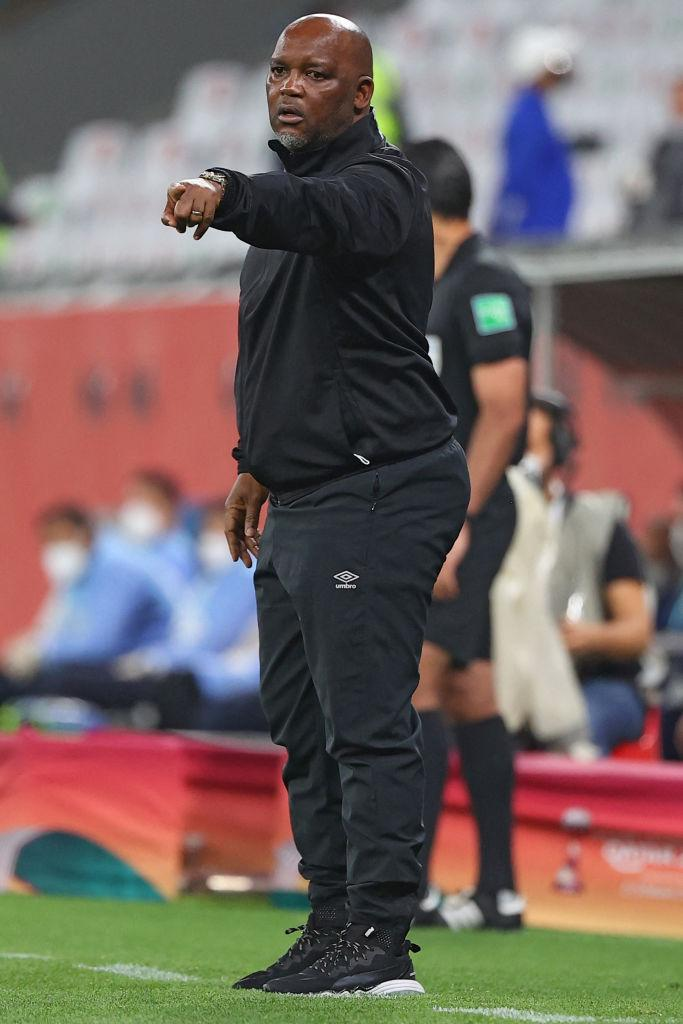
Pitso Mosimane: Building a Legacy Beyond the Touchline
A Coach Defined by Vision, Not Just Victories
Few figures in African football command the level of respect and influence associated with Pitso Mosimane. Known for his tactical intelligence and calm authority, Mosimane has built a career that extends far beyond match results. His journey reflects not only sustained success at elite level but also a deliberate shift toward shaping the future of African football through development and education.
While many remember his historic achievements with Al Ahly in the CAF Champions League, Mosimane’s current focus signals a broader ambition—one that positions him as both a strategist and a long-term architect of the game.

From Continental Dominance to Strategic Reinvention
Mosimane’s tenure at Al Ahly remains one of the defining chapters of his career. Under his leadership, the Egyptian giants maintained their dominance, highlighted by commanding performances such as the 4–0 semi-final victory over Entente Setif.
That match, driven by the brilliance of Percy Tau, demonstrated Mosimane’s ability to maximize talent within a structured tactical system. Tau scored twice and assisted twice, while teammates Taher Mohamed and Mohamed Sherif added goals to secure a decisive advantage.
The performance reflected a broader pattern: Mosimane’s teams are disciplined, efficient, and capable of exploiting numerical or tactical advantages. His Al Ahly side capitalized after a red card reduced their opponents to 10 men, turning control into a comprehensive result.
Such matches reinforced Mosimane’s reputation as one of Africa’s most successful modern coaches—particularly in high-stakes continental competitions.
A Period of Transition: Life After the Dugout
Since parting ways with Iranian club Esteghlal in January of the previous year, Mosimane has entered a transitional phase. At 61, he is not retreating from football; rather, he is recalibrating his role within it.
Despite ongoing speculation linking him to national teams such as Ghana and clubs like CR Belouizdad, Mosimane has deliberately avoided immediate re-entry into full-time coaching.
Instead, he has redirected his focus toward long-term initiatives, describing his current period as “a very busy time” filled with strategic work behind the scenes.
This shift is not accidental—it reflects a calculated move toward influence at a structural level rather than purely competitive.
The PMSS Project: Engineering the Next Generation
At the center of Mosimane’s current work is the Pitso Mosimane Soccer Schools (PMSS), a development program aimed at integrating football training into educational systems.
Unlike traditional academies, PMSS operates within schools, combining physical education with structured football coaching. The model is designed to provide consistent, age-appropriate training for children between the ages of 5 and 18.
Mosimane’s approach to this initiative is notably rigorous. He spent approximately two and a half years researching youth football methodologies, consulting with international associations—particularly in Europe—to develop a comprehensive training manual.
Key elements of the PMSS program include:
- Structured coaching tailored to different age groups
- Integration with school curricula
- Dual focus on education and athletic development
- Scalable implementation across institutions
Currently, the program operates in 18 Curro Schools across South Africa, engaging approximately 13,000 participants and employing around 100 coaches.
This scale indicates that PMSS is not a pilot initiative but an expanding ecosystem with measurable reach.
Institutional Collaboration and Continental Ambitions
Mosimane’s work has also attracted institutional attention. He has presented his youth football manual to SAFA (South African Football Association) and engaged with COSAFA, signaling alignment with regional football bodies.
There is also an expressed hope that the Confederation of African Football (CAF) could adopt or integrate elements of his development framework.
This positioning suggests a long-term objective: influencing how youth football is structured across the continent.
Rather than focusing solely on producing elite players, Mosimane appears to be addressing systemic gaps—particularly the lack of standardized development pathways in African football.
The Vision of a Dedicated Football Academy
Beyond PMSS, Mosimane has articulated a clear ambition to establish a specialized youth academy, comparable to South Africa’s School of Excellence.
His attempt to acquire the School of Excellence did not materialize, as ownership went to Chippa United’s Siviwe Mpengesi. However, this setback has not altered his broader objective.
“The ultimate goal for PMSS is to have a school that specialises in football. The talent is here in South Africa,” Mosimane stated.
This statement reflects a fundamental belief: that Africa’s challenge is not talent scarcity, but structural inefficiency in nurturing that talent.
Balancing Legacy and Future Opportunities
While Mosimane remains active in development, his return to top-level coaching remains a persistent topic of discussion.
His track record—spanning domestic leagues, continental competitions, and international experience—ensures continued demand. Whether with a national team or a major club, any future appointment would likely be high-profile.
However, his current trajectory suggests a dual pathway:
- Short-term: Strategic advisory, development programs, and institutional engagement
- Long-term: Potential return to elite coaching, backed by enhanced influence and perspective
This balance allows Mosimane to extend his impact beyond immediate results.
Cultural and Structural Impact on African Football
Mosimane’s transition from coach to developer carries broader implications for African football.
Historically, many African coaches have been defined by their success on the pitch, with limited involvement in systemic development. Mosimane challenges this model by positioning himself as both practitioner and reformer.
Key areas of impact include:
- Youth development standardization
- Integration of education and sport
- Professionalization of grassroots coaching
- Knowledge transfer from global football systems
If scaled effectively, initiatives like PMSS could contribute to more sustainable talent pipelines across the continent.
Conclusion: A Legacy Still in Motion
Pitso Mosimane’s career cannot be confined to trophies or titles, although those remain substantial. His current phase represents an evolution—from elite coach to strategic architect of football development.
His work with youth programs, institutional collaborations, and long-term planning signals a shift in how influence in football can be exercised.
While the football world waits for his next move on the touchline, Mosimane is already shaping the future of the game—quietly, methodically, and with measurable impact.


