

Spurs vs Trail Blazers: A Late-Season Statement in San Antonio
As the regular season approached its final stretch, the matchup between the San Antonio Spurs and the Portland Trail Blazers on April 8, 2026, carried more weight than a typical late-season fixture.
For Portland, it marked their final road game of the campaign—a last opportunity to test cohesion and resilience away from home. For San Antonio, it was another chance to consolidate momentum and evaluate a roster blending youth with established contributors.
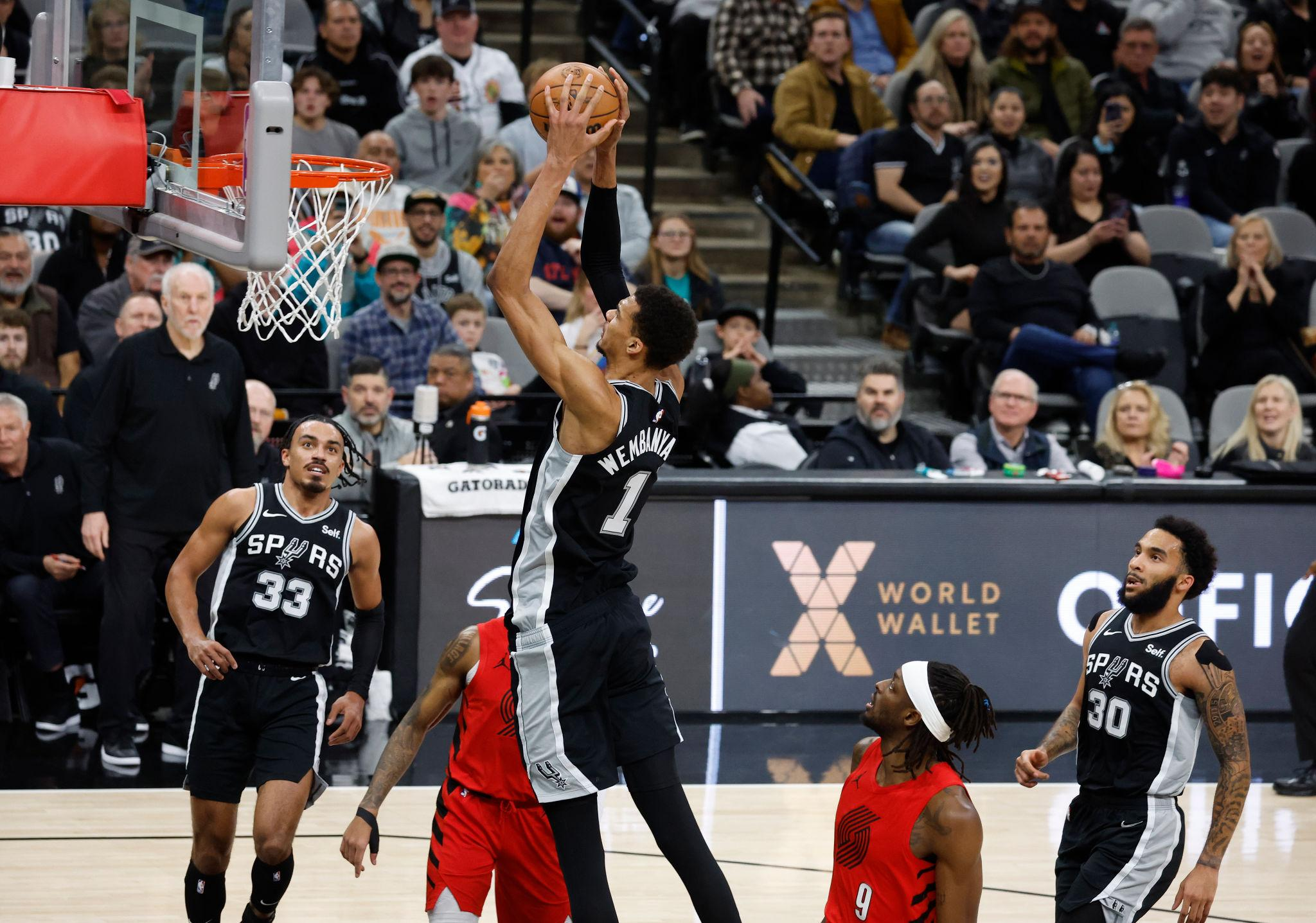
What unfolded was a competitive contest that ultimately tilted in favor of the Spurs, who secured a 112–101 victory in a performance defined by efficiency, depth, and timely execution.
First Half: Portland’s Energy Meets San Antonio’s Structure
The opening phases of the game reflected contrasting identities.
Portland leaned heavily on offensive rhythm and individual scoring bursts. Forward Deni Avdija emerged as the focal point early, attacking efficiently and setting the tone with assertive shot-making. His ability to score from multiple levels kept the Trail Blazers within reach.
San Antonio, by contrast, operated with a more balanced structure. Ball movement and spacing created high-percentage opportunities, allowing multiple players to contribute rather than relying on a single dominant scorer.
By halftime, the game remained competitive—Portland’s shot creation offset by San Antonio’s superior distribution and defensive discipline.
Turning Point: Spurs’ Depth Takes Control
The decisive shift occurred in the second half, where San Antonio’s depth and efficiency began to separate the teams.
Guard De’Aaron Fox delivered a composed and impactful performance, finishing with 25 points and 7 assists, orchestrating the offense while maintaining scoring pressure.
He was complemented by:
- Keldon Johnson – 20 points, providing consistent scoring and physical presence
- Carter Bryant – 17 points, including highly efficient perimeter shooting
- Harrison Barnes – key contributions in both scoring and experience-driven play
San Antonio’s collective output proved decisive. The team shot 48.9% from the field and maintained strong control over tempo and possession.
Portland, despite moments of offensive fluency, struggled to match that consistency across four quarters.
Portland’s Bright Spot: Avdija Leads the Fight
Even in defeat, Portland had standout individual performances.
Deni Avdija delivered one of the game’s most complete stat lines:
- 29 points
- 6 rebounds
- 6 assists
His efficiency—shooting over 60% from the field—highlighted both his scoring ability and playmaking versatility.
He was supported by:
- Scoot Henderson – 20 points, showing flashes of dynamic guard play
- Toumani Camara – 18 points, contributing both inside and from range
- Donovan Clingan – 11 rebounds and interior presence
However, Portland’s overall shooting efficiency (45.2%) and turnover count limited their ability to sustain pressure.
Statistical Breakdown: Where the Game Was Won
A closer examination of the numbers reveals the underlying factors behind San Antonio’s victory:
1. Shooting Efficiency
The Spurs outperformed Portland in field goal percentage, converting nearly half their attempts while maintaining better shot selection.
2. Free Throw Advantage
San Antonio capitalized at the line, shooting 78.9%, compared to Portland’s 50%, a significant differential in a double-digit game.
3. Ball Movement
With 28 assists, the Spurs demonstrated a cohesive offensive system, compared to Portland’s 26 assists, which were more individually driven.
4. Defensive Pressure
San Antonio recorded 13 steals, disrupting Portland’s offensive rhythm and converting defense into transition opportunities.
Tactical Insight: Structure vs Isolation
From a tactical perspective, the game illustrated a clear contrast:
- San Antonio Spurs: Emphasized spacing, ball movement, and collective scoring
- Portland Trail Blazers: Relied more on isolation scoring and individual shot creation
While Portland’s approach yielded standout individual performances, it lacked the sustained efficiency required to overcome a well-structured opponent.
San Antonio’s system proved more scalable across possessions, particularly in the second half when fatigue and defensive adjustments began to matter more.
Late-Season Implications
This result carries several implications as the regular season winds down:
For the Spurs
- Reinforces confidence in roster depth
- Highlights the effectiveness of a balanced offensive system
- Positions the team with momentum heading into the postseason phase
For the Trail Blazers
- Underscores reliance on key performers like Avdija
- Exposes inconsistencies in efficiency and defensive transitions
- Signals areas requiring refinement before the next campaign
The matchup also served as a microcosm of broader team trajectories—San Antonio trending toward cohesion, Portland still navigating development and identity.
The Bigger Picture: Development and Direction
Beyond the immediate result, the game reflects two franchises at different stages:
- The Spurs are building a system capable of distributing responsibility across multiple players, reducing dependency on a single star.
- The Trail Blazers are cultivating emerging talents who can carry offensive loads but require stronger structural support.
The presence of post-game reactions and highlights—such as De’Aaron Fox’s post-game availability and team highlight reels—further emphasizes the analytical focus teams place on performance refinement at this stage of the season.
Conclusion: A Measured Win with Clear Signals
The Spurs’ 112–101 victory over the Trail Blazers was not merely a routine regular-season result. It was a demonstration of system efficiency, depth, and execution under pressure.
Portland, despite individual brilliance, fell short due to inconsistencies that became more apparent as the game progressed.
As both teams move forward, this matchup provides a clear blueprint:
- For San Antonio: Continue refining a balanced, team-oriented approach
- For Portland: Build structural cohesion around emerging talent
In a league where margins are often defined by efficiency and adaptability, this game offered a concise illustration of what separates competitive teams from consistent contenders.


