

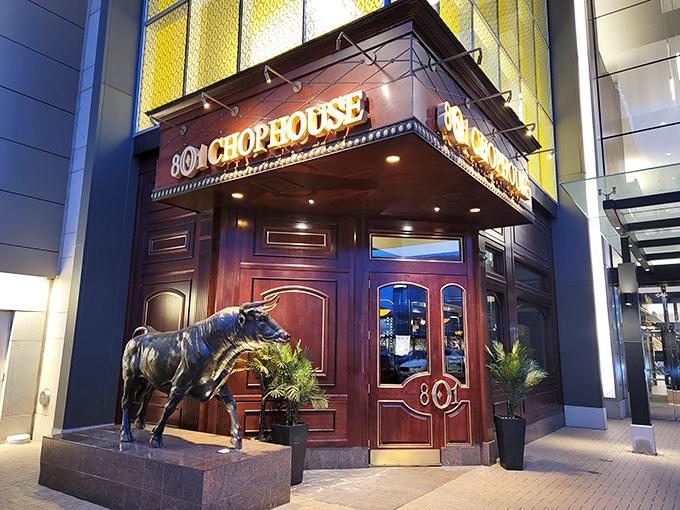
801 Chophouse Chapter 11: Inside the High-Stakes Restructuring of a Luxury Steakhouse Brand
A Strategic Reset, Not a Collapse
The decision by 801 Restaurant Group, parent company of 801 Chophouse, to file for Chapter 11 bankruptcy marks a pivotal moment—not just for the brand itself, but for the broader fine-dining industry.
On April 10, 2026, the Kansas-based company formally entered Chapter 11 proceedings in U.S. Bankruptcy Court, seeking to restructure approximately $18.7 million in debt while continuing operations across its restaurant network.
This distinction is critical. Chapter 11 is not liquidation—it is a controlled legal mechanism that allows a company to reorganize, stabilize cash flow, and renegotiate obligations without shutting down entirely. For diners and employees, the immediate impact is minimal: restaurants remain open, reservations are honored, and staff continue to be paid.
What Triggered the Bankruptcy Filing?
Mounting Financial Pressure
The filing reflects a convergence of financial strain and operational challenges. According to court disclosures, the company’s financial obligations extend beyond its headline debt:
- Assets and liabilities estimated between $10 million and $50 million
- Over $3 million in lease guarantees
- Approximately $1.8 million owed to the U.S. Small Business Administration
While the company has not cited a single definitive cause, industry analysts point to a combination of structural pressures:
- Rising beef prices, described as part of a “supply crisis of historic proportions”
- Increasing labor and rental costs
- Shifting consumer behavior toward more affordable dining options
These factors have disproportionately affected premium steakhouses, where margins are tightly tied to high-cost ingredients and consistent high-spend clientele.
A Sudden Closure Signals Deeper Issues
The bankruptcy filing coincided with the abrupt shutdown of 801 on Nicollet, a newer concept in downtown Minneapolis. The restaurant had opened in November 2025 and closed in less than six months, with signage citing “extenuating circumstances.”
The closure is notable for two reasons:
- Timing: A lifespan of under six months suggests rapid underperformance.
- Location volatility: The same site previously housed another company concept, 801 Fish, which also closed within a short period.
This pattern underscores a broader challenge facing large-format restaurants in urban centers.
The Bigger Picture: A Changing Restaurant Economy
The Decline of Downtown Dining
The difficulties facing 801 Chophouse are not isolated. They mirror a structural shift in urban dining economics:
- Reduced office foot traffic: Remote and hybrid work models have significantly diminished weekday lunch demand
- Reliance on evenings and weekends: Insufficient to offset fixed operating costs
- Changing consumer preferences: Increased demand for casual, quick-service, or lower-cost dining options
For a brand built on premium, experience-driven dining, these changes are particularly disruptive.
High-End Dining Under Pressure
Since its founding in 1993 in Des Moines, 801 Chophouse built its reputation on:
- USDA Prime and Wagyu beef
- Upscale interiors and curated wine programs
- Strong corporate dining and urban clientele
This model depends heavily on consistent high-spending customers—precisely the segment most affected by economic uncertainty and evolving work patterns.
How Chapter 11 Reshapes the Business
What the Process Actually Does
Chapter 11 provides a structured pathway to recovery. In practical terms, it allows the company to:
- Continue operating restaurants
- Renegotiate debt terms with creditors
- Restructure leases and financial obligations
- Develop a court-approved reorganization plan
Formal hearings are scheduled for May 2026, where creditors and stakeholders will assess the company’s proposed strategy.
A Shift Toward Core Locations
Management has already signaled its strategic direction:
- Maintain flagship and high-performing restaurants
- Consolidate operations around proven markets
- Scale back experimental or underperforming concepts
Key locations—including Des Moines, Omaha, Kansas City, St. Louis, Denver, and Washington, D.C.—remain operational and central to the brand’s recovery strategy.
Even in Minneapolis, while the Nicollet concept has closed, the main 801 Chophouse restaurant continues to operate—an indication of selective consolidation rather than wholesale retreat.
Stakeholders: Who Is Affected?
Customers and Employees
For now, day-to-day operations remain stable:
- Reservations are honored
- Dining experiences continue unchanged
- Employees retain their roles during restructuring
This continuity is a defining feature of Chapter 11, designed to preserve business value.
Creditors and Landlords
The situation is more complex for financial stakeholders:
- Debt repayment timelines may be extended
- Lease terms may be renegotiated
- Recovery outcomes depend on court-approved restructuring plans
The Brand Itself
For 801 Chophouse, the central challenge is reputational as much as financial. The company must demonstrate that its core locations can sustain profitability in a transformed market environment.
What Comes Next?
Three potential scenarios emerge based on current data:
1. Stabilization and Recovery
The company successfully restructures its debt, retains most locations, and adapts its business model to current market conditions.
2. Selective Downsizing
Further closures occur, particularly among weaker or newer concepts, while flagship restaurants remain intact.
3. Extended Financial Pressure
If creditor negotiations prove difficult, additional restructuring measures could follow, potentially reshaping the brand more dramatically.
The outcome will depend heavily on the May 2026 court proceedings and the company’s ability to maintain operational performance during the process.
A Defining Moment for Premium Dining
The Chapter 11 filing by 801 Restaurant Group illustrates a broader recalibration underway in the restaurant industry. Rising costs, shifting consumer habits, and changing urban dynamics are forcing even well-established brands to rethink their strategies.
For 801 Chophouse, the current phase is less about survival in the immediate sense and more about long-term repositioning. The company is attempting to preserve its identity as a premium dining destination while adapting to an environment that increasingly challenges that model.
The next few months will determine whether this restructuring becomes a successful reset—or a prolonged struggle in an industry undergoing structural change.


