


André Kaczmarczyk: The Actor Redefining Modern German Crime Drama
A Performer at the Center of Germany’s Evolving Screen Culture
In contemporary German television and theatre, few actors have navigated both traditional performance and modern storytelling as effectively as André Kaczmarczyk. Known for his versatility and depth, Kaczmarczyk has steadily built a career that spans classical theatre, experimental productions, and mainstream television.
- A Performer at the Center of Germany’s Evolving Screen Culture
- From Eisenach to the Stage: Early Foundations
- Professional Training and Theatre Breakthrough
- Expanding Creative Scope: Actor, Writer, and Director
- Transition to Screen: Film and Television Career
- The Defining Role: Vincent Ross in Polizeiruf 110
- Audience Reception: A Divided but Engaged Viewership
- Cultural Impact: Redefining the Crime Drama Archetype
- Beyond Acting: Radio, Social Engagement, and Artistic Advocacy
- What Lies Ahead: Future Trajectory
- Conclusion: A Career Defined by Range and Relevance
His recent prominence—particularly through his role as Chief Inspector Vincent Ross in Polizeiruf 110—positions him not only as a recognizable face in German entertainment but also as a figure reflecting broader cultural and narrative shifts in European media.
From Eisenach to the Stage: Early Foundations
Born on March 11, 1986, in Suhl, Germany, Kaczmarczyk grew up in Eisenach, where his artistic inclinations developed early. His formative years were closely tied to theatre, beginning with youth productions and performances at institutions such as the Freien Eisenacher Burgtheater and Landestheater Eisenach.
His early exposure to performance was not casual—it was disciplined and continuous. Notably, he portrayed Martin Luther in a historical open-air festival shortly after completing his secondary education, signaling both his commitment and early recognition in performance circles.
This early immersion established two defining traits of his career:


- A strong grounding in classical and historical storytelling
- A willingness to engage with complex, character-driven narratives
Professional Training and Theatre Breakthrough
Kaczmarczyk formalized his craft at the prestigious Ernst Busch Academy of Dramatic Arts in Berlin, one of Germany’s leading acting institutions. During and after his studies, he appeared in a range of productions, including adaptations of works by Georg Büchner and William Shakespeare.
His theatre career developed rapidly:
- Early professional engagements at the Hans Otto Theater in Potsdam
- Performances at the Maxim Gorki Theater in Berlin
- A significant tenure at Staatsschauspiel Dresden, where he became a permanent ensemble member
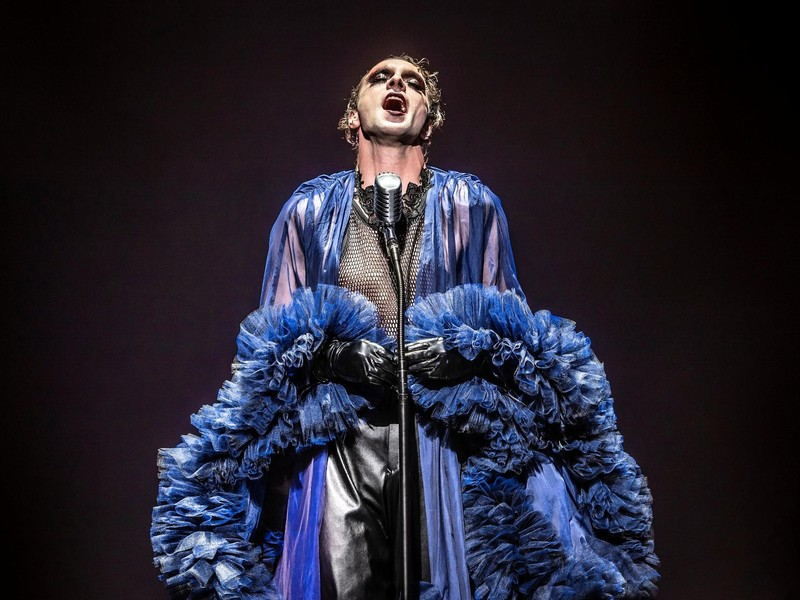
At Dresden, he demonstrated notable range—playing roles from Shakespearean characters to contemporary theatrical works. His performances often explored identity, transformation, and psychological depth, themes that would later define his television roles as well.
By 2016, he transitioned to the Düsseldorfer Schauspielhaus, further consolidating his reputation as a leading stage actor in Germany.


Expanding Creative Scope: Actor, Writer, and Director
Unlike many actors who remain confined to performance, Kaczmarczyk has also worked as a creator. He has written and staged productions, often incorporating musical and experimental elements.
Among his notable creative contributions:
- Heart of Gold, an ensemble recital
- A scenic installation based on Jeff Koons
- A musical adaptation of Alice, premiered in Düsseldorf
These projects demonstrate a broader artistic philosophy—one that treats theatre not merely as performance but as a multidisciplinary platform.
His continued innovation earned him a nomination for the prestigious Faust Award in 2024, underscoring his influence within German theatre.
Transition to Screen: Film and Television Career
While theatre remains central to his identity, Kaczmarczyk has steadily built a screen presence across film and television.
His early roles included:
- Portraying King Ludwig II in the historical series Die Deutschen
- Appearances in the film Anonymus
- Roles in German crime series such as Die Chefin and In aller Freundschaft – Die jungen Ärzte
These roles, though varied, consistently highlighted his ability to inhabit psychologically nuanced characters—often balancing emotional subtlety with narrative tension.
The Defining Role: Vincent Ross in Polizeiruf 110
Kaczmarczyk’s breakthrough in mainstream recognition came with his casting as Vincent Ross in Polizeiruf 110, one of Germany’s longest-running crime series.
Introduced in 2022, Ross stands out for several reasons:
- He is the first gender-fluid commissioner in the series
- His investigative style emphasizes empathy and introspection
- The character challenges traditional portrayals of detectives in crime dramas
In the 2026 episode Goldraub, Ross—alongside Karl Rogov—investigates the murder of a goldsmith in Potsdam, uncovering a complex case involving insider knowledge and stolen historical artifacts.
The episode reflects a broader narrative shift: away from high-action crime storytelling toward quieter, character-driven investigations.
Audience Reception: A Divided but Engaged Viewership
The reception to Kaczmarczyk’s performance in Polizeiruf 110: Goldraub has been notably polarized.
Many viewers praised his portrayal:
- “Detective Ross is absolutely convincing… empathetic and captivating.”
- “He’s simply a pleasure to watch… the suspense was very well built.”
Others, however, criticized aspects of the show’s pacing and thematic focus, particularly its emphasis on social issues.
This divergence is significant. It indicates that Kaczmarczyk’s work is not merely entertaining—it is provocative, prompting discussion about:
- Representation in media
- The evolution of crime storytelling
- Audience expectations in public broadcasting
Cultural Impact: Redefining the Crime Drama Archetype
Kaczmarczyk’s portrayal of Vincent Ross represents a broader transformation in European television.
Traditional crime dramas often center on:
- Action-driven narratives
- Emotionally detached investigators
- Formulaic plot structures
By contrast, Ross embodies:
- Emotional intelligence
- Fluid identity
- A collaborative, human-centered approach to investigation
This shift aligns with contemporary cultural trends that prioritize authenticity, diversity, and psychological realism.
Beyond Acting: Radio, Social Engagement, and Artistic Advocacy
In addition to stage and screen work, Kaczmarczyk has contributed to radio productions for institutions such as Rundfunk Berlin-Brandenburg and BBC Radio.
He has also engaged in socially conscious projects, including theatrical readings addressing humanitarian issues in the Mediterranean.
These activities suggest an artist who views performance as a tool for reflection and dialogue—not merely entertainment.
What Lies Ahead: Future Trajectory
At 40, Kaczmarczyk stands at a mature phase of his career—one characterized by both stability and expansion.
Several potential trajectories are evident:
- Continued prominence in television, particularly within Polizeiruf 110
- Further exploration of directing and writing, building on his theatrical work
- Increased international exposure, given growing recognition and critical acclaim
Audience commentary has already hinted at broader potential, with some viewers speculating about opportunities beyond German television.
Conclusion: A Career Defined by Range and Relevance
André Kaczmarczyk’s career illustrates a rare balance between tradition and innovation. From early theatre roots in Eisenach to national recognition on television, his trajectory reflects both discipline and adaptability.
His work—particularly as Vincent Ross—signals a shift in how stories are told and who gets to tell them. It is not simply about solving crimes on screen; it is about reshaping the emotional and cultural language of storytelling itself.
In an industry often driven by formulas, Kaczmarczyk’s approach stands out for its nuance, experimentation, and relevance.