

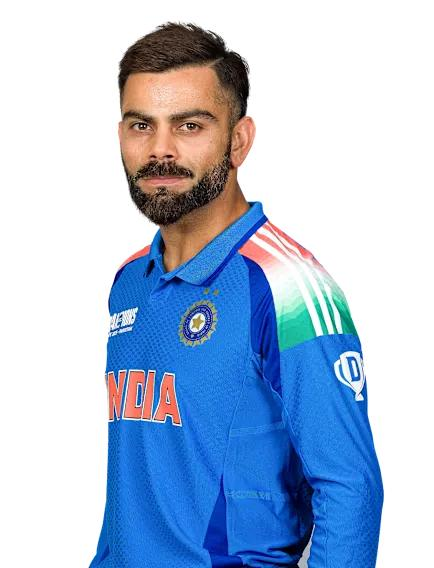
Virat Kohli: The Relentless Icon Who Redefined Modern Indian Cricket
Virat Kohli is one of the most influential cricketers of the modern era, a player whose name has become synonymous with intensity, consistency, ambition and elite sporting discipline. Born on 5 November 1988 in Delhi, India, Kohli rose from a fiercely competitive West Delhi cricket environment to become one of the most celebrated batters in world cricket. His career has stretched across eras, formats and generations, taking him from India’s Under-19 World Cup-winning captain to a global superstar, former India captain, IPL institution and one of the most commercially powerful athletes in the world.
What separates Kohli from most cricketing greats is the combination of volume, longevity and cultural force. His centuries, ODI dominance, IPL loyalty, fitness transformation, aggressive leadership and carefully built public image have made him far more than a run-scorer. He is a sporting brand, a style figure, a family man, a fitness symbol and a rare cricketer whose influence extends into entertainment, fashion, business, advertising and youth culture. Even after retiring from T20 Internationals and Test cricket, Kohli remains active in ODIs and the IPL, keeping him central to Indian cricket’s present conversation.
Virat Kohli Quick Facts Snapshot
| Category | Details |
|---|---|
| Full Name | Virat Kohli |
| Date of Birth | 5 November 1988 |
| Age | 37 years old |
| Place of Birth | Delhi, India |
| Nationality | Indian |
| Profession | International cricketer, top-order batter, former India captain, entrepreneur, brand ambassador |
| Batting Style | Right-handed batter |
| Bowling Style | Right-arm medium |
| Current Status | Active in ODIs and IPL; retired from T20Is and Test cricket |
| IPL Team | Royal Challengers Bengaluru |
| Net Worth | Estimated around ₹1,100 crore to ₹1,115 crore |
| Major Income Sources | Cricket contracts, IPL salary, endorsements, business ventures, investments, social media value |
| Relationship Status | Married |
| Wife | Anushka Sharma |
| Children | Vamika Kohli and Akaay Kohli |
| Major Achievements | 2011 ICC Cricket World Cup winner, 2013 ICC Champions Trophy winner, 2024 ICC T20 World Cup winner, 2025 ICC Champions Trophy winner, former India captain, most ODI centuries, elite IPL run-scorer, multiple ICC awards |
| Retirement Updates | Retired from T20Is after India’s 2024 T20 World Cup win; retired from Test cricket in May 2025 |
| Known For | Chase mastery, ODI consistency, aggressive leadership, fitness culture, IPL loyalty, global brand value |
Virat Kohli’s profile is unusually layered because his career does not fit into one simple category. He has been a prodigy, captain, run-machine, polarizing competitor, fitness reformer, celebrity husband, father, entrepreneur and veteran statesman. His journey is also marked by reinvention: from a fiery young batter to a disciplined global athlete, from all-format captain to senior match-winner, and from red-ball warrior to a player now focused on limited-overs cricket and the IPL.
The headline numbers remain staggering. Kohli’s international career began in 2008, and by 2026 he had built one of cricket’s most data-rich résumés, including over 9,000 Test runs, more than 14,000 ODI runs, more than 4,000 T20I runs and a record-breaking IPL presence with Royal Challengers Bengaluru. His latest IPL relevance was reinforced by a major 2026 innings, an unbeaten 105 off 60 balls against Kolkata Knight Riders, which also took him past the 14,000-run mark in T20 cricket.
From Delhi’s Cricket Circles to a National Obsession
Virat Kohli was born and raised in Delhi, where cricket is both a passion and a fiercely competitive ladder. His early years were shaped by the city’s demanding cricket culture, his family’s support and his own unusually intense hunger to succeed. Kohli was not merely a talented young batter; he carried the temperament of someone who wanted to dominate. That quality became visible early in his age-group cricket, where his technique, confidence and appetite for big scores marked him as a player to watch.
His family background has always been an important part of the Virat Kohli biography. His father, Prem Kohli, played a major emotional role in his development, while his mother, Saroj Kohli, remained a central figure in his personal life. Kohli has often been associated with resilience because of the way he continued his cricketing path through personal adversity, including the loss of his father during his formative years. That period hardened his approach to the game and became part of the larger narrative around his mental strength.
Kohli’s education and early cricket training were tied closely to Delhi’s structured cricket ecosystem. He joined formal cricket coaching at a young age and gradually moved through local and age-group levels. His rise was not accidental; it was built through constant match exposure, competitive domestic structures and a personality that responded strongly to pressure. Long before he became a global icon, Kohli was building the habits that later defined his international identity: hard practice, aggressive match awareness and a visible refusal to accept mediocrity.
His breakthrough as a youth cricketer came when he captained India to victory at the 2008 ICC Under-19 Cricket World Cup. That tournament gave him national visibility and positioned him as one of the most promising young batters in the country. The Under-19 success also created the bridge between Kohli the Delhi prospect and Kohli the future India international, setting up his ODI debut later in 2008.
Virat Kohli Career: The Making of a Modern Run Machine
Virat Kohli made his international debut for India in 2008, entering a side still led by established legends. At first, he had to prove that his Under-19 reputation could translate into senior international cricket. His early ODI career showed flashes of promise, but what quickly became clear was his ability to pace run chases. Unlike many young batters who relied heavily on flair, Kohli developed a method: rotate strike, absorb pressure, attack with precision and finish games with clinical control.
The turning point came as Kohli became one of India’s most reliable ODI batters. He built his reputation as a chase specialist by repeatedly producing high-quality innings in difficult conditions and high-pressure situations. His batting was not only about strokeplay; it was about calculation. He mastered the tempo of one-day cricket, understanding when to conserve energy, when to manipulate fields and when to accelerate. That cricketing intelligence later became one of the foundations of his legendary status.
Kohli’s Test career added another dimension to his profile. He made his Test debut in 2011 and gradually became one of India’s most important red-ball batters. As captain, he pushed India toward an aggressive, fitness-driven, pace-bowling-oriented Test identity. His leadership years were defined by intensity, overseas ambition and a refusal to treat away victories as rare miracles. His captaincy helped reshape India’s mindset, particularly in Test cricket, where he championed fast bowling depth and high athletic standards.
In T20 cricket, Kohli became a different kind of force. He was not always the most explosive batter by conventional power-hitting standards, but his consistency, running between the wickets and ability to construct chases made him one of the format’s most valuable players. His T20I career ended on a triumphant note after India won the 2024 ICC T20 World Cup, where he played a defining role in the final before announcing his retirement from the format.
Virat Kohli Stats and Centuries: Numbers That Define Greatness
Virat Kohli’s stats are central to his cricketing identity. Across formats, his record reflects not just longevity but sustained excellence at the highest level. His ODI numbers are especially historic: by early 2026, his ODI tally had reached 14,797 runs from 311 matches, with an average above 58 and 54 centuries. That makes his ODI career one of the most dominant statistical profiles ever assembled by a batter in the format.
His Test career closed with 123 matches, 9,230 runs, 30 centuries and an average of 46.85. Those numbers are significant on their own, but Kohli’s Test value cannot be measured only through aggregate runs. His peak years included defining overseas hundreds, hard-fought innings in difficult conditions and a captaincy era that changed India’s red-ball standards. His Test retirement in May 2025 ended a 14-year red-ball journey that included 68 matches as captain.
In T20Is, Kohli finished with 4,188 runs, one century and 38 half-centuries. His T20I legacy rests heavily on tournament performance, especially in major ICC events, where he repeatedly delivered under extreme pressure. His unbeaten 82 against Pakistan at the 2022 T20 World Cup remains one of the format’s most iconic modern innings, while his performance in the 2024 T20 World Cup final gave his T20I career a fitting farewell arc.
The keyword “Virat Kohli centuries” remains one of the most searched parts of his profile because his hundred-making ability is central to his fame. His centuries are not merely statistical decorations; they represent his habit of converting starts into match-shaping performances. In ODIs, he became the defining century-maker of his generation. In Tests, his hundreds often carried emotional intensity and technical authority. In the IPL, his centuries have extended his dominance into franchise cricket, including his ninth IPL hundred in 2026.
Virat Kohli IPL Journey: The Royal Challengers Bengaluru Constant
Virat Kohli’s IPL career is inseparable from Royal Challengers Bengaluru. Unlike many major T20 stars who moved across franchises, Kohli became the face of one team, building one of the most recognizable player-franchise relationships in cricket. His loyalty to RCB has become part of his mythology, making him not only a batter for the franchise but also its emotional center.
His IPL journey has included record-breaking seasons, captaincy highs, playoff heartbreaks, individual brilliance and constant public scrutiny. The 2016 IPL season remains one of the greatest individual batting campaigns in franchise cricket history, with Kohli producing a level of scoring consistency that transformed expectations for top-order batting in the league. His ability to dominate both spin and pace, play long innings and accelerate late made him a blueprint for modern T20 anchors.
In IPL 2026, Kohli remained a central figure for Royal Challengers Bengaluru. He was listed with RCB and continued to carry elite relevance in the tournament. His unbeaten 105 off 60 balls against Kolkata Knight Riders in Raipur was one of the major recent highlights of his career, guiding RCB to a six-wicket win while chasing 193 and pushing the team to the top of the points table. The innings also marked his ninth IPL century and reinforced his reputation as the “Chase Master.”
That innings also carried historical weight because Kohli crossed 14,000 T20 runs, becoming the first Indian cricketer to reach that mark. In a format often associated with volatility, Kohli’s T20 longevity has been remarkable. His IPL record shows how he has adapted across eras: from classical accumulator, to aggressive opener, to senior tactical batter who understands matchups, scoring zones and tournament pressure.
Retirement Updates: Why Virat Kohli Still Matters After Leaving Tests and T20Is
Virat Kohli’s retirement story has unfolded in stages rather than as a single farewell. He retired from T20 Internationals after India’s 2024 T20 World Cup victory, closing that chapter on the highest possible note. The decision reflected both timing and transition: Kohli had achieved the global T20 title that had long eluded India, and his exit opened space for a younger generation in the format.
His Test retirement came in May 2025 and carried a different emotional weight. Test cricket had been central to Kohli’s identity as a player and captain. He had often spoken through his career with visible reverence for the format, and his captaincy era was deeply tied to India’s ambition to dominate in whites. Walking away from Tests meant closing the chapter on one of the most intense red-ball careers of the modern age.
Importantly, Kohli has not retired from all cricket. He remains active in ODIs and the IPL, which keeps him highly relevant to Indian cricket and global cricket audiences. His ODI future continues to attract attention because he remains one of the greatest players in the format’s history, and his IPL appearances continue to generate enormous fan interest, commercial value and media coverage.
The phrase “Virat Kohli retirement” often trends because fans are trying to understand exactly where he stands. The accurate current position is clear: retired from T20Is, retired from Test cricket, active in ODIs and active in the IPL. That balance gives Kohli a carefully narrowed cricketing schedule while still allowing him to perform on major stages and preserve his competitive legacy.
Net Worth, Income Sources and Lifestyle: The Business of Brand Kohli
Virat Kohli’s net worth is widely estimated in the range of ₹1,100 crore to ₹1,115 crore, placing him among the wealthiest cricketers in India and one of the most commercially valuable athletes in Asia. His earnings come from multiple channels, including cricket contracts, IPL salary, brand endorsements, business ventures, investments, social media influence and licensing value.
His IPL salary remains a major part of his sports income, but the larger financial story is his endorsement empire. Kohli has been associated with fitness, fashion, technology, sportswear, lifestyle, automobile, food and consumer brands. His appeal is unusually broad because he connects with several markets at once: cricket fans, fitness-conscious youth, premium lifestyle consumers and mainstream Indian households.
Kohli’s business portfolio has included fashion, fitness and hospitality interests. His association with the One8 brand ecosystem, restaurant ventures, fitness-related investments and fashion positioning has helped him build a commercial identity that goes beyond cricket. He has also benefited from the rise of athlete-led branding in India, where top sports personalities function as entrepreneurs, investors and cultural influencers.
His lifestyle reflects elite athlete status but is often presented through a controlled public image. Kohli is associated with premium homes, luxury cars, disciplined fitness routines, high-end grooming, stylish public appearances and carefully curated family privacy. Unlike celebrities who live through constant exposure, Kohli’s modern public persona balances visibility and restraint: he remains commercially omnipresent while keeping major parts of his family life protected.
Virat Kohli Wife, Children and Relationships: A Closely Watched Personal Life
Virat Kohli is married to Anushka Sharma, one of India’s leading film personalities. Their relationship became one of the most closely followed celebrity partnerships in India because it brought together two enormous public worlds: cricket and cinema. The couple married in December 2017, and their wedding became one of the most discussed celebrity events of that period, admired for its elegance, privacy and visual sophistication.
Their relationship has often been framed around mutual respect, public support and a shared preference for protecting their private life. Anushka Sharma has been seen supporting Kohli at major cricketing moments, while Kohli has publicly expressed admiration for her influence on his life. Their partnership also reshaped Kohli’s public image, adding maturity and emotional depth to a persona once defined largely by fire and aggression.
The couple has two children: daughter Vamika Kohli and son Akaay Kohli. They have been careful about shielding their children from excessive public exposure, repeatedly emphasizing privacy. This approach has become a major part of their family dynamic, especially in an era when celebrity children often become public subjects from birth.
Before marriage, Kohli’s dating life was heavily discussed in entertainment media, largely because of his growing fame and the public fascination around his relationship with Anushka. Today, however, the “Virat Kohli relationships” search interest is centered overwhelmingly on his marriage, family life and his evolution from cricket’s fiery young star into a husband and father with a more grounded public presence.
Hairstyle, Fitness and Style Evolution: The Making of a Modern Sports Icon
Virat Kohli’s hairstyle has become a surprisingly consistent part of his public identity. Over the years, he has moved through sharp fades, textured crops, side-parted looks, undercuts and neatly styled short hair, usually paired with his signature beard. The “Virat Kohli hairstyle” search trend reflects how closely fans follow his grooming choices, particularly young men who see him as a style reference.
His beard-and-hair combination became one of the defining looks of Indian cricket in the 2010s and 2020s. Kohli’s grooming style helped shift the image of Indian cricketers from traditional sportsmen to highly styled global athletes. His public appearances, ad campaigns and IPL visuals turned him into a fashion and grooming template, especially for fans who associate his look with confidence, discipline and masculine polish.
Fitness is even more central to the Kohli image. He is widely credited with helping normalize elite fitness standards in Indian cricket. His transformation from a talented but less disciplined young player into one of the fittest cricketers in the world became a major part of his career story. Kohli’s dietary discipline, training intensity and emphasis on athleticism influenced younger players and changed public expectations of Indian cricketers.
This fitness-first identity also strengthened his brand value. Kohli’s body language, running between wickets, fielding intensity and training culture all reinforced the idea that he was not simply gifted but obsessively prepared. In a cricketing environment increasingly shaped by power, speed and endurance, Kohli became one of the faces of the modern professional athlete in India.
Current Relevance and Latest Updates: Kohli in 2026
Virat Kohli remains a major cricket headline in 2026 because he continues to produce defining performances despite stepping away from two international formats. His unbeaten 105 for Royal Challengers Bengaluru against Kolkata Knight Riders in May 2026 was a reminder that his competitive aura remains intact. The innings came in a high-pressure chase, carried RCB to victory and placed him back at the center of IPL conversation.
The same match also strengthened his T20 legacy because he crossed 14,000 T20 runs, a milestone that underlines both longevity and adaptability. For a player who built his reputation on ODI chase mastery, remaining relevant in T20 cricket into his late thirties is a major achievement. It demonstrates how Kohli has kept refining his game even as cricket’s shortest format has become more power-driven and tactically specialized.
His public relevance also extends beyond live matches. Kohli continues to dominate social media discussion, brand campaigns, fan edits, hairstyle trends, fitness discourse and debates about cricket’s greatest batters. Every century, lean patch, celebration, family appearance or retirement hint becomes a national talking point. Few athletes in India generate such constant attention across both sports and entertainment audiences.
Kohli’s current status is therefore not that of a retired legend fading into nostalgia. He is a selective-format superstar, still capable of match-winning performances, still commercially powerful and still emotionally central to millions of fans. His reduced international schedule may even sharpen the focus on each remaining appearance, especially in ODIs and the IPL.
Interesting Facts and Lesser-Known Details About Virat Kohli
One of the most interesting facts about Virat Kohli is how dramatically his image changed over time. Early in his career, he was seen as emotional, combative and sometimes volatile. Over time, that same intensity was reframed as elite competitiveness. His aggression did not disappear; it matured into a performance identity built around control, preparation and responsibility.
Kohli’s nickname “Cheeku” is another well-known part of his personality, often used affectionately by teammates and fans. The nickname contrasts with his fierce on-field image, revealing a lighter side to a player often seen through the lens of pressure and expectation. This duality has helped make him relatable: intimidating at the crease, but familiar and human away from it.
His ODI chase record is one of the defining features of his cricketing legacy. Kohli became famous not only for scoring centuries but for scoring them in matches where India needed clarity under pressure. He made chasing look almost systematic, turning what had once been a nerve-heavy art into a repeatable method.
Another key detail is his long association with Royal Challengers Bengaluru. In a league built around auctions, trades and constant movement, Kohli’s continuity with RCB has become rare. That loyalty created a deep emotional bond with the fanbase, even during years when the franchise fell short of the title. His connection with RCB is one of the most enduring player-team relationships in IPL history.
Influence, Impact and Legacy: Beyond Runs and Records
Virat Kohli’s influence on cricket is larger than his statistical record. He helped redefine what Indian cricketers were expected to be: fitter, sharper, more aggressive, more professional and more globally marketable. His career coincided with India’s transformation into cricket’s most powerful commercial and cultural force, and Kohli became one of the central figures of that era.
As captain, his impact was especially visible in Test cricket. He pushed India toward a more confrontational, pace-driven and fitness-oriented identity. Under his leadership, India treated overseas Tests with greater ambition, and fast bowlers became central to the team’s personality. That shift remains one of the most important parts of his cricketing legacy.
As a batter, Kohli’s legacy is built around mastery of the chase, extraordinary ODI numbers, emotional Test performances and sustained IPL relevance. His records will be debated against other greats, but his cultural impact is harder to dispute. He became the cricketer most associated with India’s post-Tendulkar era, carrying enormous expectations while creating a distinct identity rather than living in anyone’s shadow.
As a public figure, Kohli shaped the modern athlete-celebrity model in India. He proved that a cricketer could be a sporting icon, fashion figure, business personality, fitness influencer and global brand simultaneously. His marriage to Anushka Sharma further connected cricket with entertainment culture, turning him into one half of one of India’s most high-profile celebrity couples.
Additional Relevant Insights: Why Searches for Virat Kohli Stay So High
Search interest around Virat Kohli remains consistently strong because different audiences look for different parts of his story. Cricket fans search for Virat Kohli stats, centuries, IPL runs and retirement updates. Entertainment audiences search for Virat Kohli wife, family, hairstyle and public appearances. Business readers search for Virat Kohli net worth, endorsements and brand value.
That multi-category appeal is rare. Many athletes dominate sports coverage but have limited crossover relevance. Kohli belongs to a smaller group whose professional, personal and commercial lives all attract major public attention. His career can be read as a sports story, a celebrity profile, a business case study and a cultural phenomenon.
His recent retirement decisions have also increased interest in his future. Fans want to know how long he will continue in ODIs, whether he will remain with RCB through the next stages of the IPL, and what role he will eventually take after cricket. Commentary, mentorship, business expansion, fitness ventures and sports leadership are all plausible parts of his post-playing future.
For now, though, Kohli remains an active performer rather than merely a former great. His 2026 IPL century proved that his competitive relevance is not symbolic. He can still win games, drive narratives and produce moments that dominate cricket discussion across India and beyond.
Conclusion: Virat Kohli’s Place in Cricket History
Virat Kohli’s career is one of the defining sporting stories of modern India. From Delhi’s cricket grounds to World Cup glory, from Under-19 captain to India captain, from fiery young batter to global icon, his journey has been built on hunger, discipline and constant reinvention. His centuries, stats, IPL record, leadership years and commercial influence place him among the most complete cricket personalities of his generation.
His retirement from T20Is and Tests has changed the shape of his career, but not the scale of his relevance. Kohli remains active in ODIs and the IPL, still capable of producing headline-making performances and still central to the emotional life of Indian cricket. His name continues to command attention because it represents excellence, pressure, ambition, style and the modern athlete’s full cultural power.
The lasting Virat Kohli legacy will not be measured only by centuries or averages, even though those numbers are extraordinary. It will also be measured by the standards he set: fitness as non-negotiable, chasing as an art, captaincy as confrontation, branding as professionalism and cricket as a stage for relentless self-belief. In every sense, Virat Kohli is not just a cricketer with records; he is one of the central figures in the story of 21st-century cricket.


