




UFC 2026: A Night of Upheaval, Resilience, and Brutal Reality
The Octagon Delivers Another Turning Point
The Ultimate Fighting Championship (UFC) has long been defined by unpredictability, but UFC Fight Night 271 in Seattle offered a particularly stark reminder of how quickly narratives shift in mixed martial arts. Established stars faltered, rising contenders seized the spotlight, and deeply human stories emerged beneath the spectacle of combat.
- The Octagon Delivers Another Turning Point
- A Changing Guard in the Middleweight Division
- The Human Side of Victory: Pyfer’s Emotional Revelation
- A Disturbing Finish in the Women’s Flyweight Division
- The Structure of Chaos: Why UFC Remains Unpredictable
- Rankings Shake-Up and Division Implications
- Cultural and Psychological Dimensions of Modern MMA
- What Comes Next for the UFC?
- Conclusion: A Sport Defined by Extremes
From a shocking main-event upset involving Joe Pyfer and Israel Adesanya to a frightening co-main event featuring Maycee Barber and Alexa Grasso, the event encapsulated the sport’s volatility—both physically and psychologically.
This was not merely another fight card. It was a case study in the evolving dynamics of the UFC.




A Changing Guard in the Middleweight Division
The headline story of the night was Joe Pyfer’s decisive victory over Israel Adesanya, a result that reverberated across the middleweight division.
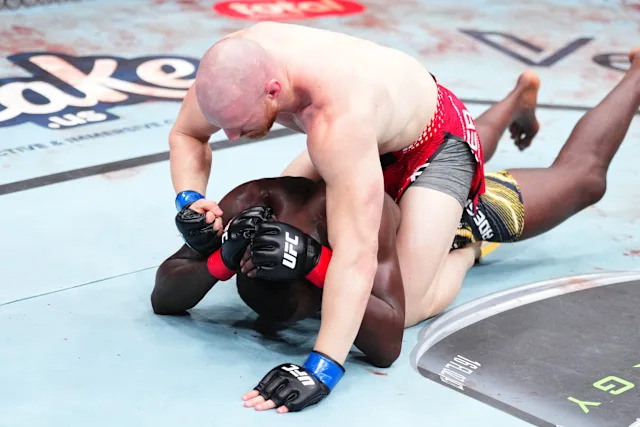
Pyfer secured a second-round TKO after weathering early adversity, using grappling control and ground-and-pound to overwhelm the former champion. The stoppage came after sustained unanswered strikes, forcing referee intervention and marking Adesanya’s fourth consecutive loss.



For a fighter once considered one of the most dominant champions in UFC history, the defeat signals a critical inflection point. Adesanya, known for his elite striking and 13-fight UFC win streak during his prime, now faces mounting questions about longevity and adaptation.
In contrast, Pyfer’s trajectory is sharply upward. The win extends his streak to four consecutive victories and places him firmly within the division’s elite. Updated rankings now position him among the top contenders, reflecting both his recent performances and the division’s shifting hierarchy.
The broader implication is clear: the middleweight division is undergoing generational turnover. Fighters like Pyfer represent a new wave—physically aggressive, strategically adaptable, and increasingly difficult to predict.
The Human Side of Victory: Pyfer’s Emotional Revelation
While the technical aspects of Pyfer’s win were significant, the emotional context added a deeper layer to the narrative.



In his post-fight remarks, Pyfer revealed that he had nearly taken his own life just weeks before the bout, stating:
“I almost took my own life a couple of weeks ago and I found God.”
The admission stunned both fans and UFC leadership. UFC president Dana White acknowledged he was unaware of Pyfer’s struggles, responding with visible concern.
This moment underscores a critical reality within combat sports: behind elite performance lies immense psychological pressure. Fighters operate in an environment where physical risk is constant, and mental resilience is equally essential.
Pyfer’s victory, therefore, extends beyond rankings—it represents a personal recovery narrative that resonated across the MMA community.
A Disturbing Finish in the Women’s Flyweight Division
If the main event highlighted resilience, the co-main event illustrated the brutal consequences of elite competition.
Alexa Grasso delivered a violent first-round knockout followed by a submission against Maycee Barber. A left hand dropped Barber early, after which Grasso secured a rear-naked choke, forcing the stoppage.
The aftermath was particularly concerning. Barber remained motionless in the octagon for several minutes, prompting immediate medical attention. The scene raised alarm among spectators and viewers, reflecting the inherent dangers of mixed martial arts.
Despite the severity of the finish, Barber’s team later confirmed she was in good health and recovering well. She even shared updates indicating she is already considering a return to competition.
The result ended Barber’s seven-fight winning streak and halted her momentum toward a title opportunity.
For Grasso, the victory marks a significant rebound, reaffirming her position as a top contender in the women’s flyweight division.
The Structure of Chaos: Why UFC Remains Unpredictable
The events in Seattle reinforce a fundamental characteristic of the UFC: competitive equilibrium.
Unlike many traditional sports leagues, MMA allows for rapid shifts in dominance. A single fight can:
- End a championship trajectory
- Launch a new contender into title contention
- Permanently alter public perception
This structural volatility is amplified by stylistic diversity. Strikers, grapplers, and hybrid fighters each bring unique variables, making outcomes inherently uncertain.
In the case of Pyfer vs. Adesanya, the clash of styles—technical striking versus aggressive grappling—proved decisive. Once the fight transitioned to the ground, the dynamic shifted irreversibly.
Rankings Shake-Up and Division Implications
Following UFC Seattle, the middleweight rankings have undergone notable changes.
- Joe Pyfer enters the top 10 for the first time
- Israel Adesanya drops out of elite positioning
- Fighters like Khamzat Chimaev and Sean Strickland remain central to the title picture
The division now appears more competitive than at any point in recent years. No single fighter dominates, and multiple contenders are positioned for potential title opportunities.
This parity enhances viewer interest while increasing uncertainty for matchmakers and analysts alike.
Cultural and Psychological Dimensions of Modern MMA
Beyond competition, UFC events increasingly intersect with broader societal themes.
Pyfer’s mental health disclosure highlights growing awareness around psychological well-being in professional sports. Historically, such discussions were rare, particularly in combat disciplines where toughness is emphasized.
Now, fighters are more willing to share vulnerabilities, contributing to a more nuanced understanding of athletic performance.
Simultaneously, incidents like Barber’s knockout raise ongoing debates about fighter safety, medical protocols, and the long-term effects of repeated trauma.
These dimensions are reshaping how the UFC is perceived—not just as entertainment, but as a complex ecosystem involving health, identity, and resilience.
What Comes Next for the UFC?
Looking ahead, several trajectories emerge:
1. Joe Pyfer’s Title Path
With his current momentum, Pyfer is likely to face top-tier opponents or enter title contention discussions.
2. Israel Adesanya’s Career Decisions
Adesanya has stated clearly:
“I’m not f***ing leaving.”
However, his next performances will determine whether he can reestablish himself among the elite.
3. Women’s Flyweight Division Dynamics
Grasso’s victory reshapes the title landscape, while Barber’s recovery and return will be closely monitored.
4. Continued Emphasis on Fighter Welfare
Mental health narratives and safety concerns are likely to remain central topics in UFC discourse.
Conclusion: A Sport Defined by Extremes
UFC Fight Night 271 encapsulated the essence of mixed martial arts: volatility, intensity, and human complexity.
Victories can be career-defining or deeply personal. Losses can be devastating yet transformative. And beneath every fight lies a story that extends beyond the octagon.
As the UFC continues to evolve, events like this reinforce its unique position in global sports—a domain where outcomes are uncertain, stakes are high, and narratives are constantly rewritten.