




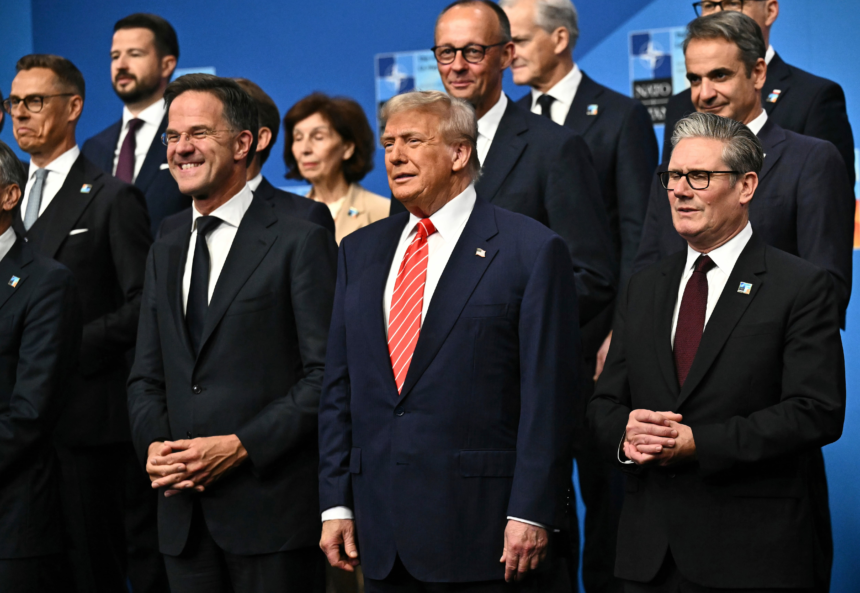
Trump, NATO, and a Fracturing Alliance: A Strategic Breaking Point
A Crisis Interview That Signals a Turning Point
In a high-stakes moment for global security, Donald Trump has delivered one of his most direct challenges yet to NATO, stating that he is “strongly considering” withdrawing the United States from the alliance.
- A Crisis Interview That Signals a Turning Point
- The Iran War as the Immediate Trigger
- A Breakdown in Trust Between Allies
- The “One-Way Street” Argument Gains Momentum
- The Structural Reality: America as NATO’s Backbone
- Article 5 and Its Limits in Modern Conflict
- Legal and Political Barriers to Withdrawal
- Strategic Consequences for Europe and Beyond
- A Possible “Pay-to-Play” Future
- A Defining Moment for the Transatlantic Alliance
- Conclusion: From Alliance to Uncertainty
The remarks, made during an interview, come amid escalating tensions surrounding the ongoing Iran conflict and reflect a deeper strategic rupture between Washington and its European allies. Trump’s description of NATO as a “paper tiger” underscores a long-held skepticism, but the current context—marked by military disagreements and geopolitical strain—has transformed rhetoric into a tangible policy possibility.
This moment is not isolated. It represents a culmination of frustration within the White House, where officials increasingly view NATO not as a mutual defense partnership, but as an arrangement that disproportionately benefits Europe at America’s expense.


The Iran War as the Immediate Trigger
At the center of this rupture is the war involving Iran, which has reshaped alliances and exposed divisions within NATO. The conflict began with joint US-Israeli air strikes on February 28, aiming to halt Iran’s nuclear ambitions.
A critical flashpoint has been the Strait of Hormuz, through which approximately 20 percent of the world’s oil supply typically flows. Iran’s effective closure of the strait has triggered a surge in global oil and gas prices, raising fears of a broader economic downturn.


The United States sought allied support to reopen this strategic passage. However, NATO partners largely declined to participate, particularly in deploying warships. This refusal appears to have deeply influenced Trump’s stance.
Reflecting on the alliance’s response, Trump stated:
“They haven’t been friends when we needed them… it’s a one-way street.”
This perception—that NATO obligations are not reciprocated—has become central to the administration’s evolving doctrine.
A Breakdown in Trust Between Allies
The tension is not limited to collective strategy. It has spilled into direct criticism of individual allies, particularly the United Kingdom.



Trump openly criticized British leadership under Keir Starmer, dismissing the readiness of the Royal Navy and suggesting that the UK lacks adequate military capability. These remarks align with broader concerns raised by British military leadership itself, including admissions that the Royal Navy is not fully prepared for large-scale conflict.
At the time of the Iran crisis, four of Britain’s six destroyers were reportedly out of service. The UK even relied on a German warship to meet NATO commitments in the North Atlantic—an indication of structural weaknesses within European defense systems.
Starmer, however, has taken a firm stance, emphasizing that:
“This is not our war, and we’re not going to get dragged into it.”
He also reaffirmed NATO as “the single most effective military alliance the world has ever seen,” signaling a divergence in strategic outlook between London and Washington.
The “One-Way Street” Argument Gains Momentum
Trump’s critique is reinforced by senior officials, including Marco Rubio, who described NATO as a “one-way street.”
Rubio raised a key operational issue: the denial of basing rights to US forces during the Iran conflict. This restriction has amplified concerns within the administration that NATO’s framework does not adequately support American military needs during offensive operations.
Rubio warned:
“If Nato is just about us defending Europe if they’re attacked, but them denying us basing rights when we need them, that’s not a very good arrangement.”
The implication is clear: the United States is reconsidering whether the alliance delivers sufficient strategic value under current conditions.
The Structural Reality: America as NATO’s Backbone
Any discussion of US withdrawal must account for NATO’s structural dependence on American power. The United States contributes more than 60 percent of NATO’s total defense spending and provides critical capabilities, including:
- Strategic airlift and logistics
- Satellite and signals intelligence
- Nuclear deterrence
- Naval and air superiority
With approximately 1.3 million active military personnel—far exceeding any other NATO member—the US functions as the alliance’s operational core.
Without American involvement, NATO’s ability to project force, deter adversaries, and coordinate multinational operations would be significantly diminished. European nations would face immediate pressure to expand their own military capabilities, both financially and technologically.
Article 5 and Its Limits in Modern Conflict
A central misunderstanding in the current dispute involves NATO’s Article 5—the mutual defense clause stating that an attack on one member is an attack on all.
This clause has only been invoked once, following the September 11 attacks in the United States. However, it applies strictly to defensive scenarios. The Iran conflict, initiated by US-Israeli strikes, does not meet the criteria for collective defense under Article 5.
This legal distinction has allowed European allies to justify their non-participation, even as it frustrates the United States, which expected broader support.
Legal and Political Barriers to Withdrawal
Despite the intensity of Trump’s rhetoric, withdrawing from NATO is not a unilateral executive decision. US law requires approval from Congress, either through Senate consent or a formal legislative act.
This requirement reflects bipartisan recognition of NATO’s strategic importance and ensures that any withdrawal would undergo rigorous debate.
Nevertheless, there are alternative pathways for reducing American involvement. Analysts note that a president could:
- Withdraw US troops from Europe
- Limit participation in NATO command structures
- Undermine operational commitments to Article 5
Such actions, while stopping short of formal withdrawal, could effectively weaken the alliance’s functionality.
Strategic Consequences for Europe and Beyond
The potential departure of the United States would represent a historic rupture in transatlantic relations, with far-reaching implications.
For Europe, the most immediate concern is security. NATO has served as a deterrent against Russian aggression for decades. Without American backing, the balance of power could shift significantly, increasing the likelihood of geopolitical instability.
The situation also introduces complex scenarios involving allied relationships. For instance, longstanding tensions involving territories like Greenland or broader North American dynamics could evolve unpredictably without NATO’s stabilizing framework.
For the United States, the costs are less obvious but equally significant. NATO enables global power projection, providing access to bases, intelligence networks, and logistical support across Europe. It also underpins economic ties, with transatlantic trade accounting for roughly one-third of global commerce.
A Possible “Pay-to-Play” Future
Within the Trump administration, there is growing interest in restructuring NATO rather than abandoning it entirely. One proposed model involves a “pay-to-play” system, where member states must meet defense spending targets to retain influence in decision-making processes.
This approach would fundamentally alter NATO’s governance, prioritizing financial contributions over traditional alliance principles. It also reflects broader frustration with European defense spending, which has long lagged behind US expectations.
Simultaneously, there are reports that Trump is considering withdrawing US troops from Germany—a move that would further signal a shift toward reduced engagement in European security.
A Defining Moment for the Transatlantic Alliance
The current crisis marks one of the most significant challenges NATO has faced in its nearly 80-year history. While internal disagreements are not new, the possibility of US withdrawal introduces an existential question: can the alliance survive without its most powerful member?
For now, the outcome remains uncertain. Trump has not made a final decision, and institutional constraints within the United States may limit drastic action. However, the trajectory is clear—relations between the US and its NATO allies are undergoing a profound transformation.
Even if formal withdrawal does not occur, the erosion of trust and cooperation could reshape the alliance for years to come.
Conclusion: From Alliance to Uncertainty
The interview signals more than a policy dispute; it reflects a shift in how the United States perceives its role in global security. NATO, once viewed as a cornerstone of Western unity, is now being reassessed through a transactional lens.
Whether this leads to reform, fragmentation, or renewal will depend on decisions made in the coming weeks and months. What is certain is that the transatlantic alliance is entering a period of unprecedented uncertainty—one that could redefine global power structures for decades.