


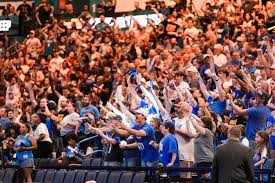
Thunder vs Lakers: A Night That Redefined the Western Conference Race
When a Contender Meets a Statement Performance
What was expected to be a high-stakes showdown between two of the NBA’s hottest teams quickly turned into something far more decisive—and far more revealing. The Oklahoma City Thunder did not merely defeat the Los Angeles Lakers; they dismantled them in a 139–96 rout that underscored the growing gap between a surging contender and a team suddenly facing uncomfortable questions.
- When a Contender Meets a Statement Performance
- A First Quarter That Set the Tone
- Efficiency vs. Disarray
- The Headline Duel: Gilgeous-Alexander vs. Dončić
- The Turning Point: Injury Compounds the Collapse
- Depth and Firepower: Oklahoma City’s Supporting Cast
- Lakers’ Key Performances: Isolated Contributions
- Historical Context: A Rare Blowout
- Playoff Implications: A Shift in Perception
- What Comes Next
- Conclusion: More Than Just a Loss
Entering the game, both teams carried momentum. Oklahoma City held a dominant 61–16 record, while Los Angeles arrived at 50–27, riding a strong run of form. The matchup had all the ingredients of a playoff preview. Instead, it became a case study in execution, discipline, and depth.
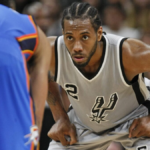
A First Quarter That Set the Tone
The game’s trajectory was established almost immediately. Oklahoma City’s defensive intensity disrupted the Lakers from the opening tip, forcing turnovers and generating easy transition points.
Within minutes, the Thunder had built a double-digit lead. By the end of the first quarter, the scoreboard read 44–21—a margin that reflected not just scoring efficiency but structural dominance on both ends of the floor.
Lu Dort emerged early as a catalyst, scoring 14 points in the opening frame while anchoring a defense that held the Lakers to just 14% shooting at one point. The Lakers struggled to establish any rhythm, managing only sporadic scoring opportunities, many of which came from free throws rather than structured offensive sets.
Efficiency vs. Disarray
The statistical contrast between the two teams was stark and decisive:
- Oklahoma City shot 53.9% from the field
- They connected on 45.2% from three-point range (17 made threes)
- The Lakers, by contrast, endured prolonged scoring droughts and high turnover rates
This imbalance was not incidental—it reflected systemic differences in execution. The Thunder moved the ball with precision, consistently finding high-percentage looks. The Lakers, meanwhile, appeared reactive, often settling for contested attempts late in the shot clock.
By halftime, the Thunder led 82–51, nearly setting a franchise record for first-half scoring.
The Headline Duel: Gilgeous-Alexander vs. Dončić
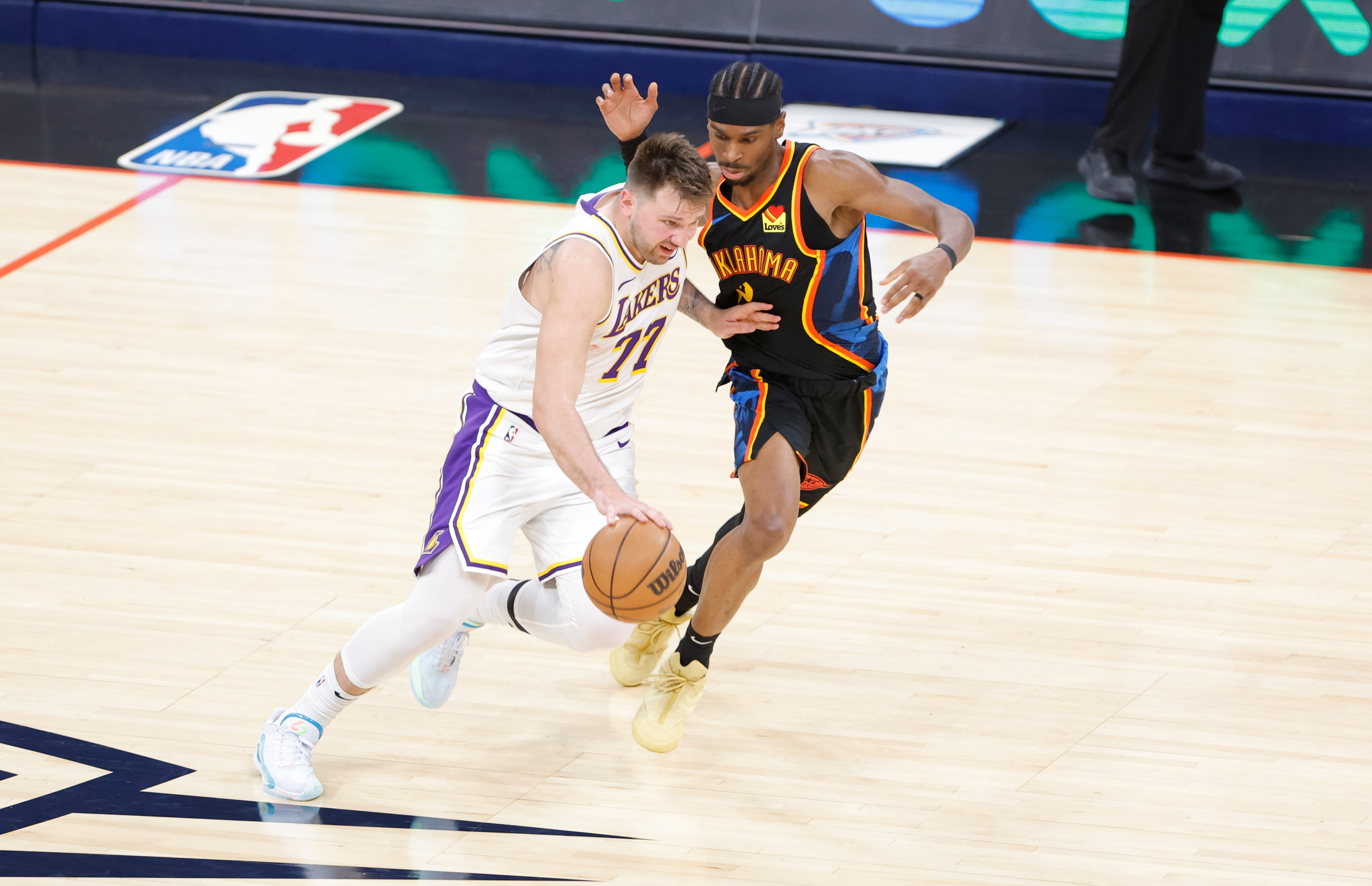
Much of the pregame narrative centered on the duel between Shai Gilgeous-Alexander and Luka Dončić—two leading MVP candidates. The outcome of that matchup mirrored the game itself.
Shai Gilgeous-Alexander delivered a composed and efficient performance, finishing with 28 points while orchestrating the offense with control. He dictated tempo, exploited defensive gaps, and maintained consistency throughout.
Dončić, on the other hand, was contained. After scoring at least 40 points in five of his previous seven games, he was held to 12 points on 3-for-10 shooting, including 1-for-7 from three-point range.
The Thunder’s defensive scheme—anchored by physical perimeter pressure and timely help rotations—effectively neutralized his usual impact.
The Turning Point: Injury Compounds the Collapse
Any hope of a Lakers resurgence evaporated midway through the third quarter when Luka Dončić exited the game with a left hamstring injury. He did not return and is scheduled for an MRI.
At that point, the Thunder already held a commanding lead, but the injury removed any remaining competitive tension. The Lakers’ offensive structure, already fragile, lost its primary initiator.
From there, the game transitioned into a formality.
Depth and Firepower: Oklahoma City’s Supporting Cast
While Gilgeous-Alexander led the way, Oklahoma City’s depth proved equally decisive.
- Isaiah Joe added 20 points, including six three-pointers
- A rapid sequence of three triples in just 85 seconds extended the lead beyond recovery
- Isaiah Hartenstein and others contributed efficiently in transition and half-court sets
This distributed scoring model highlights one of Oklahoma City’s defining strengths: the ability to sustain offensive pressure regardless of lineup rotations.
Lakers’ Key Performances: Isolated Contributions
For Los Angeles, individual contributions failed to coalesce into a cohesive team effort:
- Luka Dončić: 12 points, 4 rebounds, 7 assists (before injury)
- Austin Reaves: 15 points, 4 rebounds
- LeBron James: 13 points, 6 rebounds, 2 assists
- Deandre Ayton: 8 points
Notably, LeBron James did not make a field goal in the first half, scoring primarily from the free-throw line. The absence of early offensive production from key players further compounded the Lakers’ struggles.
Historical Context: A Rare Blowout
The magnitude of the defeat carries historical weight. The 43-point loss ranks among the largest in Lakers franchise history, falling just short of their worst-ever margin—a 49-point loss to the Dallas Mavericks in 2017.
Such a result is not merely a single-game anomaly; it signals structural vulnerabilities that could become critical in playoff scenarios.
Playoff Implications: A Shift in Perception
For Oklahoma City, the victory reinforces their status as a legitimate championship contender:
- They have now won 16 of their last 17 games
- They maintain a strong position for home-court advantage throughout the playoffs
- Their system demonstrates both offensive efficiency and defensive resilience
For the Lakers, the implications are more complex:
- The loss ends a strong run (13 wins in 14 games)
- Dončić’s injury introduces uncertainty at a critical stage of the season
- Defensive inconsistencies and turnover issues are now under renewed scrutiny
What Comes Next
The immediate future presents contrasting trajectories:
- The Thunder will host the Utah Jazz, aiming to sustain momentum
- The Lakers face the Dallas Mavericks before a scheduled rematch with Oklahoma City on April 7
That rematch will carry added significance—not just as a chance for redemption, but as a test of adjustments. Whether the Lakers can respond tactically and mentally will determine whether this loss becomes a turning point or a precursor.
Conclusion: More Than Just a Loss
This game was not simply a defeat for the Lakers; it was a diagnostic event. It exposed weaknesses in execution, depth, and resilience under pressure.
For Oklahoma City, it was validation—a demonstration that their system, discipline, and star leadership can overwhelm even elite opposition.
As the playoffs approach, this result will linger in the strategic calculations of both teams. One has clarified its identity. The other must now reassess its own.