



Clippers vs Thunder: A Statement Win That Redefines the West
A Dominant Night in Inglewood
The clash between the Oklahoma City Thunder and the Los Angeles Clippers on April 9, 2026, was expected to carry playoff intensity. Instead, it became a clear demonstration of hierarchy in the Western Conference.
- A Dominant Night in Inglewood
- First-Half Surge Sets the Tone
- Holmgren’s Breakout Performance
- Gilgeous-Alexander’s Controlled Leadership
- Supporting Cast and Depth Advantage
- Clippers Show Resistance, But Fall Short
- Season Context: Thunder’s Sustained Dominance
- Playoff Implications
- Tactical Takeaways
- Conclusion: A Preview of What’s Ahead
Oklahoma City delivered a decisive 128–110 victory at the Intuit Dome in Inglewood, California. Beyond the final score, the result carried broader implications: the Thunder officially secured the NBA’s best regular-season record and locked in the No. 1 seed for the third consecutive season.
From the opening tip, this was less a contest and more a controlled exhibition of a team peaking at precisely the right moment.



First-Half Surge Sets the Tone
The Thunder established control early, building a 34–23 lead after the first quarter and extending it to 69–49 by halftime. The offensive efficiency and defensive discipline were evident throughout.
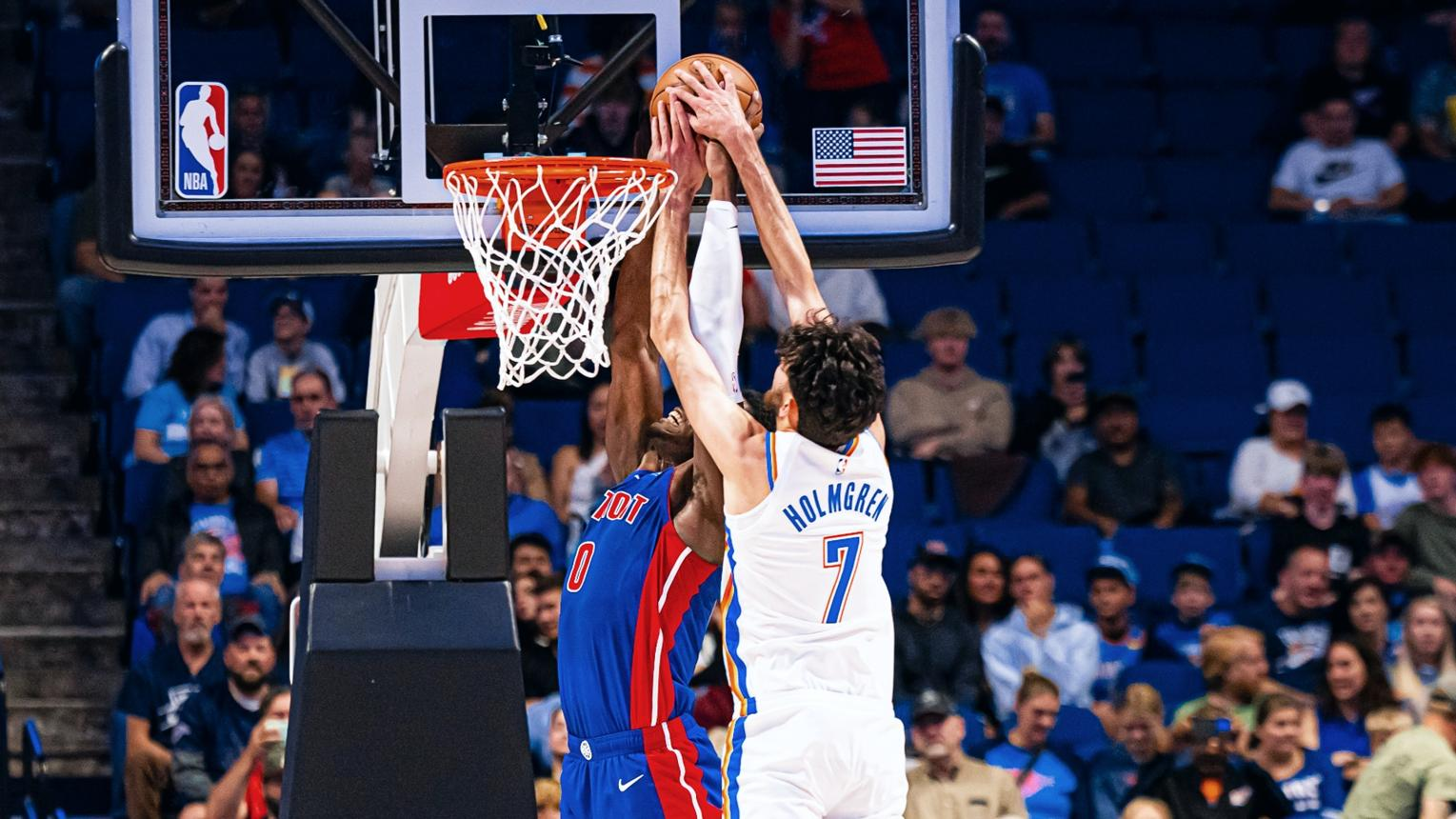
Chet Holmgren was central to that dominance. He scored 24 of his eventual 30 points in the first half, dictating tempo on both ends of the floor. His ability to stretch the defense, finish inside, and protect the rim created immediate matchup problems for the Clippers.



Oklahoma City’s execution was clinical:
- 58.1% shooting from the field
- Consistent ball movement leading to high-quality looks
- Defensive containment that eliminated fast-break scoring opportunities
At one point, the Thunder stretched their lead to 25 points, effectively placing the game beyond reach before halftime adjustments could take effect.
Holmgren’s Breakout Performance
Holmgren’s stat line—30 points, 14 rebounds, 5 assists, and 4 blocks—was not just impressive; it was historically significant.



He became the first player in NBA history to record those numbers in under 35 minutes, shooting an efficient 10-of-13 from the field and 3-of-4 from beyond the arc.
His performance showcased a rare combination of:
- Interior scoring efficiency
- Perimeter shooting versatility
- Defensive rim protection
- Transition impact
Holmgren’s dominance wasn’t limited to scoring. His defensive presence altered shot selection, and his ability to initiate fast breaks added another layer to Oklahoma City’s offensive structure.
As he noted after the game:
“I definitely think that I have a unique skillset… I’ve been given certain God-given talents, but I’ve also tried to maximize the opportunity.”
Gilgeous-Alexander’s Controlled Leadership
While Holmgren dominated the headlines, Shai Gilgeous-Alexander orchestrated the game with precision.
He finished with:
- 20 points
- 11 assists
- Extended scoring consistency (20+ points in over 140 consecutive games)
Rather than forcing offense, Gilgeous-Alexander prioritized distribution, repeatedly creating scoring opportunities for teammates. His composure allowed the Thunder to maintain control even when the Clippers attempted to close the gap in the third quarter.
Coach Mark Daigneault highlighted this approach, noting how Gilgeous-Alexander’s energy was directed toward elevating teammates rather than dominating individually.
Supporting Cast and Depth Advantage
Oklahoma City’s depth proved decisive. Multiple players contributed across rotations:
- Jalen Williams: 18 points, 6 rebounds, 6 assists
- Isaiah Joe: 21 points, including a decisive fourth-quarter scoring burst
- Isaiah Hartenstein: 10 points, 7 rebounds
The Thunder recorded 30 assists on 48 baskets, emphasizing their collective offensive identity.
Even with Gilgeous-Alexander resting in the fourth quarter, the second unit extended the lead—an indicator of roster depth that becomes critical in postseason scenarios.
Clippers Show Resistance, But Fall Short
The Clippers, despite entering the game with strong recent form (seven wins in nine games), struggled to match Oklahoma City’s pace and execution.
Key performances included:
- Kawhi Leonard: 20 points, 8 rebounds
- Brook Lopez: 16 points
- Balanced scoring with seven players in double figures
However, structural issues were evident:
- Defensive breakdowns against pick-and-roll actions
- Inability to contain Holmgren’s inside-out scoring
- Limited rim protection
A third-quarter push briefly reduced the deficit to 87–75, but Oklahoma City quickly responded, restoring a comfortable lead and closing the game decisively.
Season Context: Thunder’s Sustained Dominance
This victory was not an isolated result—it was the culmination of a sustained campaign of excellence.
- Record: 64–16
- Current streak: 7 consecutive wins
- Recent form: 19 wins in 20 games
- Third straight No. 1 seed in the West
The Thunder also joined elite historical company, becoming one of only a handful of teams to secure their conference’s best record in three consecutive seasons.
Their consistency across seasons—combined with adaptability through injuries and competitive pressure—has positioned them as the benchmark in the league.
Playoff Implications
Clinching the top seed ensures:
- Home-court advantage throughout the playoffs
- Strategic rest opportunities in final regular-season games
- Favorable positioning against play-in tournament teams
For the Clippers, the implications are more precarious. Positioned around the eighth seed, they face a critical stretch where:
- A win secures direct playoff entry
- A loss risks dropping into the play-in tournament
The gap between the two teams, as demonstrated in this matchup, highlights the challenge awaiting lower-seeded contenders.
Tactical Takeaways
1. Offensive Efficiency as Identity
The Thunder’s ball movement and shot selection—30 assists on 48 baskets—reflect a system built on collective execution rather than individual isolation.
2. Defensive Versatility
Holmgren’s rim protection and perimeter mobility compress opposing offensive space, forcing inefficient shot attempts.
3. Depth as Competitive Edge
The ability to extend leads without star players on the floor underscores Oklahoma City’s rotational strength.
4. Momentum Timing
Entering the playoffs with a 19–1 stretch provides psychological and tactical momentum that few teams can match.
Conclusion: A Preview of What’s Ahead
The Clippers vs Thunder matchup served as more than a regular-season game—it was a preview of postseason dynamics.
Oklahoma City demonstrated:
- Structural superiority
- Tactical discipline
- Individual brilliance within a team-first framework
For the Clippers, the game exposed areas requiring immediate adjustment, particularly on defense and interior containment.
As the playoffs approach, the Thunder are not just contenders—they are the standard. The rest of the Western Conference must now measure itself against a team that has combined consistency, depth, and elite-level execution at exactly the right time.